
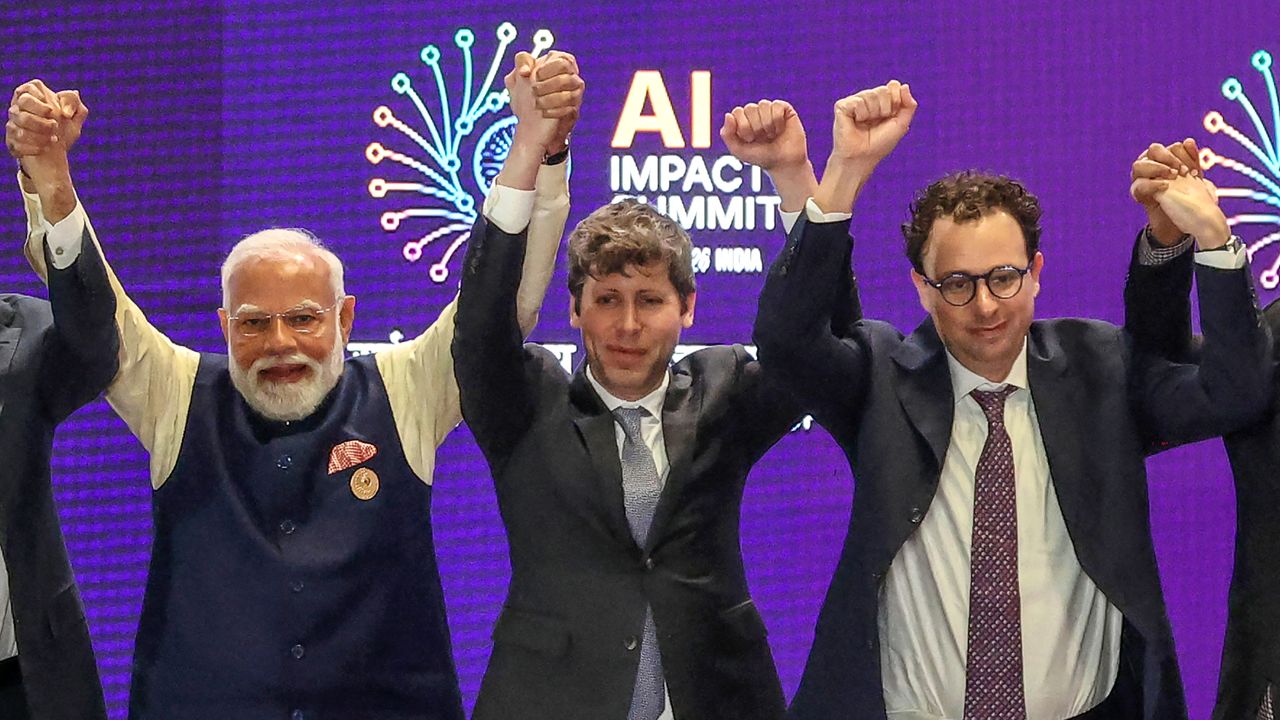
If you opened social media today, you probably saw the clip of India’s Prime Minister Narendra Modi standing center stage, raising the hands of OpenAI CEO Sam Altman and Anthropic CEO Dario Amodei in an awkward victory pose. The moment — a confused mix of handshake and fist bump where the two leaders refused to clasp hands — quickly went viral, with Altman later calling it “sort of confusing.”
But beyond the memes, the real story unfolding at the India AI Impact Summit 2026 was far bigger: a signal that Silicon Valley’s dominance in AI may no longer be guaranteed.
Here's the biggest news to come out of the summit.

1. The "Sarvam" breakthrough: Outperforming the giants of silicon valley
The biggest technical shock of the summit was the official launch of Sarvam Vision. The Bengaluru-based startup, backed by the likes of Peak XV, unveiled a 105-billion parameter model that is doing what ChatGPT-5.2 and Gemini 3 have struggled with: Indic language precision.
In the new olmOCR vision test, Sarvam Vision hit an accuracy score of 84.3%, surpassing Google's Gemini 3 Pro and ChatGPT.
PM Modi was seen testing the Kaze smartglasses, Sarvam’s first hardware product, which uses on-device AI to translate 10 Indian languages in real-time with sub-200ms latency.
2. Google’s $15 billion "Sovereign" bet

Not to be outdone, Google CEO Sundar Pichai used the summit to announce a massive $15 billion investment in a "full-stack AI hub" in Visakhapatnam. In a rare partnership with the Adani Group, Google will build a gigawatt-scale AI data center aimed at providing "Sovereign AI" for the Global South — i.e. countries in Asia, Latin America, and Africa.
"India is no longer just a user of AI," Pichai told the plenary session. "It is becoming the world's laboratory for frugal, scalable innovation."
3. The 'MANAV' Vision: A new ethical standard

During his keynote, PM Modi unveiled the MANAV Vision (Moral, Accountable, National, Accessible, Valid). This is India’s formal response to Western AI regulation, prioritizing "Open AI" over proprietary, "black box" systems.
The PM’s call to "democratize" AI — ensuring it doesn't remain in the hands of "a few billionaires" — was a clear nudge to the CEOs sitting in the front row.
Bottom line
In early 2026, the AI world is undergoing a massive "de-centralization." We are moving past the era of "one-size-fits-all" models — like the standard versions of ChatGPT — and entering the age of Sovereign AI.
For the average user, this shift could be revolutionary. It means your AI could finally understand regional nuances, local dialects and cultural context without needing to route your private data through a server in California.
But more importantly, the success of Sarvam and the MANAV framework proves that "frugal innovation" can beat "big tech" brute force. When an Indian startup can outperform Gemini 3 on a fraction of the budget, it levels the playing field for creators and entrepreneurs across the Global South.

Follow Tom's Guide on Google News and add us as a preferred source to get our up-to-date news, analysis, and reviews in your feeds.






