
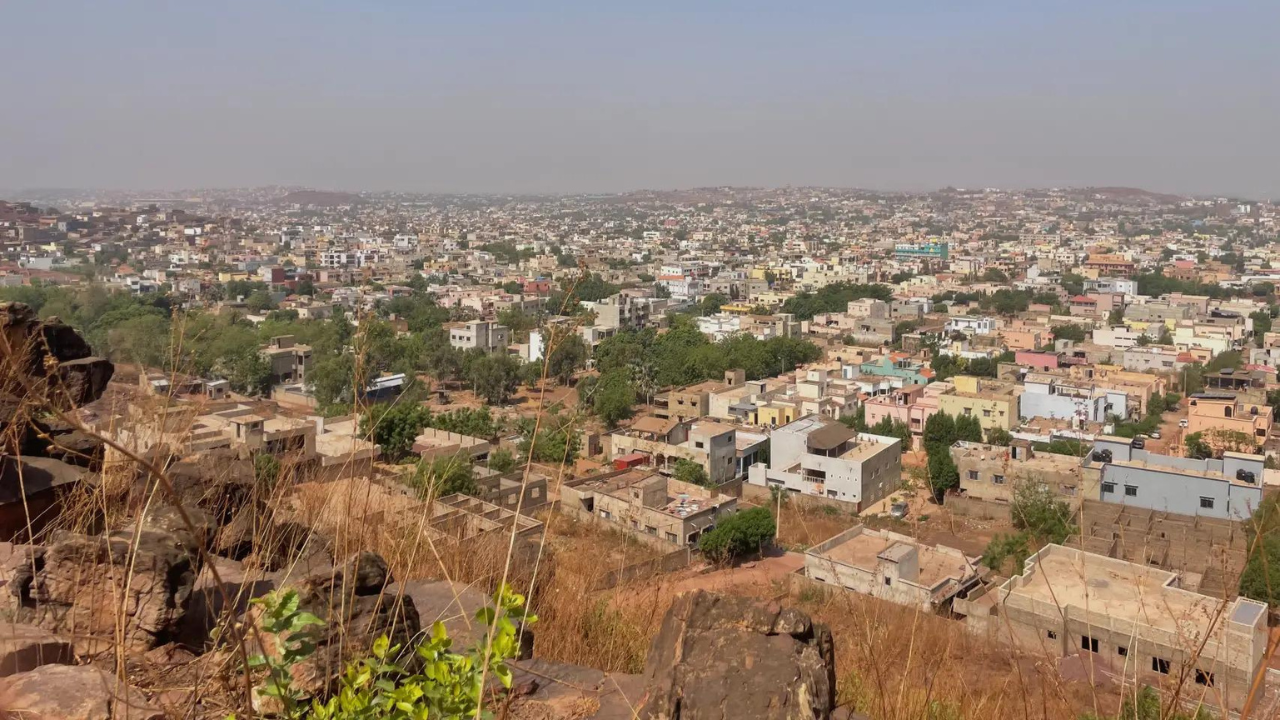
For two decades, the world's war on jihadism has been told through the ruins of Kabul, the streets of Mosul and the deserts of Syria.
Get breaking news anytime, anywhere. Download the TOI app now!

Yet while global attention remained fixed on the Middle East, the centre of gravity quietly shifted thousands of kilometres to the south. Today, it is not Iraq or Afghanistan but the vast, overlooked Sahel that has become the deadliest theatre of Islamist militancy.
Here, extremist groups are no longer simply carrying out hit-and-run attacks; they are blockading capitals, governing villages, exploiting climate crises, toppling fragile states and outlasting foreign armies.
Coups have redrawn political maps, Western powers have retreated, Russian mercenaries have moved in, and millions of civilians have found themselves trapped in a conflict that rarely commands international attention. The rise of global jihad's new epicentre did not happen overnight, nor was it inevitable.
So how did a forgotten belt of Africa become the world's most dangerous breeding ground for jihadist violence?
A belt of sand, poverty and forgotten wealth
The Sahel is a transition zone, not a country. It runs in a band roughly 5,000 kilometres wide, from Senegal and Mauritania on the Atlantic coast, through Mali, Burkina Faso and Niger, across Chad, and on towards Sudan and Eritrea. To the north sits the Sahara, the largest hot desert on Earth. To the south lie the greener, wetter tropics. The Sahel is the seam between the two, and seams are always where things fray first.
Its population is young and growing fast, among the fastest-growing anywhere on the planet. That ought to be an asset. Instead it has become a pressure point, because jobs, schools and services haven't kept pace. Most Sahel states rank near the bottom of global development indices. Chad, Mali and Niger regularly appear among the world's most fragile states. Farming and herding remain the backbone of daily life for most people, which means most people are also directly exposed when rains fail or land runs short.
And the land is running short. Temperatures across the Sahel are rising about one and a half times faster than the global average. Rivers shrink, pasture disappears, and farmers, herders and fishing communities are pushed into each other's space. These local resource fights sound small next to the word "jihad", but they are often the spark that jihadist groups exploit, turning old disputes over water and grazing rights into recruitment pitches.
The irony is that the region is not actually poor in resources. Niger sits on some of the world's richest uranium deposits. Mali and Burkina Faso are major gold producers. There is oil beneath parts of Chad and Niger too. Very little of that wealth reaches ordinary Sahelians, and that gap between what the ground holds and what people actually have is one of the oldest grievances jihadist propagandists lean on.
None of this is new to the region, either. A thousand years ago the same Sahel corridor hosted the empires of Ghana, Mali and Songhai, wealthy trading states built on gold, salt and Trans-Saharan caravans, with Timbuktu once a genuine centre of Islamic scholarship rivalling anywhere in the medieval world. Islam itself arrived here gradually, over centuries, carried by merchants rather than armies, blending with local practice long before anyone spoke of jihadism. The empires that made the Sahel rich are long gone. What's left is the same geography, minus the wealth, plus a lot more guns.
Al-Qaeda vs Islamic State
Jihadist violence in the Sahel isn't one movement with one chain of command. It's closer to a rough duopoly, with most active groups aligned to either al-Qaeda or the Islamic State.
The al-Qaeda side is represented chiefly by JNIM, formed from a 2017 merger of several older factions. The Islamic State side operates through the Islamic State in the Greater Sahara, largely active in the Mali–Niger–Burkina Faso border zone, plus the Islamic State West Africa Province further east around Lake Chad, the successor to what was once Boko Haram. Both wings claim the same broad goal, an Islamic state governed by their version of sharia, but they've spent years fighting each other as much as they fight national armies.
That rivalry turned violent around 2020, when clashes between JNIM and the Islamic State's Sahel affiliate intensified, eventually pushing the Islamic State group largely into northern Burkina Faso and western Niger while JNIM consolidated its grip on Mali. It's a strange kind of turf war: two organisations that both want a caliphate, unable to agree on whose caliphate it should be.
Further east, around the Lake Chad Basin where Nigeria, Niger, Chad and Cameroon meet, the same al-Qaeda–Islamic State split plays out under different names. Boko Haram, founded in north-eastern Nigeria in the early 2000s, spent years fighting largely alone before pledging allegiance to the Islamic State in 2015 and rebranding as the Islamic State West Africa Province. A rump faction kept the old Boko Haram name and structure until its own leader was killed by his former allies in 2021, after which most of his fighters were simply absorbed. Nigeria has poured enormous resources into the fight since, and its army now claims tens of thousands of militants killed and a sharp fall in its own casualties, though independent verification of such figures is difficult and abuses by government forces have drawn scrutiny of their own, including reports of civilian deaths from military airstrikes.
JNIM: The group running the show
If one name has come to define the current crisis, it's JNIM, short for Jama'at Nusrat al-Islam wa-l-Muslimin, roughly "Group for the Support of Islam and Muslims". It was stitched together in 2017 from several older Malian and Algerian factions, including Ansar Dine and elements of al-Qaeda in the Islamic Maghreb, under the leadership of Iyad Ag Ghaly, a Tuareg who reportedly turned towards hardline Islamism after a stint as a Malian diplomat in Saudi Arabia.
JNIM has grown from a Malian problem into the most capable jihadist force in the wider Sahel. It has expanded well beyond its original northern Mali strongholds into the country's centre and south, and its fighters have carried out attacks as far afield as Niamey's international airport in Niger. It funds itself through smuggling routes, local taxation of trade and, in some areas, direct control of territory where it enforces its own version of law.
What makes JNIM genuinely dangerous isn't just its firepower. It's the group's patience. In parts of central Mali, JNIM has struck informal arrangements with villages: residents accept the group's rules and in exchange are allowed to return home and farm in peace. That's not the behaviour of a group planning to disappear. It's the behaviour of a group planning to govern.
Its recent alliance with Tuareg separatist fighters, the FLA, has added a further layer of danger, combining jihadist manpower with a separatist movement that has its own decades-old grievances against Bamako. Together they've besieged army camps, ambushed military convoys, and by mid-2026 had brought parts of northern Mali's transport network to a standstill.
Enter Russia
Into the vacuum left by departing Western forces stepped Russia, first through the Wagner Group and, after its founder's death in 2023, through a rebranded successor known as the Africa Corps, operating under closer Russian state control.
Mali's junta brought Wagner in from late 2021, at a moment when relations with France had soured beyond repair. Roughly a thousand Russian mercenaries were deployed, working alongside Malian forces against jihadist strongholds. The results have been brutal and controversial in equal measure. Wagner-backed operations have been linked to some of the worst civilian death tolls of the entire conflict, including an assault on the town of Moura in March 2022 in which several hundred civilians were reportedly killed, an episode UN investigators later flagged as a possible war crime.
Russia's presence hasn't ended the insurgency it was brought in to fight. If anything, JNIM and allied Tuareg forces have inflicted serious losses on Malian and Russian personnel in 2026, including sustained fighting around the town of Anéfis and the reported downing of a Russian helicopter. Yet Moscow has kept doubling down rather than pulling back, expanding military cooperation talks with all three Alliance of Sahel States governments through 2026.
For Russia, the calculation looks straightforward: security assistance and mercenary muscle in exchange for influence, mining access, and a foothold in a region the West has partly stepped away from.
A world left watching
Mali, Burkina Faso and Niger have all lived through military coups in the past few years, each justified in part by the argument that civilian governments were failing to stop jihadist violence. And in each case, the juntas that took power have gone on to preside over more violence, not less, while growing steadily more isolated from Western partners.
France, the former colonial power and the country that led the biggest counter-jihadist military effort in the region, Operation Barkhane, pulled its forces out of Mali in 2022 and out of Niger by late 2023, as anti-French sentiment hardened and juntas cut cooperation agreements.
The United Nations' peacekeeping mission in Mali, MINUSMA, was expelled at the junta's request in 2023. The regional G5 Sahel counter-terrorism force lost Mali as a member and effectively fell apart. Mali, Burkina Faso and Niger have since banded together as their own bloc, the Alliance of Sahel States, and all three have begun withdrawing from the International Criminal Court, dismissing it as a politically weaponised institution.
Niger's own coup, in July 2023, was a particularly hard blow, since it had been the West's last dependable counter-terrorism partner left standing in the region after Mali and Burkina Faso's juntas took power. The officers who ousted elected president Mohamed Bazoum refused to back down even under threat of regional military intervention, and neighbouring juntas in Mali and Burkina Faso quickly pledged to treat any such intervention as an act of war.
France withdrew its remaining troops from Niger within months. Washington took a more cautious path, formally suspending several hundred million dollars in aid while still quietly keeping around a thousand American troops in the country and resuming drone operations, a sign of just how reluctant outside powers have become to walk away entirely, even from governments they can no longer openly support.
It would be too simple to say the world has ignored the Sahel entirely. The United States still maintains a limited troop presence in the region and has, at times, weighed direct strikes against JNIM. The European Union has signed new defence arrangements with coastal states like Ghana that fear the violence spreading south. But engagement has become reactive, thinly resourced, and increasingly reluctant to deal with juntas that keep expelling their old partners and cosying up to new ones.
A warning for the world
The Sahel's descent into the epicentre of global jihad is not merely a regional tragedy; it is a warning about what happens when weak governance, climate stress, economic exclusion and geopolitical rivalry collide.
Extremist groups did not create these fractures, but they have exploited them with ruthless efficiency, often proving more adaptable than the states trying to defeat them. Military coups have promised security yet delivered deeper instability, foreign interventions have come and gone, and new external powers have pursued influence without addressing the grievances that keep fuelling recruitment.
History has a habit of punishing those who mistake distance for safety. The Sahel may seem far away today, but the forces reshaping it are unlikely to stay there forever.







