Closing summary
It’s coming up to 8pm in Kyiv and the Ukraine war live blog is about to close. Here’s a summary of the days’ events:
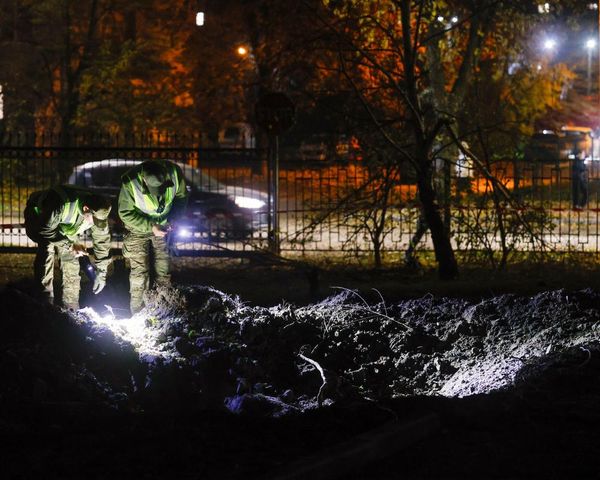
Russia says it has shot down 36 Ukrainian drones over the Black Sea and the Crimean peninsula. There were claims in local media outlets that a fire at an oil refinery in the early hours of Sunday had been caused by a drone strike or debris from a downed drone. Ukraine has said it shot down five Iranian-made Shahed exploding drones launched Russia overnight.
State media in Russia has reported that more than 100 Ukrainian soldiers were killed in Yuzhno-Donetsk over the past 24 hours. The 58th motorised infantry, 79th air assault brigades of the Ukrainian Armed Forces and the 128th territorial defence brigade were reportedly involved in the attack by Russian troops.
Russia would confiscate assets belonging to EU states it deems unfriendly if the bloc “steals” frozen Russian funds in a drive to fund Ukraine, a top ally of Vladimir Putin said. The comments were made after Ursula von der Leyen, the president of the European Commission, said that the EU executive was working on a proposal to pool some of the profits derived from frozen Russian state assets to help Ukraine and its post-war reconstruction.
Ukraine and Russia are locked in a stalemate on the frontlines of their war and the two sides need to sit down and negotiate an end to the conflict, Alexander Lukashenko, the Belarus president, said. Lukashenko, a key Putin ally, described the current state of the conflict as “head-to-head, to the death, entrenched … seriously stalemate.”
Russian forces are believed to have suffered some of the country’s biggest casualty rates so far this year as a result of continued “heavy but inconclusive” fighting around the Donetsk oblast town of Avdiivka.
Four Ukrainian police officers were wounded when a shell fired by Russian troops exploded by their police car in the city of Siversk, located in the partly occupied Donetsk oblast.
A third round of Ukrainian-backed peace talks opened in Malta, but without Moscow. In a statement, the Ukrainian president, Volodymyr Zelenskiy, said 66 countries had taken part, proof that his plan “has gradually become global”.
That’s it from me, Donna Ferguson, for now. Thanks for following along.
Updated

Russians commemorated the victims of Soviet state terror on Sunday, in a subdued event that demonstrates how the Russian government has continued its crackdown on dissent in the country.
The “returning of the names” event is traditionally held in Moscow every year on 29 October, the eve of Russia’s Remembrance Day for the Victims of Political Repression, at the Solovetsky Stone memorial Lubyanka square, to victims of Soviet-era repression. It involves the reading out of names of individuals killed during Joseph Stalin’s Great Terror of the late 1930s.
However, since 2020, Moscow authorities have refused to grant a permit for the event, which is organised by the human rights group Memorial.
This refusal is allegedly owing to the “epidemiological situation” and a ban on holding public events, though supporters of Memorial believe the refusal is politically motivated.
Memorial was itself ordered to close by the Moscow authorities in November 2021. Although it was shut down as a legal entity in Russia, the group still operates in other countries and has continued some of its human rights activities in Russia.
Instead of a demonstration, on Sunday Muscovites and several ambassadors from western countries, including the US envoy, laid flowers at the Solovetsky Stone. The subdued event took place under the watchful eyes of police, according to Associated Press.
Banned from holding a gathering on Lubyanka square, Memorial organised a live broadcast of the reading of the victims’ names, from Moscow and other Russian cities, as well as from abroad.
Russian prosecutors are seeking a three-year prison sentence for Oleg Orlov, a human rights campaigner and co-chair of Memorial.
Updated