Get all your news in one place.
100’s of premium titles.
One app.
Start reading
Tribune News Service
World
Chris Reiter

Russia’s war drives 10 million Ukrainians from their homes

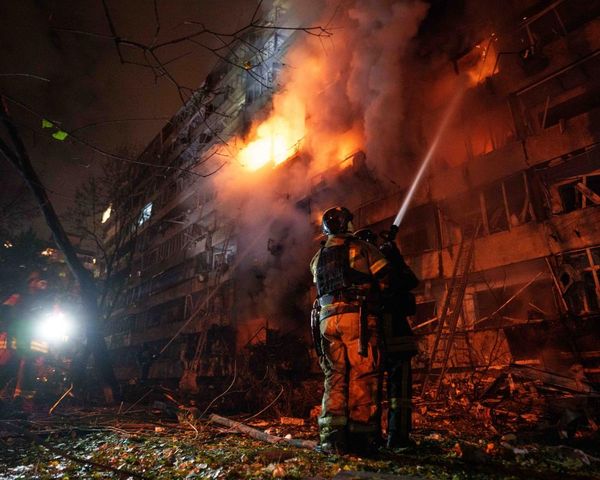
Russia’s increasingly brutal attacks on Ukraine has driven 10 million people — nearly a quarter of the population — from their homes, according to the United Nations, with growing numbers expected to head to western Europe.

Mykhailo Podolyak, President Volodymyr Zelenskyy’s chief of staff, put the number of displaced people at as high as 12 million. While most have stayed in Ukraine, about 3.4 million — mainly women, children and elderly people — have sought refuge in other countries, including more than 2 million people in Poland, according to UN data.

Russia’s invasion of Ukraine is approaching its one-month mark and attacks on civilian targets are showing no signs of abating, raising the risks that more people will seek to flee. The besieged southern city of Mariupol has been under heavy bombardment, and Ukraine has accused Russian forces of blocking humanitarian aid.

As the war grinds on, more people are likely to move on from temporary shelter near the border. Most of the 500,000 people who crossed into Romania have left, with just about 80,000 still in the country.

Germany is now bracing for as many as 1 million refugees — roughly triple its previous expectation of 340,000, according to a report by the Bild newspaper. As of Monday, more than 225,000 Ukrainian refugees had arrived in Germany, the Interior Ministry said. A spokesman for the ministry declined to confirm the figure on Monday.

If the number of people approaches 1 million in Germany, it would be reminiscent of the refugee crisis in 2015 — sparked by civil war in Syria, in which Russia provided military support for the government. But there would be decisive differences.

Public support for Ukraine is widespread in Europe, facilitated by the sympathy over the attacks and the geographical and cultural proximity. Countries like Hungary and Poland, which rejected the mainly Muslim refugees from Syria, have opened their doors to their Ukrainian neighbors.

The reaction blunts any potential for Russian President Vladimir Putin to use refugees as a weapon. After the political upheaval caused by the Syrian crisis, the Kremlin’s allies have played with the issue.

Last year, Germany accused Belarusian President Alexander Lukashenko of using migrants to retaliate against European Union sanctions by channeling people from Iraq, Syria, Yemen, Iran and Afghanistan to its border with Poland and on to Germany.

Rather than fearing the influx of Ukrainian refugees, there’s concern about their well-being and protection. Hundreds of volunteers help arrange food and housing for the thousands of people arriving from Ukraine on a daily basis in cities including Berlin, Budapest, Warsaw and Bucharest.

In Berlin’s former Tegel airport, as many as 3,000 people from Ukraine can stay for up to three nights and a registration center has been set up to process asylum applications for 10,000 people a day. Once registered, they’ll be distributed across Germany to spread the burden.

The EU is considering setting up a talent pool to help match employers with Ukrainians looking for a job, Home Affairs Commissioner Ylva Johansson said Monday in Tallinn.

Europe’s largest economy has also stepped up police presence at train stations to protect Ukrainians from sexual assault or fake housing offers, according to Interior Minister Nancy Faeser.

“No one should abuse the suffering of the people who fled Putin’s bombing raids,” she said on Twitter. “Anyone who tries to take advantage of the plight of the refugees should know that we will react with all the power of the law.”

Sign up to read this article
Read news from 100’s of titles, curated specifically for you.
Already a member? Sign in here
Related Stories
Top stories on inkl right now
One subscription that gives you access to news from hundreds of sites
Already a member? Sign in here
Our Picks
Fourteen days free
Download the app
One app. One membership.
100+ trusted global sources.