
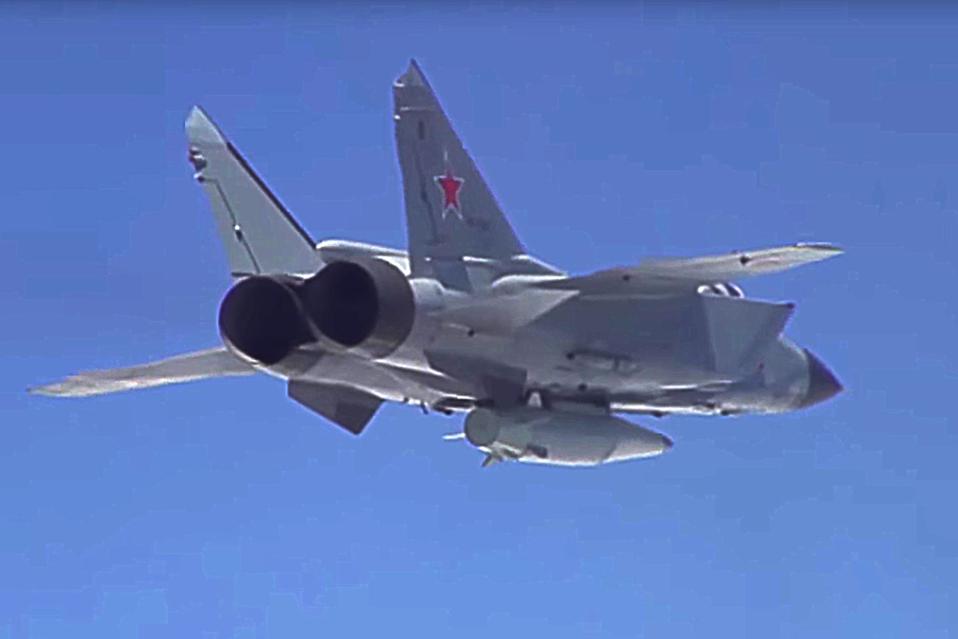
As U.S. paratroopers began arriving in Poland on Monday in response to Russia’s military buildup near Ukraine, a video posted on Telegram appears to depict the landing of a Russian MiG-31K Foxhound jet (or MiG-31I in recent Russian state media reports) carrying what looks like a Kinzhal hypersonic land-attack missile in Kaliningrad, a Russian exclave on the Baltic Sea bordering Poland and Lithuania.
The video seemingly can be geolocated to the Kaliningrad Chkalovsk naval airbase in the exclave.
Later, unconfirmed reports suggest as many as four or five Kinzhal-armed MiG-31s may have landed in Kaliningrad.
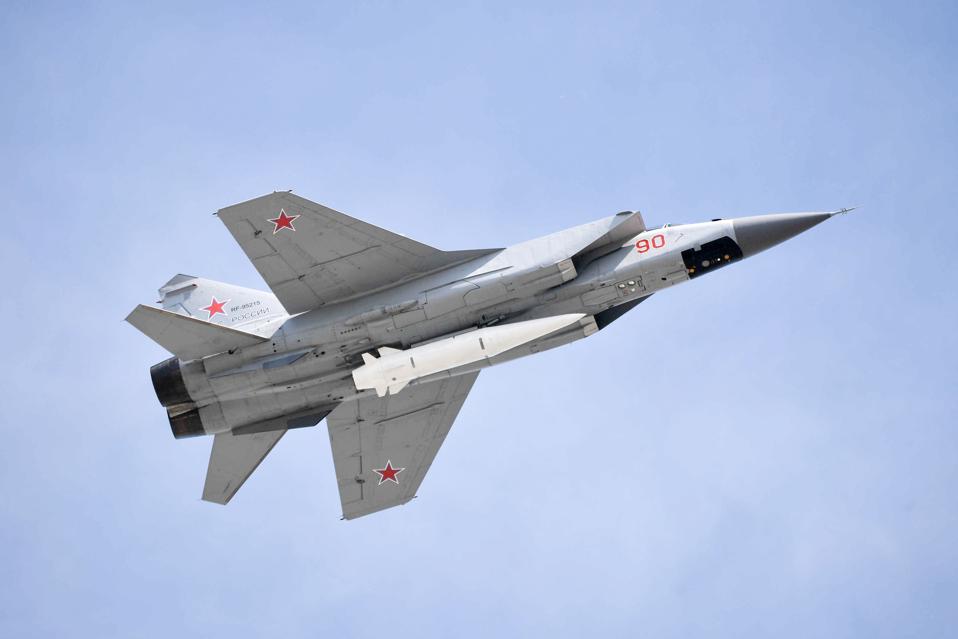
The Kinzhal (“Dagger”) missile—designated the Kh-47M2 and more recently the 9-A-76609 in Russian sources—has a reported range of 1,240 miles and can carry either an 1,100-pound fragmentation warhead or up to a 500-kiloton nuclear warhead with 33 times the yield of the Fat Man bomb dropped on Hiroshima.
Accelerating to over ten times the speed of sound (more than 2 miles per second) it leaves air defenses little time to react as it flies at a shallower trajectory than a traditional ballistic missile, and can maneuver evasively for a good measure. Allegedly, the Kinzhal is capable of precision strikes using a terrain-matching sensor, as well as engaging moving ships at sea using a radar seeker.
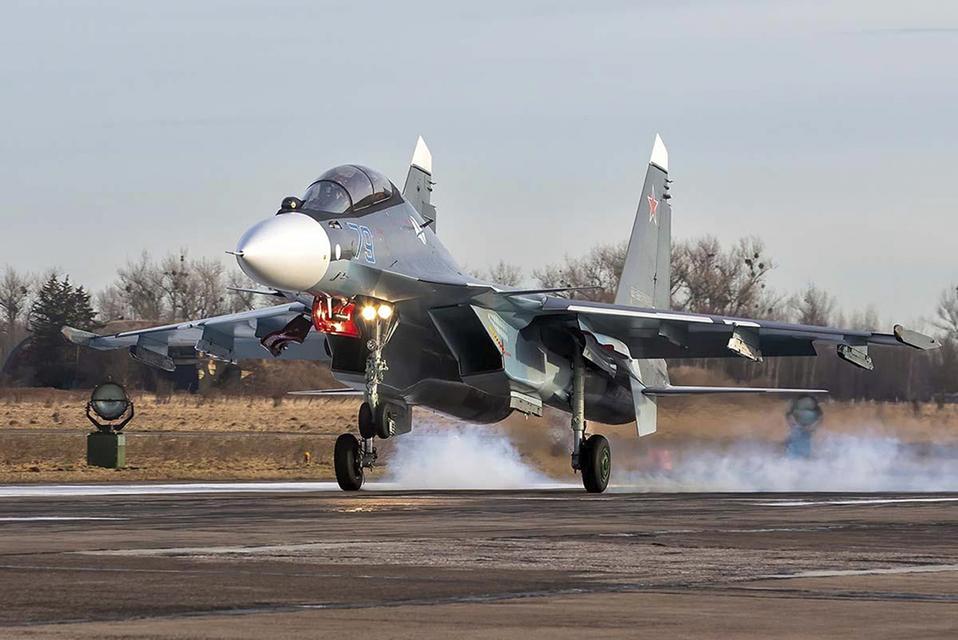
Russia’s base in Kaliningrad ordinarily does not host MiG-31Ks. While sizeable ground forces defend it, and it hosts Russia’s Baltic Fleet and nuclear-capable short-range Iskander missiles, most of the 50 warplanes based there are older Su-27 and Su-24 jets, though some newer Su-30SM and Su-35S are being phased in.
Therefore, the deployment of a MiG-31K would likely be intended as a deliberate warning to NATO: a threat of retaliation should the alliance consider intervening against possible Russian military action in Ukraine.
As military analyst Rob Lee notes in a tweet, a Kinzhal launched over Kaliningrad’s airspace can reach most West European capitals and Ankara, while the Iskander missiles in Kaliningrad can at most reach the northern edge of Berlin. Furthermore, a Kinzhal may reach those targets within 7-10 minutes of being launched from over Kaliningrad’s airspace.
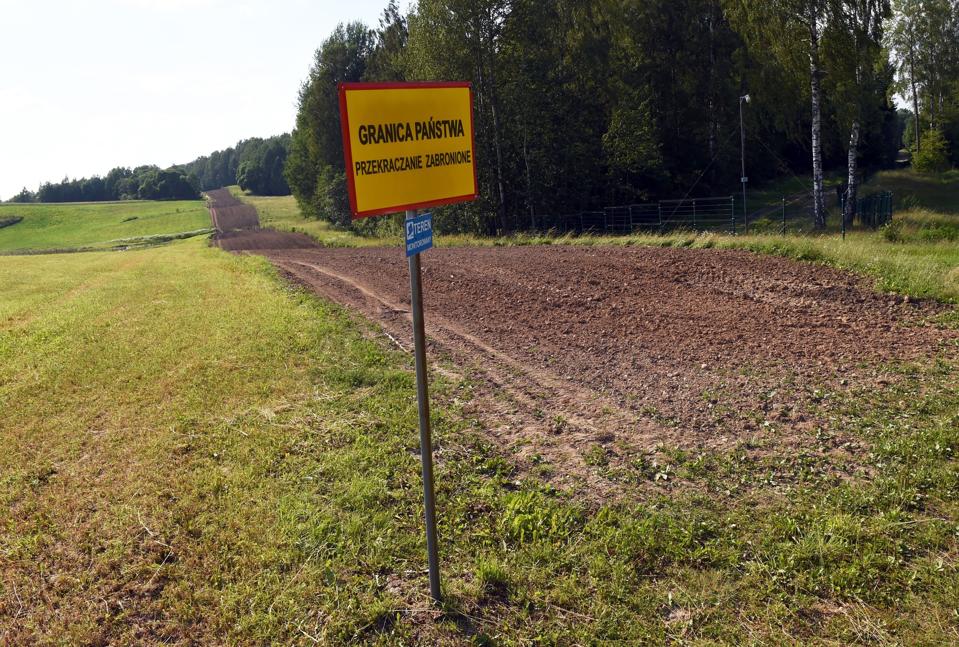
It’s worth noting that Russian deployments to Belarus, in addition to posing a tangible threat to the nearby Ukrainian capital of Kyiv, also may be intended in part to help protect Kaliningrad from NATO pressure by threatening to cut or interdict the narrow land corridor connecting Poland to the Baltic states called the Suwalki Gap.
That said, the Kinzhal presently may remain primarily a conventional weapon in both a material and doctrinal sense according to Michael Kofman, an expert on the Russian military at the Center of Naval Analyses. He commented that Kinzhal is “typically referred to as a strategic conventional weapon in Russian military discourse. I’ve not seen evidence that the aircraft operating it are equipped for a nuclear mission.”
That suggests that while the Kinzhal may still be theoretically capable of nuclear weapons delivery, that feature may not have been technically implemented and trained for yet.
Of course, Russia also has over a thousand intercontinental ballistic missiles and cruise-missile carrying bombers that can strike targets across globe, but even the limited use of these strategic nuclear delivery systems risks triggering a country-shattering strategic nuclear war.
Moscow may believe (rightly or wrongly) that the shorter-range, dual-capable Kinzhal is a still serious but more ‘useable’ threat falling under the threshold of precipitating a strategic nuclear conflict with the United States.
The Kinzhal is a shortened evolution of the ground-launched Iskander. It only works as designed if launched from an aircraft flying very high at extreme speeds, which is how the MiG-31, an aircraft designed as a Mach 3-capable air defense interceptor, came to be tapped to carry a land-attack weapon.
Russia is believed to have modified just 10-12 MiG-31Ks so far out of a planned 50 to carry Kinzhals. Thus, the deployment of at least one, or according to some reports, half of Russia’s Kinzhal-armed MiG-31K suggests how seriously the Russian military is preparing for various contingencies surrounding possible military action in Ukraine, including that of deterring NATO involvement.
That said, it’s remains uncertain whether Putin will follow through on an invasion of Ukraine, which he appears to have meticulously arrayed Russia’s military for. On the same day, Putin allegedly told French President Macron he would withdraw the 30,000 troops in Belarus at the end of an exercise due to conclude February 20. Time will tell if those assurances speak to Putin’s intentions more clearly than recent movements of Russian forces, including the hypersonic weapon landed in Kaliningrad.
Updated Tuesday at 2:53 pm EST with additional information on the number of MiG-31s deployed, clarifications to designation, and commentary on whether Kinzhal yet has a nuclear role.