
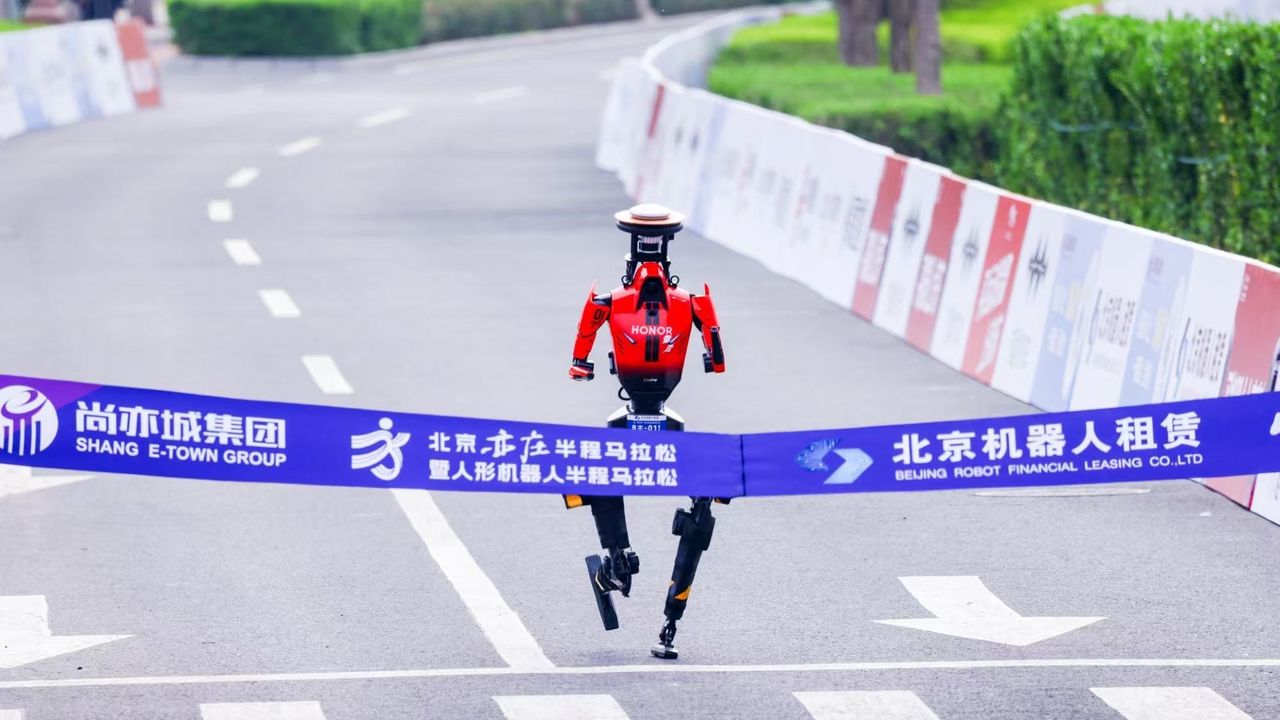
An autonomous humanoid robot built by the smartphone maker Honor has shattered the human half-marathon record.
Called the Honor Robotics D1, the mech-inspired, vibrant-red bot completed the 13.1-mile (21.1 kilometers) race in 50 minutes, 26 seconds at the 2026 Beijing E-Town Humanoid Robot Half-Marathon, eclipsing the previous human record of 57 minutes, 20 seconds, which was set by Ugandan runner Jacob Kiplimo in March.

Another separate robot that Honor representatives revealed at Spain's MWC Barcelona (formerly known as Mobile World Congress) in March completed the race even faster — in just 48 minutes, 19 seconds. But this humanoid machine wasn't awarded the win because it was remotely controlled, rather than being fully autonomous, and was thus given a 20% time increase penalty.
The result is especially notable when you compare it with last year's race, when the winning model achieved a finishing time of 2 hours, 40 minutes. Both the second and third runners-up in this year's content were also Honor robots, crossing the line at around 51 minutes and 53 minutes, respectively.
Honor's first robot, that it showcased at MWC Barcelona, is 5 feet, 3 inches (1.6 meters) tall, weighs 176 pounds (80 kilograms) and demonstrates 20 degrees of freedom, with human-like, five-fingered hands. This is unlike D1, which was optimized for aerodynamics with simple, blade-like appendages.

Whereas the MWC bot topped out at 2.5 mph (4 km/h), D1 reached a remarkable average speed of 15.6 mph (25.1 km/h) in Beijing.
A critical part of D1's ability to sustain that speed over long distances is a powerful liquid-cooling system developed primarily in-house. It's a self-developed closed-loop liquid-cooling system adapted from Honor's smartphone technology. A pipeline covers core heat-generating components, especially joint motors, with two high-speed micro pumps with flow rates up to 6 liters per minute of water circulation.

Honor has a long history of incorporating compact cameras, sensors and artificial intelligence (AI) chips into electronics, although these developments have been focused on the company's smartphones. The bridge to humanoid robots is most apparent in another technology Honor debuted at MWC: the Robot Phone.
The Robot Phone combines embodied AI interaction with robotic motion and cinematic imaging capabilities. It has a pop-up camera that serves as the device's "head," and it can bop along to music, track motion, and identify sounds.
The D1 that competed in Beijing is equipped with autonomous perception and navigation, as well as an in-house high-dynamic motion system. Company representatives said in a statement that it's capable of providing real-time interactive feedback during motion. This ability is enhanced by light strips and signature gestures, and Honor intends to deploy it for events such as urban night runs and street sports.
By contrast, the robot that Honor debuted at MWC is positioned more as an assistant. Honor representatives said that the robot can serve multiple everyday support roles, like helping with shopping or workplace inspections, or in a more general role as a "supportive companion."







