Get all your news in one place.
100's of premium titles.
One app.
Start reading
The Conversation
The Conversation
Science
Joanna Barstow, Ernest Rutherford Fellow, The Open University

Ruby clouds and water behaving strangely – what we found when studying an exoplanet's dark side

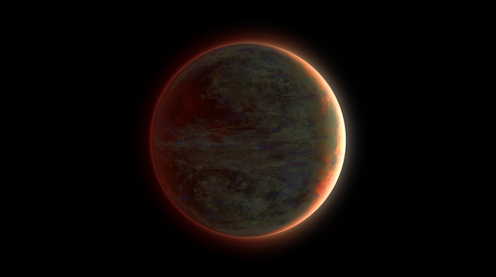
An artist's impression of the dark side of ultra-hot Jupiter WASP-121b. Credit: Patricia Klein / MPIA, CC BY-SA

Since astronomers discovered the first planet orbiting a star other than the Sun, we have found many worlds that are very unlike the ones in our own Solar System. A large number of these “exoplanets” are large, gaseous planets roughly the size of Jupiter, orbiting close to their parent stars once every few days.

Although we can’t directly see these “hot Jupiters”, because they are hidden in the glow from their parent stars, they are the easiest planets to detect using the transit method. This works by inferring their presence indirectly when they pass in front of their parent star, blocking some of the starlight.

Sign up to read this article
Read news from 100's of titles, curated specifically for you.
Already a member? Sign in here
Related Stories
Top stories on inkl right now
One subscription that gives you access to news from hundreds of sites
Already a member? Sign in here
Our Picks
Fourteen days free
Download the app
One app. One membership.
100+ trusted global sources.