Get all your news in one place.
100’s of premium titles.
One app.
Start reading
LiveScience
LiveScience
Kristina Killgrove

Roos Carr figures: Creepy 2,600-year-old carvings with 'removable genitalia' and eyes that may have symbolized Odin's soothsayer powers

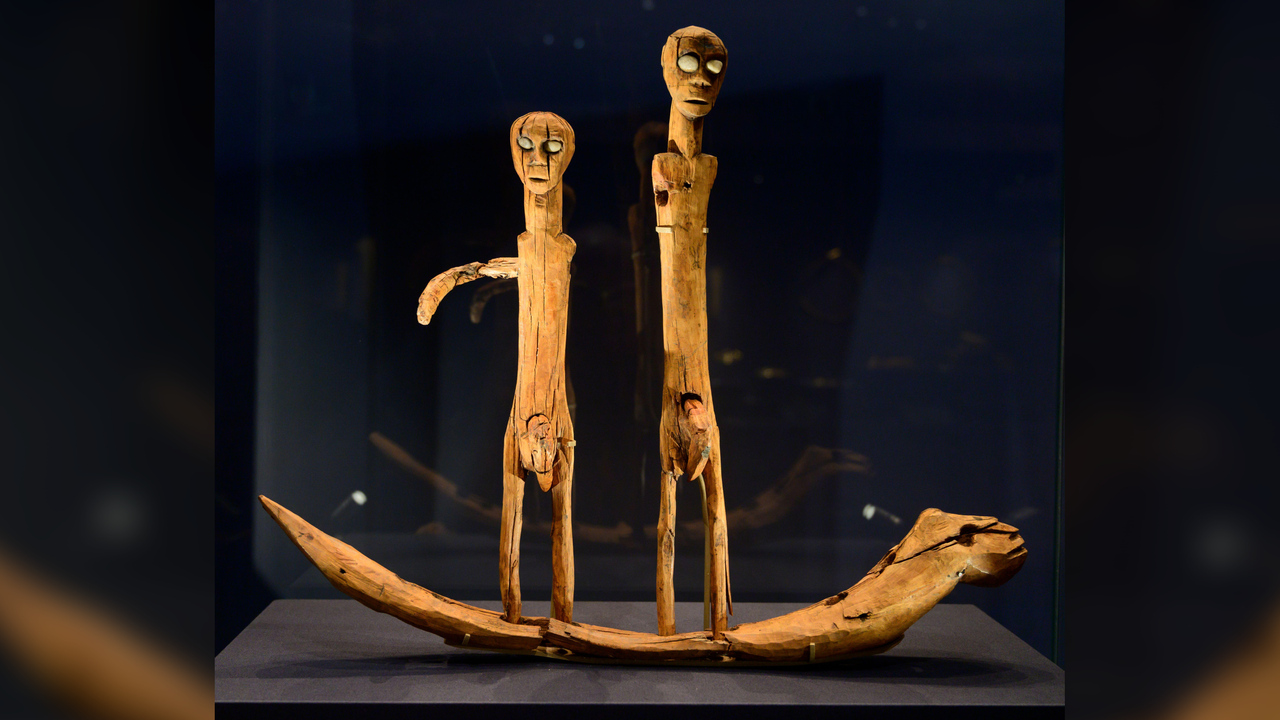
Two wooden human figurines with quartz eyes and removable phalluses stand on a snake-headed boat.
QUICK FACTS

Name: Roos Carr figures

What it is: A set of figurines carved from yew wood and quartzite

Where it is from: Roos Carr, East Yorkshire, U.K.

When it was made: Circa 600 to 500 B.C.

This set of carved figurines was discovered in the parish of Roos, on England's east coast. The carvings, which have been carbon-dated to the Late Bronze Age, may have been offered to the god Odin.
When laborers were digging a drainage ditch in 1836, they discovered a set of eight human figures, two miniature boats and an assortment of arms and tiny weapons underneath a layer of blue clay. Three of the figures and one of the boats were in poor condition and unable to be removed.

The Roos Carr figurines have been studied for decades at the Hull and East Riding Museum of Archaeology, where they were originally donated in the late 19th century. Carved from yew wood, the human figures range from 14 to 16 inches (35 to 41 centimeters) tall, and their heads are inset with quartzite eyes. The sea serpent-headed boat includes partially drilled holes that could support up to four figurines.

Although a handful of similar figurines exist in England and Ireland, their meaning continues to elude experts. According to a 1990 study, one of the earliest theories put forth was that the eight original Roos Carr figurines represented the eight people on Noah's Ark. Another early theory suggested that the carvings were "sinister cult figures."

But the figurines may have actually been deposited in some sort of ritual related to the god Odin or his earlier incarnation called Ull, according to the Hull and East Riding Museum of Archaeology. A wizard and a shape-shifter, Odin is associated with yew trees. He also had only one good eye, having sacrificed the other one to see the future. The quartzite eyes of the wooden figurines are noticeably different sizes.

An additional clue is found in the figurines' groins. Small curved pieces of wood can be put into the drilled holes, making them detachable or "removable genitalia," according to the museum. But when the pieces are absent, the figurines can be seen as female. Odin was known to shape-shift into female form as well as into the form of a sea serpent.

The Roos Carr figurines "challenge our modern day conception of gender identity and gender roles," according to the museum, because the figures also have shields and clubs with them, which are usually associated with male warriors.

The fact that the figurines were discovered under a layer of clay suggests they were deposited in or near water around 2,600 years ago, according to the museum, which was a common place for ritual offerings in prehistoric times.

For more stunning archaeological discoveries, check out our Astonishing Artifacts archives.

Sign up to read this article
Read news from 100’s of titles, curated specifically for you.
Already a member? Sign in here
Related Stories
Top stories on inkl right now
One subscription that gives you access to news from hundreds of sites
Already a member? Sign in here
Our Picks
Fourteen days free
Download the app
One app. One membership.
100+ trusted global sources.