
Get all your news in one place.
100's of premium titles.
One app.
Start reading
Space
Space
Science
Robert Lea

Roman Space Telescope will use a century-old idea from Einstein to probe the nature of mysterious dark matter

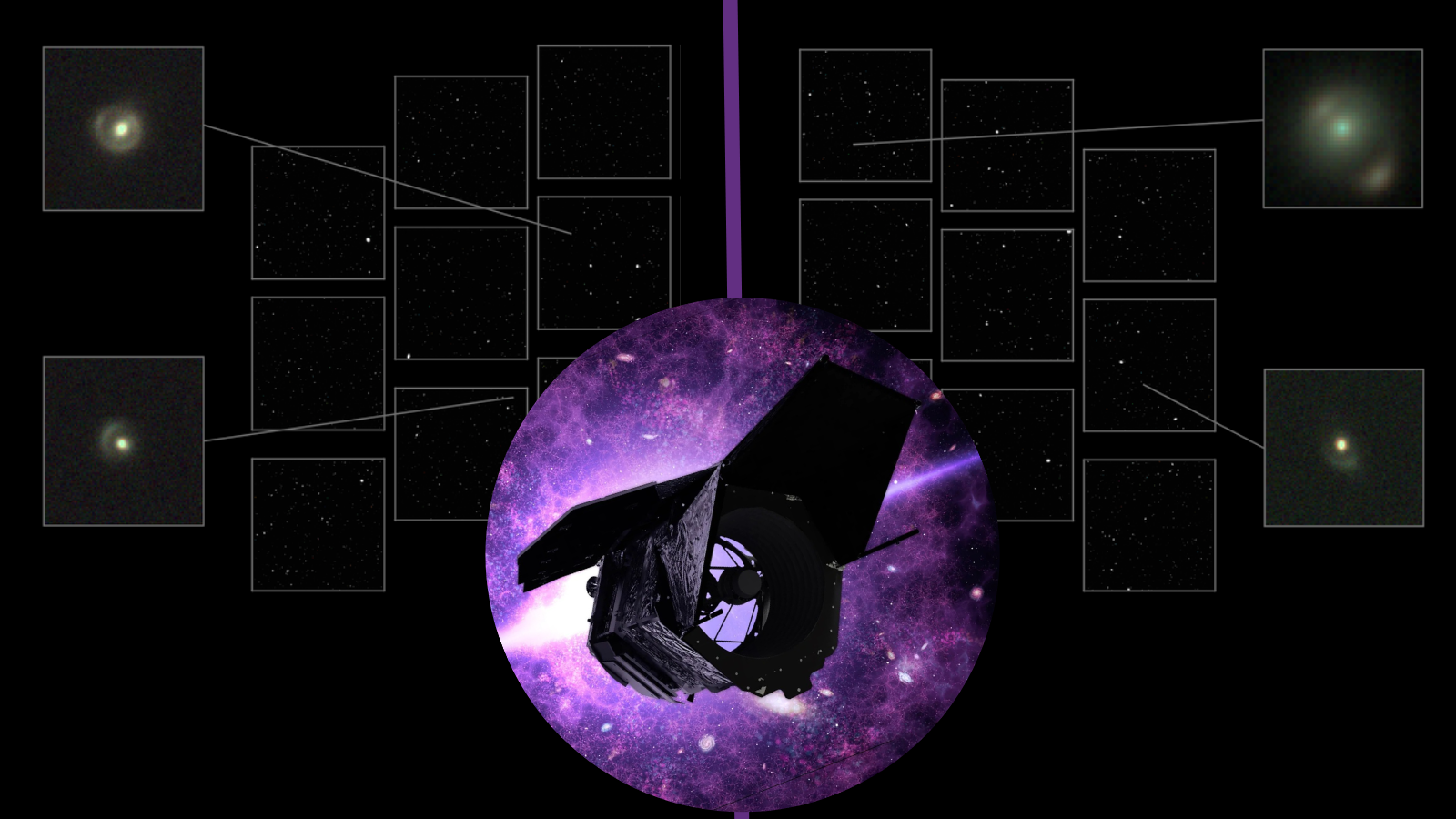
(Main) A simulated observation from NASA’s Nancy Grace Roman Space Telescope with an overlay of its Wide Field Instrument’s field of view. More than 20 gravitational lenses, with examples shown at left and right, are expected to pop out in every one of Roman’s vast observations. (Inset) an illustration of Roman in space.

When NASA’s Nancy Grace Roman Space Telescope begins science operations in 2027, it will use a space-bending effect first predicted by Einstein back in 1916 in an attempt to crack one of science's greatest mysteries: the nature of dark matter.

The phenomenon in question is that of "gravitational lensing." The great physicist's magnum opus theory of gravity, general relativity, proposes that this occurs when objects of great mass warp the very fabric of space-time (the four-dimensional unification of space and time), and light from background sources is curved as it passes these "dents" in the cosmos.

Sign up to read this article
Read news from 100's of titles, curated specifically for you.
Already a member? Sign in here
Related Stories
Top stories on inkl right now
One subscription that gives you access to news from hundreds of sites
Already a member? Sign in here
Our Picks
Fourteen days free
Download the app
One app. One membership.
100+ trusted global sources.