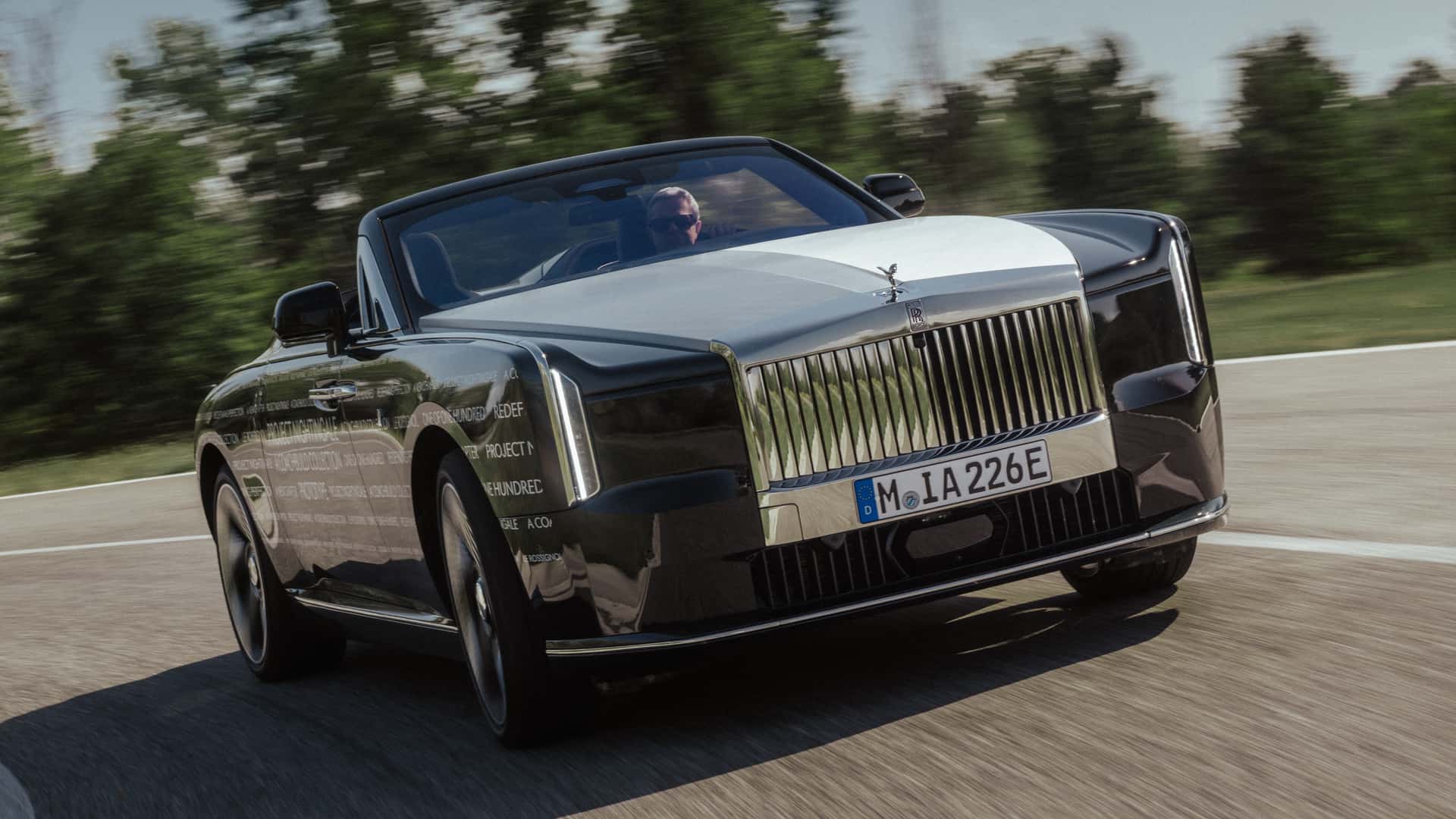
- Rolls-Royce’s low-volume Project Nightingale convertible is hitting the road for extensive testing.
- The coachbuilt EV features a cashmere-lined roof and a side-opening Piano Boot.
- As part of the endurance testing process, the exclusive two-door Rolls-Royce will go through extreme temperatures and extensive stress testing.
While some car manufacturers are scratching their heads, trying to come up with new ways to make their electric models more efficient and cheaper to build, Rolls-Royce has unlocked a new first-world problem.

The British marque has officially kicked off the real-world testing program for its upcoming Project Nightingale electric convertible, and one of the challenges of developing an ultra-exclusive coachbuilt car is making sure that all the components can survive scorching heat and freezing winters.
Sure, all automakers do the same, but I haven’t heard of many EVs with a cashmere-lined retractable roof that needs to survive temperatures of up to 176°F (80°C). But that’s not all, as the roof will go through 10 separate procedures that will put the fabrics, closing mechanism, and performance to the test.
The side-opening Piano Boot, a first for Rolls-Royce, will also be opened and closed 15,000 times to ensure that it “never interrupts the perfect theater and effortless operation of this hallmark gesture for generations to come.” The company’s words, not mine.
With just 100 cars scheduled to be assembled, the first working prototypes are now driving in Southern Europe, where the company originally started testing its luxury cars over 100 years ago. As part of the endurance testing program, several Project Nightingale EVs will spend a total of 350 weeks driving on Mediterranean roads to the Arctic Circle and the deserts of the Arabian Peninsula.
Gallery: Rolls-Royce Project Nightingale
Along the way, the prototypes will have to endure extreme temperatures and climb as high as 9,022 feet (2,750 meters). Separately, a collective 1,430 hours will be spent on aerodynamic modelling and wind tunnel testing to ensure that air won’t become a nuisance. With a practically silent powertrain, Rolls-Royce wants its exclusive EV to eliminate all unwanted sounds, enabling occupants to enjoy the sounds of nature from the comfort of their battery-powered Rolls.
Speed testing at up to 155 miles per hour is also part of the whole process, during which a specially designed electric wind deflector will go through its paces to minimize wind turbulence in the cabin.
Unveiled earlier this year, the Rolls-Royce Project Nightingale is the company’s first Coachbuild Collection model. Based on the same Architecture of Luxury aluminium spaceframe that underpins the electric two-door Spectre, the 100 Nightingale EVs are expected to be powered by a dual-motor setup with over 600 horsepower and 800 pound-feet of torque.
Pricing is being kept under wraps, but rumors suggest that every unit will cost anywhere between $5 and $10 million. Deliveries are scheduled to start in 2028.