
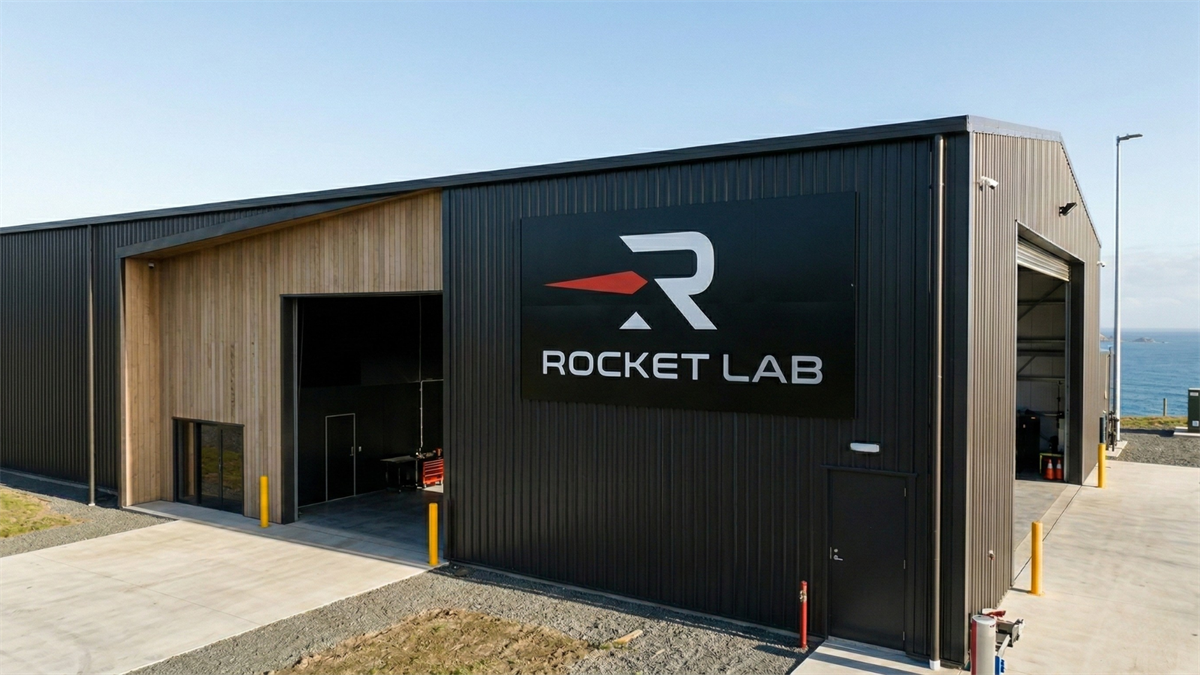
Rocket Lab (NASDAQ: RKLB) just reported its highly anticipated Q4 2025 earnings. On the surface, the numbers were strong. The aerospace and defense company delivered a top and bottom-line beat, posted record revenue, expanded margins, and grew backlog to new highs. But despite that, the stock opened lower the day after the release, down almost 6%.
As covered previously, there was far more at stake in this report than quarterly revenue and earnings per share (EPS). Investors were looking for clarity on execution, scalability, and most importantly, Neutron.

Let’s break it down.
Record Revenue and Expanding Backlog
Rocket Lab closed out 2025 with several key milestones. The company completed 21 successful launches during the year, a new annual record, including seven missions in Q4 alone. Importantly, it maintained a 100% mission success rate in 2025, reinforcing reliability as a competitive advantage.
Financially, the growth story remains intact.
Full-year revenue reached $602 million, up nearly 40% year-over-year. Q4 revenue came in at $180 million, representing 36% growth over the prior-year period. GAAP EPS for the quarter showed a loss of 9 cents, slightly better than expectations.
Margins also improved. GAAP gross margin reached 38%, up sequentially, while non-GAAP gross margin expanded to 44.3%. Adjusted EBITDA loss narrowed to $17.4 million, significantly better than the company’s prior guidance range.
Liquidity remains strong, with $1.1 billion in cash and equivalents at year-end. That balance sheet strength matters as the company continues investing in its next phase of growth.
Perhaps most notably, the company’s backlog climbed to $1.85 billion, up more than 73% from 2024. Management indicated that roughly 37% of that backlog is expected to convert into revenue within the next 12 months, providing meaningful forward visibility.
A major contributor to that growth was an $816 million prime contract from the Space Development Agency to build 18 satellites, the largest single award in the company’s history. The Space Systems segment continues to be a powerful growth engine alongside launch services.
Vertical Integration Accelerates
Beyond the headline numbers, Rocket Lab continues to expand its vertically integrated model.
The company established a new Precision Machining Complex following the acquisition of Precision Components Ltd., now operating as the Auckland Machine Complex. The facility will produce high-tolerance machined components to support spacecraft customers, increase Electron production cadence, and enable future Neutron development.
Rocket Lab also signed another multi-launch agreement with BlackSky, securing four additional dedicated Electron missions. This brings the total number of Electron launches for BlackSky since 2019 to 17, reinforcing Rocket Lab’s position as a trusted, repeat launch provider.
In addition, the company acquired Optical Support, a specialist in high-precision optical and optomechanical systems. These components are critical for national security payloads, space domain awareness, missile tracking, and defense applications. Each acquisition deepens Rocket Lab’s control over key subsystems and strengthens its end-to-end space infrastructure offering.
All of this supports a broader thesis: Rocket Lab is evolving from a launch company into a fully integrated space systems provider.
So, why is the stock lower?
Neutron Maiden Flight Delayed…Again
The most anticipated update from this earnings report centered on the maiden flight timeline for the Neutron medium-lift rocket. Management announced that the first launch is now expected in Q4 2026, following a Stage 1 tank rupture during hydrostatic pressure testing in January.
For investors betting on a near-term successful Neutron launch, that delay was disappointing.
That said, the setback does not appear thesis-breaking. Development risk is inherent in aerospace. Importantly, CFO Adam Spice indicated that Q1 2026 is expected to be Neutron's peak R&D spending quarter. As development winds down, the company anticipates a significant improvement in profitability metrics.
Guidance for Q1 2026 calls for revenue between $185 million and $200 million. GAAP gross margins are expected to dip modestly to 34%–36% due to a higher mix of Space Systems revenue versus launch services.
Short-Term Setback, Long-Term Trajectory
Rocket Lab delivered record revenue, expanded margins, grew its backlog, and continued pursuing vertical integration. The balance sheet remains strong, and demand visibility is improving.
The Neutron delay introduces short-term uncertainty, which likely explains the immediate market reaction following the earnings release.
But fundamentally, the company continues to scale its launch cadence, deepen its manufacturing capabilities, and build out a diversified space infrastructure platform.
For long-term investors, the story remains one of execution, integration, and eventual leverage as development spending peaks and next-generation launch capability comes online.
Where Should You Invest $1,000 Right Now?
Before you make your next trade, you'll want to hear this.
MarketBeat keeps track of Wall Street's top-rated and best performing research analysts and the stocks they recommend to their clients on a daily basis.
Our team has identified the five stocks that top analysts are quietly whispering to their clients to buy now before the broader market catches on... and none of the big name stocks were on the list.
They believe these five stocks are the five best companies for investors to buy now...
The article "RKLB Delivers Record Results, But Neutron Delay Weighs on Shares" first appeared on MarketBeat.