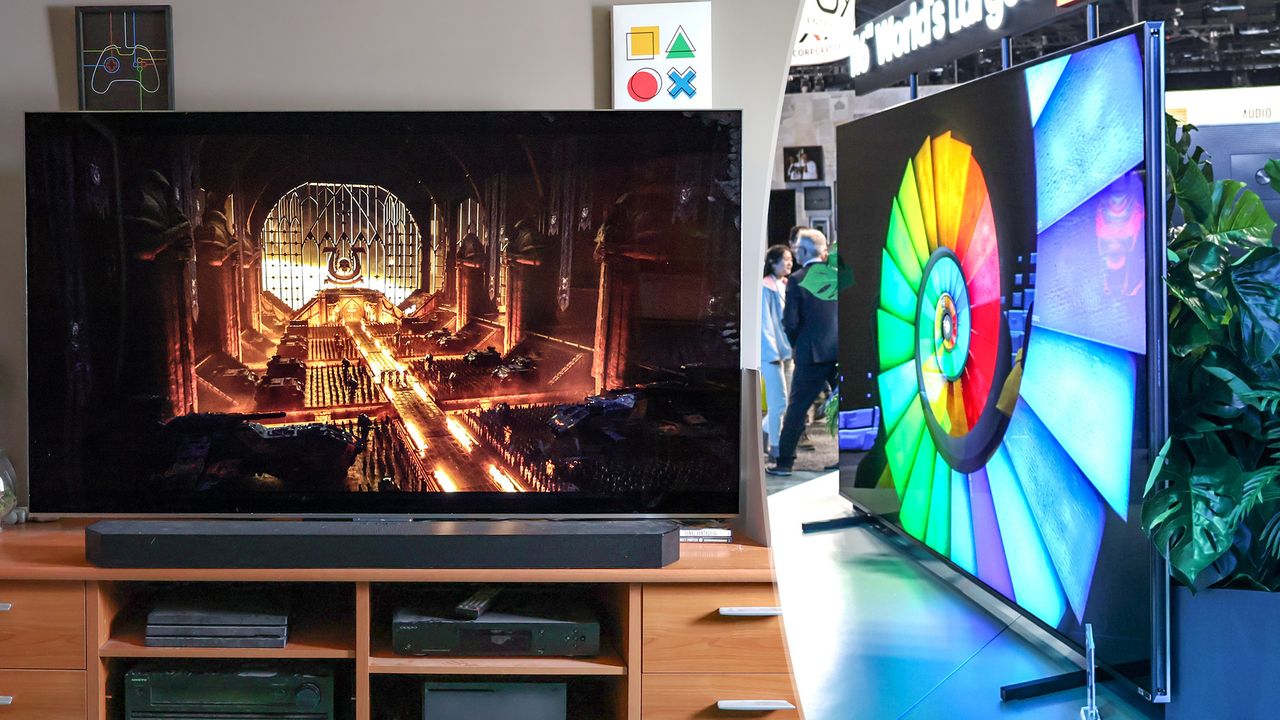
As someone who reviews TVs for a living, I don’t often see a downside to recommending older models. Take, for example, the 2025 LG C5 OLED. It’s one of the best TVs we’ve ever tested, sure, but the 2024 LG C4 OLED is still an incredible TV that, to most folks, would look great.
However, sometimes there’s such a leap in performance between one year and the next, that it becomes hard to recommend buying a previous year’s model.

That’s exactly how I feel about the TCL QM9K — the brand’s flagship Mini-LED TV from 2025 that is, by all accounts, a very good-looking screen, but one that just pales in comparison to TCL's latest X11L model and the upcoming 2026 Mini-RGB TVs from Samsung, Hisense and LG. Here’s why.
Not enough color where it counts
When we talk about color on TVs, we’re talking about two distinct metrics — color volume and color accuracy. To make your favorite movies and shows look their best, you need both.
The QM9K has rock-solid color accuracy. In our lab tests, the QM9K was incredibly accurate with a Delta-E score of 1.8 (the lower the score, the more accurate it is). That rivals most OLED TVs. But its color vibrancy is comparatively lacking — it only covers 97% of the DCI-P3 color space and 79% of the more-advanced Rec.2020 spectrum.

Five years ago, these numbers would’ve blown my mind ... But in 2026 these numbers just aren’t as impressive as they once were.
Five years ago, these numbers would’ve blown my mind. Even last year, these numbers were relatively good. But in 2026, the year that we’re getting Mini-RGB and TCL's own SQD TVs, these numbers just aren’t as impressive as they once were.
So why aren’t they good enough? Well, the QM9K has been superseded by the TCL X11L, the brand’s first SQD TV and its flagship model for 2026. In our lab tests, the X11L not only had a similar Delta-E score of 1.8, but it covered a lot more of the DCI-P3 and Rec.2020 color spaces (97.82% and 91.77%, respectively). That’s a lot of extra color.
We’re still awaiting the new Mini-RGB TVs from Hisense, Samsung and LG, but each claim that their Rec.2020 coverage will all be in the 90% range or better.
But brightness in spades
While color isn’t exactly a strong suit for the QM9K, it’s very good at combating ambient light thanks to its high peak brightness stats. In our lab tests, we measured the QM9K’s peak brightness at 4,207 nits in a 10% window in Standard mode — and we probably could’ve pushed that number even further had we played around with more of the settings.
To help combat potential haloing from this ultra-bright backlight, the QM9K uses TCL’s new Halo Control system that includes 5,000 contrast control zones. I haven’t seen any haloing in my time with the TV so far, so that’s incredibly impressive.

I’ve been watching it in a room with a side-facing window that just lets light in like you wouldn’t believe. Again, the QM9K isn’t phased by it.
The jury is still out on how bright these new Mini-RGB TVs will be — but I don’t think we’ll see a precipitous drop off in peak brightness once they arrive in our test labs later this year. As it stands, the aforementioned X11L can reach upwards of 6,000 nits in the same settings without breaking a sweat, thanks to its Super Quantum Dot (SQD) display. Ambient light, watch out.
How good is good enough?
This is the question that’s delayed my review of the TCL QM9K. It’s a good TV — and for a 2025 model I’d even say it’s great. But I keep coming back to the issue with its color saturation. It’s good enough for now, but it pales in comparison to what’s coming.
The problem, however, is that those TVs could come at untenable prices. The X11L, for example, starts at $6,999 for the 75-inch model. Conversely, the 75-inch QM9K can be purchased for $2,299 at Best Buy.
Should we give up the pursuit of vibrant color for a lower sticker price? I'm not sure. As a reviewer, it's something I'm still grappling with.
What I do know is that, after seeing them in-person, Mini RGB TVs are at the top of my wish list for 2026 and the QM9K... well, probably won't be.