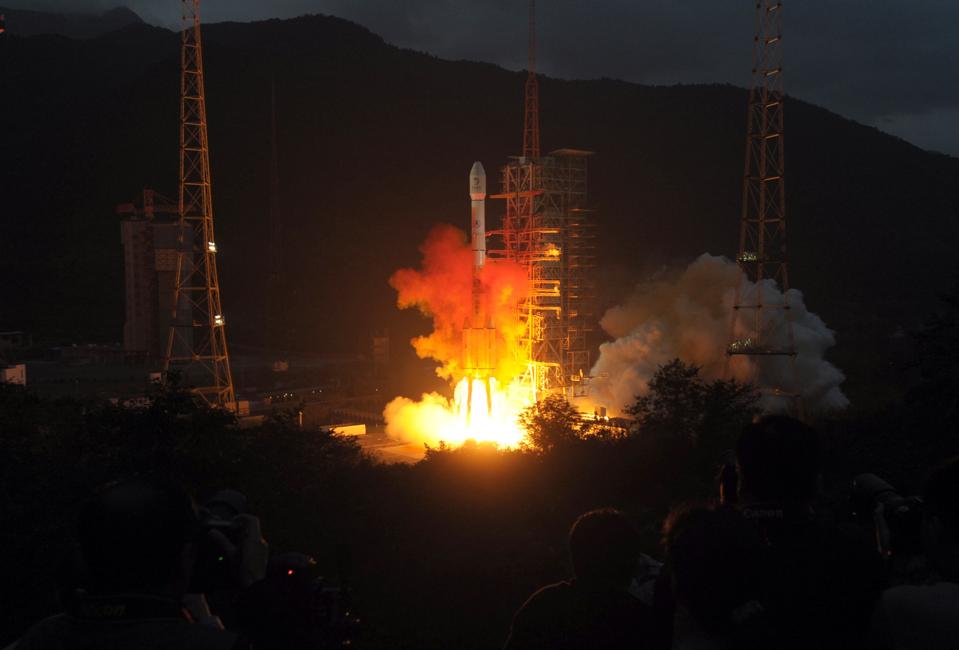
A rocket part left in space after a launch will strike the Moon on March 4, 2022 at a speed of about 5,700 mph. It will leave a crater on the lunar surface.
But contrary to my earlier stories published on January 27, 2022 and February 3, 2022 the object now appears to be of Chinese origin and not from a SpaceX launch as initially reported.
Ironically, it now appears that the object comes from a Chinese mission to return a sample of lunar rock to help scientists understand why the Moon is so heavily cratered.
Bill Gray at Project Pluto, software that tracks near-Earth objects, has published a correction to his initial claim that the doomed object was part of a SpaceX Falcon 9 rocket launched on February 11, 2015 to put a NASA satellite into Earth orbit.
Gray now says that he thinks the object is actually from the launch of the China National Space Administration’s (CNSA) Chang'e 5-T1 lunar mission in October 2014.
“I am persuaded that the object about to hit the Moon on 2022 Mar 4 at 12:25 UTC is actually the Chang’e 5-T1 rocket stage,” writes Gray.
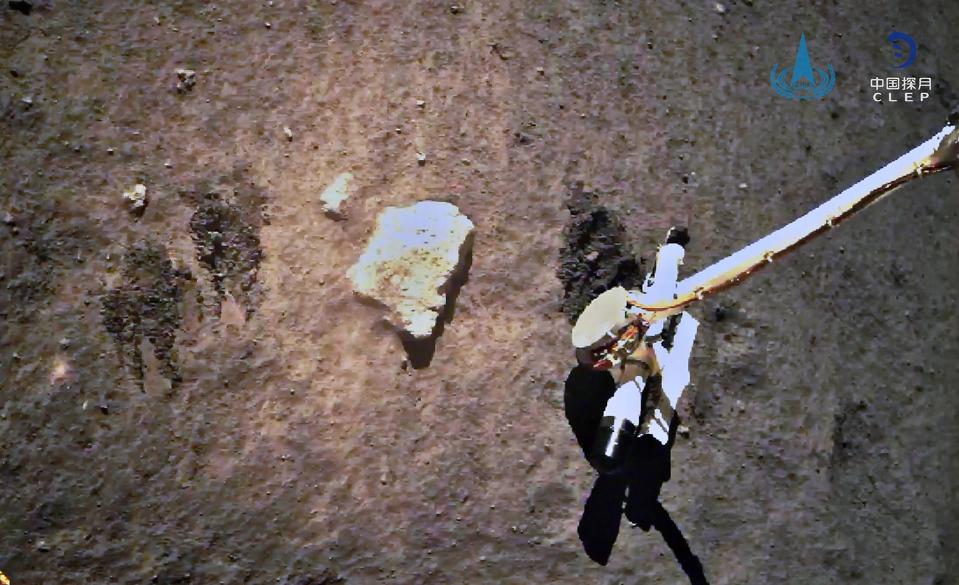
Chang’e 5-T1 was an experimental mission to test a capsule during re-entry into Earth’s atmosphere in advance of the full Chang'e-5 mission, the first sample return mission for 45 years. It successfully sent back valuable lunar rock samples to Earth in 2020.
The lunar rock samples returned are two billion years old, which makes them the youngest moon rock scientists have. The samples show that the Moon was active for much longer active than previously thought.
The errant object—the third stage booster from a Long March 3C rocket—was launched from the Xichang Satellite Launch Center on October 23, 2014.
It’s now in a highly elliptical orbit of Earth that takes it beyond the distance of the Moon. On March 4, 2022 it will crash into the far side of the Moon.
It’s possible that the crater it causes could be imaged by NASA’s Lunar Reconnaissance Orbiter (LRO) and India’s Chandrayaan-2, both of which are in orbit around the Moon.
Wishing you clear skies and wide eyes.