Get all your news in one place.
100's of premium titles.
One app.
Start reading
The Canberra Times
The Canberra Times
Steve Evans

How one daughter loves the mother who forgets her

Most days, Belle Hogg makes funny faces or sings to her mother, even though her mum rarely recognises her.

It's an act of love by a daughter to the woman she's known literally from birth but who in her early 70s is now in another world of dementia.

"I see little glimpses of her. Every now and then, you get these tiny, tiny windows of clarification where she'll suddenly use my name."
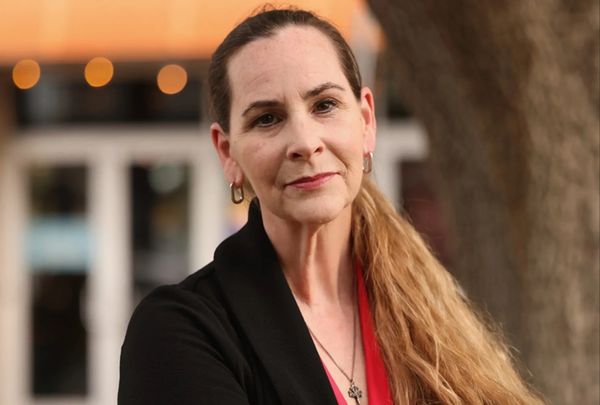
Her mum, Chrissy, lived with her daughter and granddaughter, Ava, until her Alzheimer's disease (a form of dementia) became too much. She now lives in a nearby care home where her daughter and granddaughter visit frequently.

If Belle can't get there because of work, she FaceTimes. Carers put Chrissy in front of the screen and link her up to her daughter.

Belle Hogg (right) with her daughter Ava (left) and her mother Chrissy. Picture by Keegan Carroll

"It's not like we can have full conversations. We sing songs. With her Alzheimer's, she can burst into '80s pop songs word-for-word sometimes. I'll pull faces at her and just make her laugh."

With dementia, memory fades. Daily tasks become impossible in a confused state of mind. It's caused by damage to brain cells.

It's not a normal part of ageing - but there is a lot of it about, with much more to come as older people increase as a proportion of the Australian population.

"In 2026 there are an estimated 446,500 Australians living with dementia," according to Dementia Australia. "Without a significant intervention, the number of Australians living with dementia is expected to increase to more than one million by 2065."

Apart from the human cost, the economic cost is great. The government's Australian Institute of Health and Welfare estimated that $4.7 billion was spent on the care, diagnosis and treatment of people with dementia in 2022-23. Two-thirds of that was spent on aged care ($3.2 billion), particularly in care homes.

So the task policymakers are trying to address is how to head off a ballooning economic burden.

"We are in a bind. There's a massive demand for our ageing services," Tracy Comans, director of the National Ageing Research Institute, said.

Professor Comans said that people in mid-life needed to be persuaded not to do things which led to dementia in old age.

Scientists have identified 14 risk factors which indicate a person is more likely to get dementia. Some of them are well known and avoidable: heavy drinking, smoking, not doing enough exercise, eating badly, having a head injury, diabetes. Others - like encountering pollution - were less avoidable.

But new ones have been discovered: a good education can help children 60 or so years later.

Scientists think that more active young brains become more active old brains.

"By giving the children in your life the best education you can, you're helping to reduce their future risk of developing dementia," Dementia Australia advised.

"You don't suddenly age at 65," Professor Comans said. "You're ageing from the time you become an adult, so people need to think about how to manage that. There's lots of things you can do to set yourself up for a cracking old age."

There's lots of things you can do to set yourself up for a cracking old age.

"If you really don't want to live in a nursing home, it's really important that you incorporate these good habits much earlier than you probably think you need to. If you live until you notice the issues, you've actually already deteriorated a lot.

"There is a genetic component, but that's the hand you're dealt. You've just got to live your best life. There's a lot you can do to change the trajectory."

"If you're boiling a kettle, stand on one leg. These are things that you don't have to make a special effort for. Just make them a habit. Walking is excellent".

Suffering bad hearing loss in middle age is also a sign of dementia later, so Professor Comans urged people to stay away from music that blasts out.

On the best estimates, there are about 100,000 people in Australia caring for someone with dementia. More than half those carers were the partner of the sufferer - and partners, of course, suffer in a different way: they see the person they loved fail to recognise them.

Belle said it was important not to get exasperated. She thinks the way she deals with her mum is like dealing with a baby: giving love to someone you love.

"Kids under a certain age don't remember anything, and yet we'll throw a one-year-old a big birthday party, or we'll do special things for them, take them on a holiday. Why? It's because we're sharing, we're having special moments together.

"Mum probably won't remember as soon as we've walked out the door. But in that moment, she's laughing, she's happy. And that's what's important.

"The worst thing can be just completely shutting them off because it's uncomfortable for you and you think, 'I don't know what to say to them'. But I would say to people, 'Don't treat them like they're stupid, because that is the worst thing'.

"After work, I go there. I might have dinner with her, take her to the cafe; doing nails; do her hair; do her makeup. I know old Mum would want to have her make-up done. She loved getting dressed up.

"Because dignity is very important."

Sign up to read this article
Read news from 100's of titles, curated specifically for you.
Already a member? Sign in here
Related Stories
Top stories on inkl right now
One subscription that gives you access to news from hundreds of sites
Already a member? Sign in here
Our Picks
Fourteen days free
Download the app
One app. One membership.
100+ trusted global sources.