
Get all your news in one place.
100's of premium titles.
One app.
Start reading
The Conversation
The Conversation
Hugh Lippincott, Associate Professor of Physics, University of California, Santa Barbara

Researchers dig deep underground in hopes of finally observing dark matter

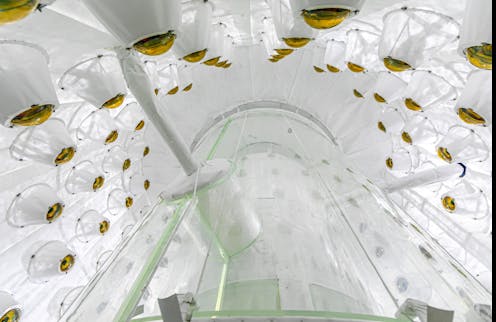
The inside of the LZ outer detector. The LZ is a super sensitive machine that may one day detect a dark matter particle. Matt Kapust, SURF, CC BY-SA

Physicists like me don’t fully understand what makes up about 83% of the matter of the universe — something we call “dark matter.” But with a tank full of xenon buried nearly a mile under South Dakota, we might one day be able to measure what dark matter really is.

In the typical model, dark matter accounts for most of the gravitational attraction in the universe, providing the glue that allows structures like galaxies, including our own Milky Way, to form. As the solar system orbits around the center of the Milky Way, Earth moves through a dark matter halo, which makes up most of the matter in our galaxy.

Sign up to read this article
Read news from 100's of titles, curated specifically for you.
Already a member? Sign in here
Related Stories
Top stories on inkl right now
One subscription that gives you access to news from hundreds of sites
Already a member? Sign in here
Our Picks
Fourteen days free
Download the app
One app. One membership.
100+ trusted global sources.







