
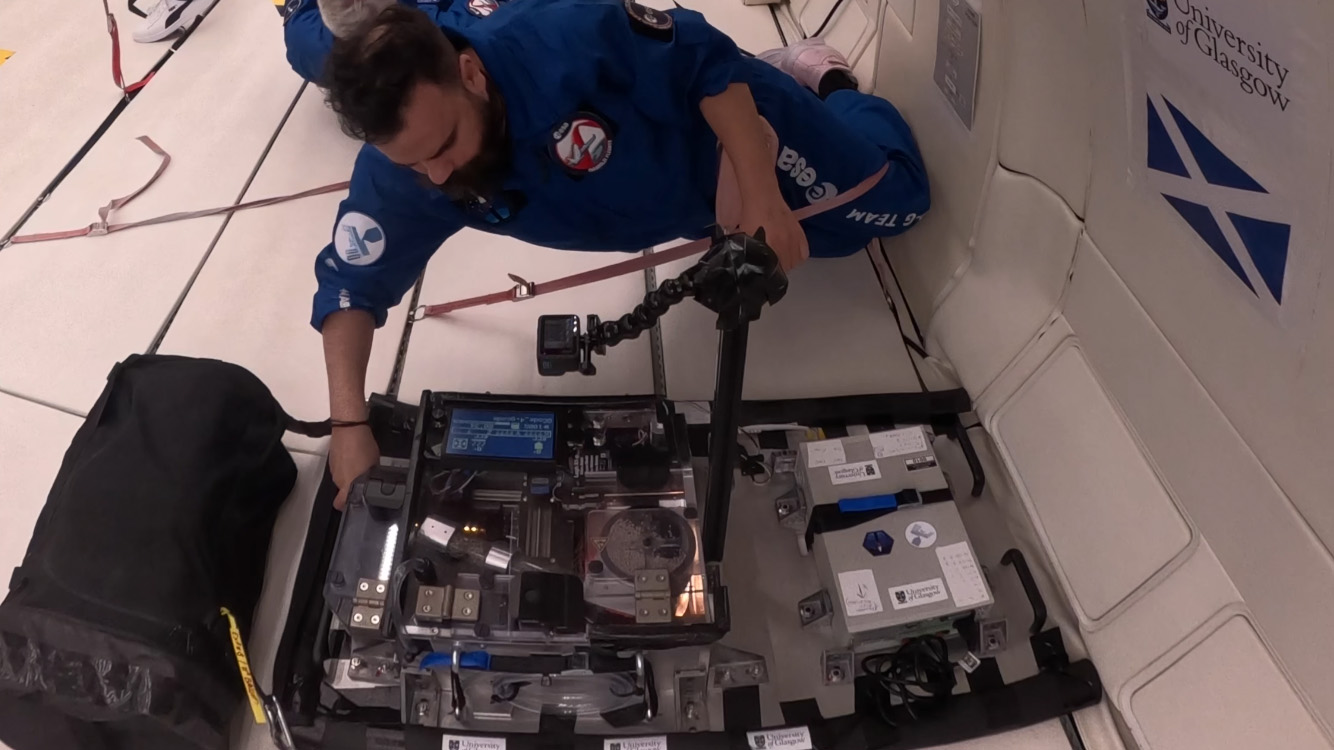
Dr. Gilles Bailet and his team at James Watt School of Engineering at the University of Glasgow received a patent for a prototype 3D printer that has been tested to work in zero gravity. Aside from that, this system is also designed to work in the vacuum of space, allowing for its use outside of spacecraft and space stations. According to the University of Glasgow, the research team has taken the kit on three test flights that allowed for more than 90 22-second periods of weightlessness, allowing them to test how it works in microgravity.
3D printers were first used in orbit in 2014, which allowed the astronauts onboard the International Space Station (ISS) to print plastic parts and tools as required. Just last year, the European Space Agency launched a metal 3D printer and is currently testing it on the ISS to see how microgravity affects printing metal parts. However, all this equipment is designed to be used within the ISS’s modules, which are pressurized at around the same level as here on Earth.