Get all your news in one place.
100's of premium titles.
One app.
Start reading
The Conversation
The Conversation
Christopher Wolff, Associate Professor of Anthropology, University at Albany, State University of New York

Repatriation to Indigenous groups is more than law, it’s human rights − an archaeologist describes the day that lesson hit home

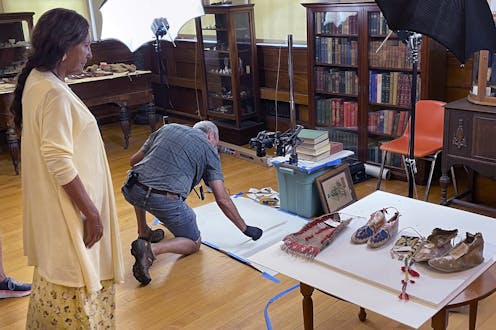
Leola One Feather of the Oglala Sioux Tribe observes as Native American artifacts are photographed at the Founders Museum in Barre, Mass., in 2022, before their return. AP Photo/Philip Marcelo

As an archaeologist, you picture yourself traveling to some remote location, digging into the ground, and returning to a lab in a university or museum to study the remains of past civilizations, with hopes of answering important questions.

In contrast, I’ve often found myself working to return those remains to their rightful cultures. Repatriation is the process of returning ancestral human remains and important objects to descendant populations. Since the passing of the National Museum of the American Indian Act in 1989 and the Native American Graves Protection and Repatriation Act in 1990, it has become an increasingly important part of archaeological practice, yet about 110,000 ancestors remain in collections.

Sign up to read this article
Read news from 100's of titles, curated specifically for you.
Already a member? Sign in here
Related Stories
Top stories on inkl right now
One subscription that gives you access to news from hundreds of sites
Already a member? Sign in here
Our Picks
Fourteen days free
Download the app
One app. One membership.
100+ trusted global sources.