Get all your news in one place.
100’s of premium titles.
One app.
Start reading
The Guardian - UK
The Guardian - UK
National
Bethan McKernan, Jamie Grierson and Nadeem Badshah

Red and amber weather warnings in UK as Storm Goretti evolves into ‘weather bomb’

A man points at a website on a large screen showing coloured weather graphics overlaid on a satellite image of the UK and France
An officer at the Falmouth Maritime Rescue Coordination Centre monitoring the progress of Storm Goretti. Photograph: Hugh Hastings/Getty Images

Red and amber weather warnings have been issued across the UK as Storm Goretti evolves into a “weather bomb” expected to bring up to 30cm of snowfall in Wales and the Midlands and winds of up to 100mph (160km/h) in Cornwall and the Isles of Scilly.

The Met Office on Thursday described Goretti, the first named storm of 2026, as a “multi-hazard event”, expected to be more powerful than Storm Ciarán in 2023 and the Great Storm of 1987.
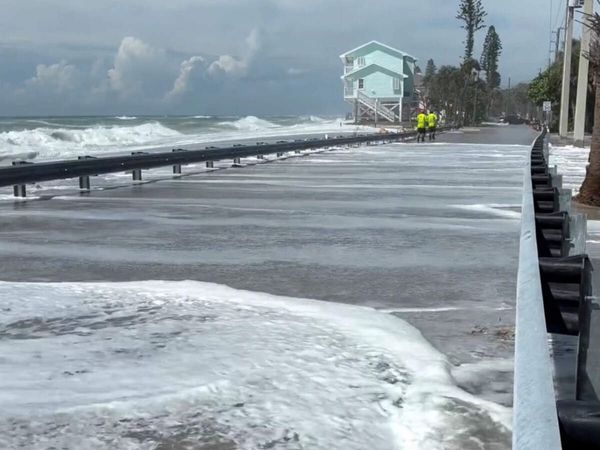
Winds of 99mph were recorded at St Mary’s airport on the Isles of Scilly, which is a new record for the site, the forecaster said.

Birmingham Airport suspended the use of its runway on Thursday night due to heavy snow.

A storm becomes a weather bomb when its central pressure drops by more than 24 millibars in 24 hours, causing violent winds. Goretti was expected to drop by 36 millibars between 6pm on Wednesday and 6pm on Thursday.

Named by Météo France, Goretti is set to cause travel disruption, power and communications problems and pose a potential risk to life and property across England and Wales after changing direction and approaching from the south-west.

The worst of the weather will hit overnight before the storm wanes on Friday.

The Met Office meteorologist Alex Burkill said: “As that rain pushes its way and it hits against that cold air that we currently have across us … on the northern edge, we are likely to see some fairly significant snow as we go through later [Thursday] and into Friday.”

The warnings stretch from Sheffield, down to Leicester, across much of the West Midlands and most of Wales, coming into force at 8pm on Thursday and ending at 9am on Friday.

A rare red warning for “dangerous, stormy” winds of up to 100mph in exposed and coastal areas has also been issued for Cornwall and the Isles of Scilly for Thursday evening.

An emergency alert, which means sounds blare from mobile phones, was issued to people in the Isles of Scilly at approximately 3pm, and people in Cornwall at approximately 5pm, a Cabinet Office spokesperson said.

The weather could cause damage to buildings and homes, with roofs blown off and power lines brought down, the Met Office said. Very large waves and beach material thrown on to coastal roads, seafronts and homes also presented a threat, it added.

More than 47,000 properties were without power in the south-west at about 9pm, according to National Grid’s website, while 5,000 had no power in the West Midlands and 2,000 in Wales.

The National Grid has issued guidelines, including advice to keep a torch and fully charged mobile phone ready for use, because of expected power cuts. Dŵr Cymru and Scottish Water have advised against keeping outdoor taps running, asking customers to instead check and protect exposed pipes and water tanks.

As well as in Wales and the Midlands, heavy snow of up to 20cm is expected in South Yorkshire.

There is a further yellow warning for wind for much of south-west England from 3pm on Thursday to 6am on Friday and yellow snow warnings for a large part of England and almost all of Wales from 5pm on Thursday until midday on Friday.

Yellow rain warnings have also been issued across eastern England from 6pm on Thursday to 9pm on Friday, and in west Wales from midday on Thursday to 10am on Friday.

National Highways has issued its own amber warning for snow in the Midlands from 6pm on Thursday to 9am on Friday, advising of “particularly difficult driving conditions” in Birmingham, Leicester and Nottingham.

Rail passengers have been advised to check journeys before travelling, with services cancelled across Wales, Cornwall and north-west England. National Rail said all train services in parts of south-west England will be cancelled on Thursday evening and warned that there were likely to be delays and cancellations on Eurostar routes from London.

Major airports have said they will continue to function normally with the exception of Jersey and Guernsey, which will close at 6pm.

Amber cold weather health alerts have been put in place by the UK Health Security Agency until 11 January, meaning severe effects can be expected across health and social care services. Officials expect a rise in deaths, particularly among those aged 65 and over or with health conditions, with younger age groups also potentially affected.

Meanwhile, Scotland’s attention had turned to recovery efforts after days of heavy snow that caused widespread travel disruption, the first minister, John Swinney, said on Thursday.

More than 250 schools are set to remain closed on Friday, including more than 150 in Aberdeenshire, dozens in the Highlands and a number in Moray.

A total of 278 schools were closed on Thursday across northern Scotland.

Sign up to read this article
Read news from 100’s of titles, curated specifically for you.
Already a member? Sign in here
Related Stories
Top stories on inkl right now
One subscription that gives you access to news from hundreds of sites
Already a member? Sign in here
Our Picks
Fourteen days free
Download the app
One app. One membership.
100+ trusted global sources.