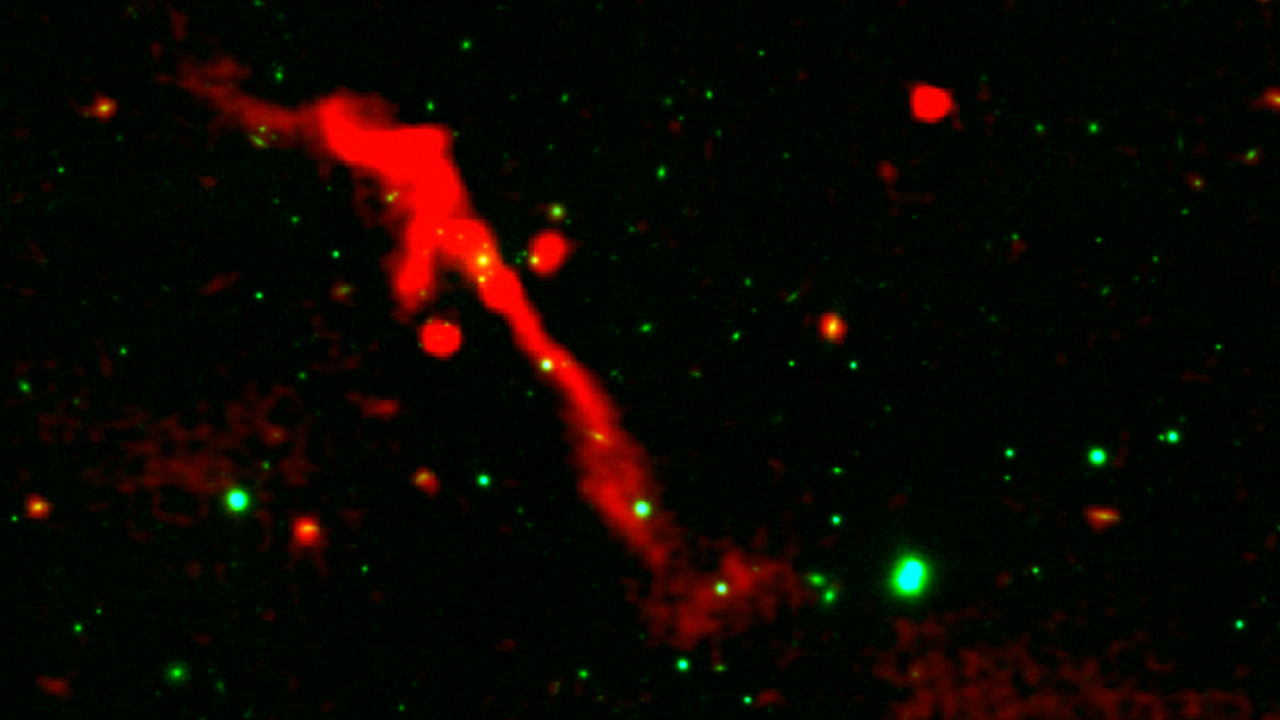
Astronomers have discovered a once-dormant supermassive black hole springing back to life in a very dramatic and spectacular fashion, acting as a "cosmic volcano" blasting out an eruption that stretched out for 1 million light-years. The supermassive black hole in question sits at the heart of the galaxy J1007+3540 and has lain dormant for around 100 million years.
The team of scientists behind these observations used the Low Frequency Array (LOFAR) in the Netherlands and India's upgraded Giant Metrewave Radio Telescope (uGMRT) to create radio images of J1007+3540 and its incumbent supermassive black hole. These images revealed this vast black hole jet is in a tug-of-war for dominance with the gravitational force of the rest of the galaxy.