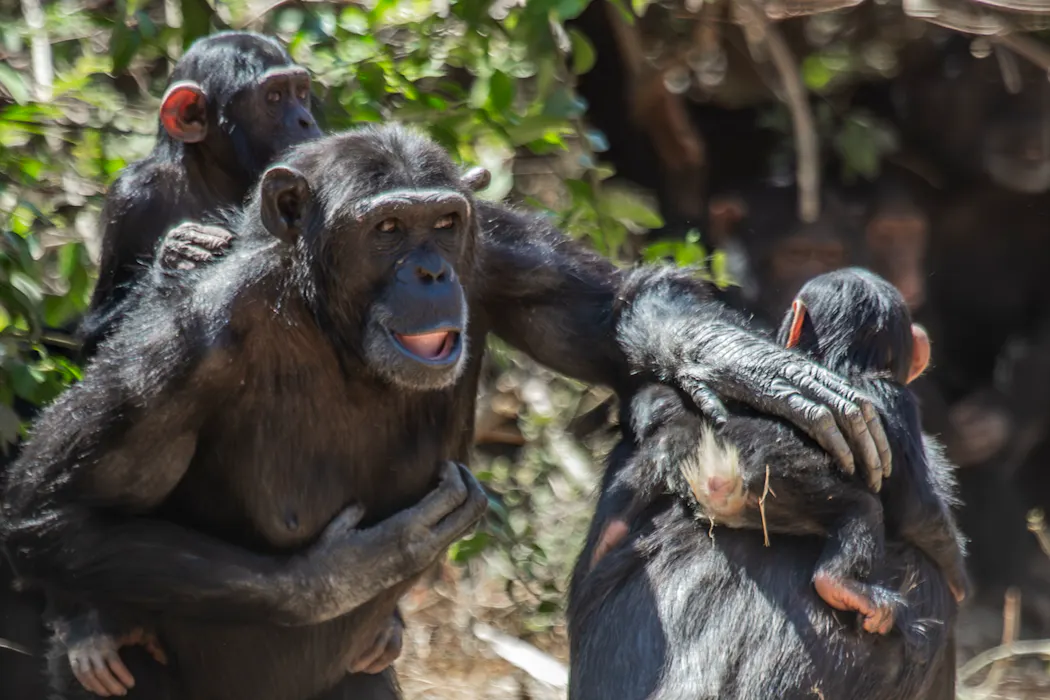
During an eight-month-long research trip to the Democratic Republic of Congo (DRC) and Zambia, we studied consolation: the way bonobos and chimpanzees comfort each other after conflicts and distress. But early on, we kept noticing something that didn’t quite fit.
The animals were exchanging a lot of friendly physical contact, embracing, touching and kissing, in competitive situations before any clear conflict or distress signals had broken out. We started wondering what all that touching was actually for.

Our new research into how great apes manage social stress suggests it could be quite important, and that this behaviour dates back at least 6 million years, long before our species evolved. Like us, our closest ape cousins, the bonobos and chimpanzees, also navigate stressful and competitive situations every day.
One example is when they discover a tree laden with ripe fruit. Everyone wants to eat and conflicts of interest can often lead to fights. But something else caught our attention. More often, apes reach out to one another with friendly touch: embracing, patting and making gentle contact.
Our colleague Edwin van Leeuwen, a Dutch biologist, had developed a feeding task to measure social tolerance across great ape groups. This task is called the peanut swing. It involves filling a bamboo trough with peanuts and swinging it over the fence so the food lands in front of the apes. This spreads peanuts evenly across a small area while researchers record who gets food, and how much. We used this test to measure whether groups could share resources peacefully in close proximity.
Because the apes watched the trough being filled, we could observe how they behaved as anticipation built. Friendly touch clustered in the minutes just before the food arrived. Previous researchers called this celebration behaviour. But discovering food is not just a cause to celebrate. It is also tense and risky.
Could friendly physical contact be helping to keep that tension at bay?
To find out, we measured a five-minute anticipation period before the food was released. We watched everything the apes did: friendly contact like kissing, embracing and patting, as well as aggression and threats. Over several months, we filmed 116 apes from five groups across 60 sessions at two African sanctuaries, Lola ya Bonobo in the DRC and Chimfunshi in Zambia.
In both species, the answer was clear. Bonobos and chimpanzees who engaged in more reassuring friendly contact before the food arrived spent significantly more time feeding peacefully alongside others afterwards. This pattern held across most groups and was strongest in the most tolerant ones. Researchers consider tolerance – the willingness to share space without aggression – to be the foundation of cooperation and social learning across the animal kingdom. Our findings suggest that pre-emptive friendly touch may be part of how that tolerance is maintained.
The patterns followed the social structure of each species. In bonobos, female-female pairs were the most likely to show friendly reassurance. This reflects how bonobo society works: females form strong alliances to counter male aggression and occupy high status positions. In chimpanzees, it was males who reassured each other most, reflecting the importance of male coalitions in their societies.
For both apes, these patterns were clearest in the more tolerant groups. In groups with more authoritarian leaders, the pattern disappeared.
Some of the most striking behaviour we saw were among the chimpanzees. During tense moments, they placed fingers, hands and other body parts inside each other’s mouths. They also held each other’s genitals. For a species known for lethal aggression, these are extraordinarily risky things to do.
Perhaps the vulnerability is itself the signal of trust. You only offer a risky contact if you are confident the other animal won’t bite. And this communicates something important about how you see the relationship.
Read more: Inside the sex lives of chimpanzees: it’s about much more than just reproduction
Touch is among humanity’s oldest forms of communication. Skin-to-skin contact between infants and caregivers is one of the first channels through which attachment forms, long before language develops. A 2006 study found holding a romantic partner’s hand can reduce threat-related brain activity. A 2001 paper found that a brief touch from a stranger can increase cooperation.
Research across five European cultures published in 2015 found that the area of the body you’ll let someone touch maps almost directly onto the strength of your emotional bond with them. There’s plenty of cultural variation though. Brits are famously more guarded about casual contact than other Europeans, and touch between men in many western contexts carries particular social weight.
Perhaps most strikingly, touch before competition makes a difference. A study of negotiators found that pairs who shook hands before bargaining cooperated more, lied less and reached better joint outcomes, even in situations where cooperation came at a personal cost. A handshake may signal something important about intent before a word is even spoken.
But physical contact matters even during competition. A 2010 study of all 30 teams in the US National Basketball Association during the 2008-09 season found that the teams who touched more during games early in the season, through fist bumps, hugs and high fives, performed better and played more cooperatively later. This held even after controlling for player salaries and preseason expectations. In another 2024 study of women’s college basketball, players who received more physical contact from teammates after missing their first free throw were more likely to score on the second.
We see the same thing in genuinely high-stakes situations too. Research analysing street conflicts using CCTV found that witnessing a fight increased anxiety in bystanders. But, those who then engaged in physical contact with others showed reduced anxiety afterwards. A separate study of consolation after street robberies found that the way bystanders approached and touched victims closely mirrored the post-conflict consolation we observe in chimpanzees.
Humans, bonobos and chimpanzees all use reassuring touch but our evolutionary lineages split over 6 million years ago. The simplest explanation is that reassuring touch predates all three of us, and is certainly far older than our own species. So let’s not forget that we hold within us powerful and ancient behaviour that can help us manage our social worlds and maintain peace.
This article was originally published on The Conversation. Read the original article.