
Get all your news in one place.
100's of premium titles.
One app.
Start reading
LiveScience
LiveScience
Jamie Carter

Rare 'sungrazer' comet MAPS will shine superbright on Saturday ‪—‬ if it survives a dangerous encounter with our star

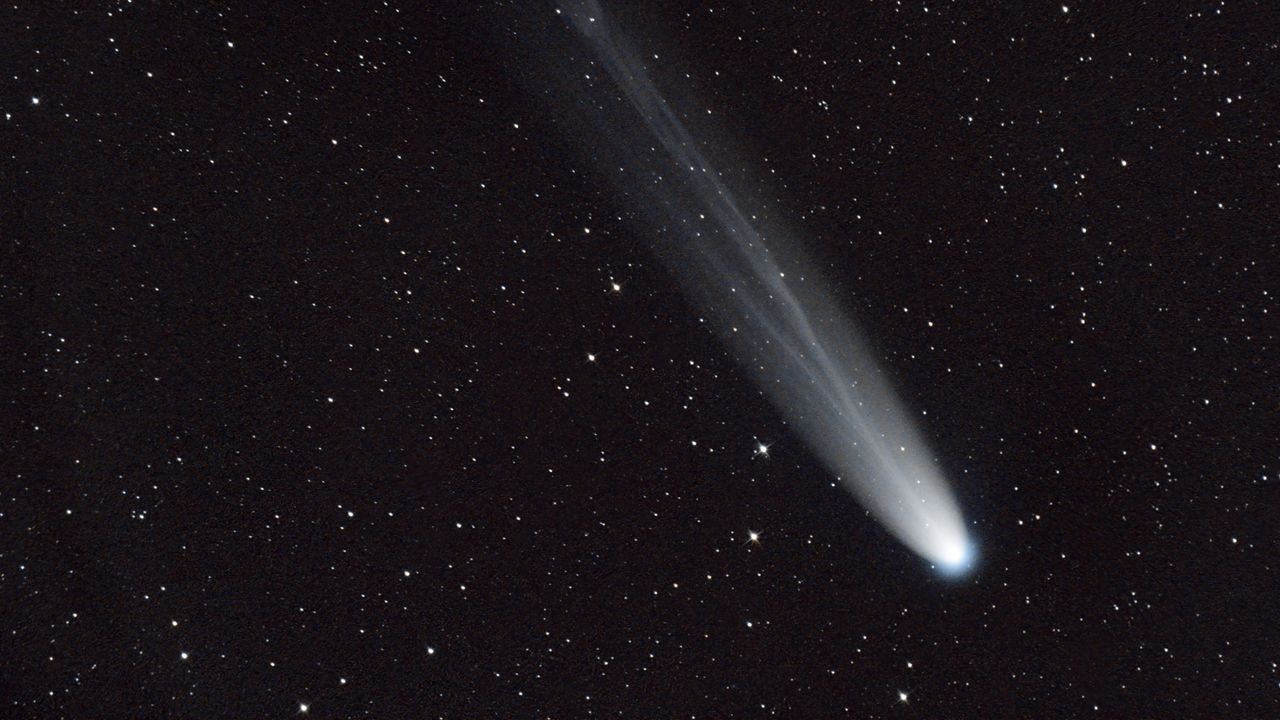
A streak of white across a dark starry night sky shows a comet moving toward the bottom right of the image.

A rare "sungrazer" comet is about to pass very close to our star and could become visible in daylight — or it could completely disintegrate before our eyes. Either way, there could be something special to see in the night sky, with a large tail potentially visible late this week.

Comet C/2026 A1 (MAPS) was discovered Jan. 13 by French astronomers at the AMACS1 Observatory in Chile. Although the comet was initially thought to have a nucleus measuring around 1.5 miles (2.4 kilometers) wide, astronomers later reduced the estimate to under 0.25 miles (0.4 km) based on James Webb Space Telescope observations taken in February.

C/2026 A1 (MAPS) belongs to a special family of comets called Kreutz "sungrazers," so called because they get very close to the sun, lighting up brightly but often breaking into smaller pieces. There are around 3,500 members of the Kreutz family, all of which are thought to be fragments of a single giant comet that got too close to the sun about 1,700 years ago, according to Live Science's sister site Space.com.

C/2026 A1 (MAPS) is expected to get within 98,000 miles (158,000 km) of the sun's surface and pass through the lower regions of the sun's outer atmosphere, or corona, at 9:30 a.m. EDT (13:30 UTC) Saturday (April 4), according to the British Astronomical Association (BAA). According to the European Space Agency, many Kreutz sungrazers evaporate, but if they survive, they could put on a spectacular show.

Because C/2026 A1 (MAPS) is traveling into the sun's glare, it will be difficult to see before April 4. If it survives its close encounter with the sun — even if it fragments — it could become visible for a short time after sunset in the evenings that follow. Unless it breaks apart before it gets close to the sun, there will be a possibility of seeing a potentially large and bright tail in the western evening sky starting around April 9, according to the BAA.

If that occurs, Comet C/2026 A1 (MAPS) will be the first of two comets visible in April, with the likely dimmer but more predictable C/2025 R3 (PanSTARRS) set to become an easy binocular target close to April 20.

Sign up to read this article
Read news from 100's of titles, curated specifically for you.
Already a member? Sign in here
Related Stories
Top stories on inkl right now
Our Picks
Fourteen days free
Download the app
One app. One membership.
100+ trusted global sources.