
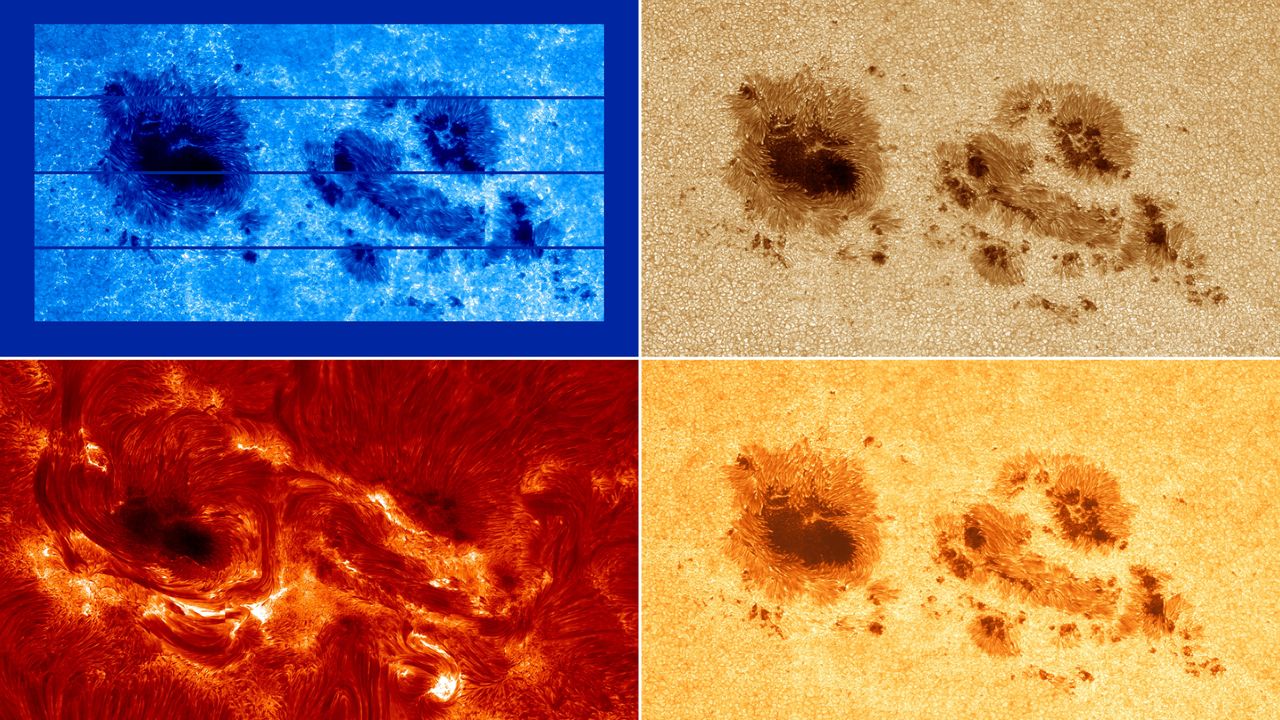
In early November, a series of powerful X-class solar flares triggered coronal mass ejections that resulted in an astonishing auroral display for viewers as far south as Mexico. But for some solar scientists, the real excitement wasn't the northern lights — it was a series of high-definition images of the solar activity.
Using the GREGOR solar telescope at the Teide Observatory in Tenerife, Spain, researchers observed the emission of two X-class solar flares from the sunspots in active region NOAA 14274, one on Nov. 10 and another on Nov. 11. Capturing such events with a ground-based telescope is rare.
"Strong flares occur either on the backside of the sun, or during the night, or when the weather is cloudy, or when the seeing conditions are poor, or when they are just outside the field of view, where the telescope is pointing," Prof. Carsten Denker of the Leibniz Institute for Astrophysics Potsdam (AIP) said in a statement. Denker served as lead author of a study on the research.
GREGOR's high-resolution FAST IMAGER happened to scan the sunspots in active region NOAA 14274 just 30 minutes before the emission of an X1.2 solar flare, giving researchers an unprecedented view of the flare's precursors within the sunspots. The area it imaged spanned about 110,000 miles by 70,000 miles (about 175,000 km by 110,000 km).
"The penumbral fibrils, which typically extend radially from the dark umbral core, were strongly curved and braided," said Dr. Meetu Verma, solar scientist at AIP and co-author of the study. That demonstrates a highly stressed magnetic field, a prime environment for an explosive release — and that's exactly what happened.
More GREGOR images are forthcoming. Throughout the month of November, the telescope produced nearly 40,000 datasets that are currently being processed and analyzed. And hopefully, those will reveal even more information about the sun.
A study on the images was published in the journal Research Notes of the AAS in November 2025.