
Get all your news in one place.
100’s of premium titles.
One app.
Start reading
LiveScience
LiveScience
Kristina Killgrove

Rare 2,000-year-old war trumpet, possibly linked to Celtic queen Boudica, discovered in England

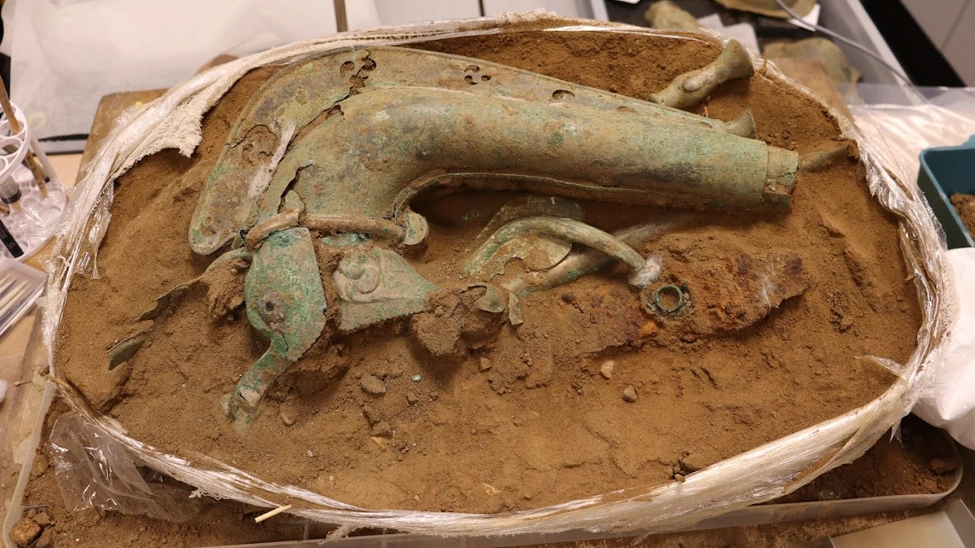
A curved bronze object with a green patina rests in a circle of reddish brown dirt.

Archaeologists have recovered a rare 2,000-year-old war trumpet in England that may have been used in Queen Boudica's wars against the Romans. The battle trumpet, also known as a carnyx, was part of a hoard of metal artifacts discovered ahead of residential construction in West Norfolk last year.

The hoard was announced Wednesday (Jan. 7) by Pre-Construct Archaeology, the company that led the original excavation, and Historic England, the organization that is coordinating the research and conservation efforts.

Artifacts in the hoard include the nearly complete animal-headed battle trumpet; a boar-headed military standard, or a decorated pole that identified a group of soldiers; five shield bosses, or ornaments that decorated the center of shields; and other metal items. According to Pre-Construct Archaeology, "finds of this kind are exceptionally rare in Britain and across Europe."

Battle trumpets were used primarily by Celtic tribes in Iron Age Europe and were often taken by Roman soldiers as war trophies, according to representatives for Historic England. "This newly excavated example is one of only three known from Britain and is one of the most complete found in Europe," they said in a statement.

The carnyx was a bronze wind instrument similar to a trumpet, but it had an elongated, vertical shape that ended in an open-mouthed animal, such as a boar. It was a common part of Celtic soldiers' military gear, along with chain mail, shields and spears.

Experts at the National Museum of Scotland have created a replica of a carnyx that, when played by musician John Kenny, gives an impression of what the battle trumpet sounded like.

Excavators also found part of a bronze military standard shaped like a boar's head. (Image credit: © Norfolk Museums Service)

Given the estimated first-century-A.D. date of the metal hoard and its discovery in West Norfolk, the items may have been used by Celts who were attempting to resist the incursion of the Roman Empire.

In A.D. 60, Boudica (also spelled Boudicca), queen of the powerful Iceni tribe that was based in what is now Norfolk, led a revolt against the Romans. But Boudica and the Iceni were defeated, paving the way for the Roman rule of Britain.

The hoard was removed from the ground in a single block so that its contents could be investigated with X-ray imaging and CT scans before being carefully excavated in the lab. Research and conservation work are ongoing, and the discovery of the hoard will be featured in an upcoming episode of BBC Two's "Digging for Britain."

Roman Britain quiz: What do you know about the Empire's conquest of the British Isles?

Sign up to read this article
Read news from 100’s of titles, curated specifically for you.
Already a member? Sign in here
Related Stories
Top stories on inkl right now
One subscription that gives you access to news from hundreds of sites
Already a member? Sign in here
Our Picks
Fourteen days free
Download the app
One app. One membership.
100+ trusted global sources.