Get all your news in one place.
100's of premium titles.
One app.
Start reading
Sports Illustrated
Sports Illustrated
Sport
Dan Lyons, Patrick Andres & Tim Capurso

Ranking the 25 Greatest College Football Teams of All Time

The first college football game took place on Nov. 6, 1869. Rutgers and Princeton faced off in New Brunswick, N.J., just four years and 211 days removed from the end of the Civil War about 400 miles to the southwest in Appomattox, Va. The sport has grown with the country in the more than 150 years since, and the modern game barely resembles that which the Tigers and Queensmen contested—or even the popular game throughout the nation in the 1940s, when Notre Dame and the service academies dominated the landscape, or the 1960s and ’70s, when many of the powerhouses we know today cemented their footholds in the sport.

For decades, the sport was primarily played on the ground—and while some programs still seem to be warming up to the downfield pass, the spread offenses of the 2000s and 2010s are virtually unrecognizable from the wishbone and Wing T offenses of old (though today’s top offensive minds have been marrying concepts from all of the above).
Comparing the greatest teams from the early 1900s and the 2020s is difficult for myriad reasons, beyond style of play. Linemen in the sport’s early days were the size of wide receivers now—and not necessarily big modern receivers. And most impactfully, the sport didn’t fully integrate until the 1970s.

That won’t stop us from trying, though. Sports Illustrated’s college football staff surveyed the sport’s history, comparing and contrasting the great teams that played from its humble beginnings to last year’s incredible 16–0 Indiana club, and the many decades in between, to bring you the 25 greatest teams of all time.

25. 1924 Notre Dame Fighting Irish (10–0)

On the 18th day of October 1924, the grandson of a Confederate soldier invented Notre Dame football.

Well, not literally—the Fighting Irish had been in the football business for decades when sportswriter Grantland Rice sat down at his typewriter at New York City’s Polo Grounds. Coach Knute Rockne had steered the team to undefeated seasons, plural. But Notre Dame was still playing home games at cozy Cartier Field (capacity: in the 20,000s) when it beat Army 13–7 in ’24, and Rice (as he was wont to do) decided to show off his classics B.A.

“Outlined against a blue-gray October sky the Four Horsemen rode again,” he wrote. “In dramatic lore they are known as famine, pestilence, destruction and death. These are only aliases.”

The Horsemen in question, as Rice proceeded to sketch out, were Fighting Irish halfback Jim Crowley, fullback Elmer Layden, halfback Don Miller and quarterback Harry Stuhldreher. All but Miller were consensus All-Americans, all were recognized across the country as spectacular, and their publicity photo atop four local horses still adorns Notre Dame bars from coast to coast.

The “Four Horsemen” from the 1924 Notre Dame Fighting Irish.
Notre Dame stars Don Miller, Elmer Layden, Jim Crowley and Harry Stuhldrehr, who were named the “Four Horsemen” by legendary sportswriter Grantland Rice after a win over Army. | Courtesy of Library of Congress

The Fighting Irish dominated their 1924 schedule, a fact almost incidental to their legend. They beat strong Princeton and Nebraska teams by double digits, and they also won the Rose Bowl (which they haven’t done since) over Stanford. The only team aside from the Cadets to keep Notre Dame within single digits was Northwestern, a 13–6 loser on Nov. 22.

That team is not only one of the finest pre-AP poll teams, but almost certainly the most influential. The Four Horsemen acted as a force multiplier to the Fighting Irish’s already growing national profile under Rockne, and by the end of the decade Notre Dame had a reputation it has never relinquished: a program with a strong American Catholic identity, beloved by millions who’ve never set foot in Michiana and loathed by many in equal measure. —Patrick Andres

24. 2009 Alabama Crimson Tide (14–0)

On Nov. 17, 2007, in the 11th game of his tenure at Alabama, Nick Saban’s Crimson Tide fell to Louisiana-Monroe, 21–14. They’d follow that contest, the spot on the schedule typically reserved for SEC teams to play easy warmup games before rivalry week, with a loss to Auburn in Saban’s first Iron Bowl. After an Independence Bowl win over Colorado, Saban’s first Alabama team finished 7–6.

It wasn’t an overly concerning first year for Saban in Tuscaloosa, but it also wasn’t a start that seemed to foretell the defining dynasty of the next decade. In 2008, the Crimson Tide went 12–2, posting an undefeated regular season before losing to Urban Meyer’s Florida in the SEC championship game and an upstart Utah team in the Sugar Bowl.

Even so, the corner had been turned, and the following year, Saban laid the groundwork for college football’s most recent dynasty. The defense led the way, with stars like Butkus Award winner Rolando McClain and All-Americans Javier Arenas, Terrence Cody and Mark Barron allowing just 11.7 points per game against a schedule that featured four top-10 opponents.

On the offensive end, quarterback Greg McElroy was the kind of steady hand under center that thrived in the early Saban years, with one of the greatest weapons in program history, Julio Jones, on the outside, and Mark Ingram II in the backfield. Ingram exploded for 1,678 yards rushing and 17 touchdowns, winning what was amazingly the first Heisman Trophy in Alabama history.

The Tide opened the season ranked No. 5 in the AP poll, and had a statement win against Virginia Tech in Atlanta, 34–24. The first significant test came on the Third Saturday in October, when Alabama survived a 12–10 slugfest against a mediocre Tennessee team thanks to a pair of blocked field goals by Cody in the fourth quarter. Two weeks later, the Tide took down Saban’s former club, LSU, 24–15 behind 144 yards rushing by Ingram and 102 yars receiving by Jones, 73 of which came on a screen pass the future NFL star took to the house. That win clinched a spot in the SEC championship game, and Alabama got its revenge on Meyer’s Gators when McElroy outdueled Florida superstar Tim Tebow in a 32–13 win.

The BCS pitted the No. 1 Crimson Tide against No. 2 Texas for the national title, a titanic showdown that was unfortunately diminished by an early injury to Longhorns star QB Colt McCoy after a hit from Marcell Dareus. Texas put forth a valiant effort with freshman Garrett Gilbert under center, but a 24-point second quarter for Alabama put the game out of reach. With the win, the Tide captured their eighth national title, their ninth undefeated season and officially became the sport’s standard bearer for the rest of Saban’s legendary career. —Dan Lyons

NEXT: Ranking the 50 Best College Football Players of All Time

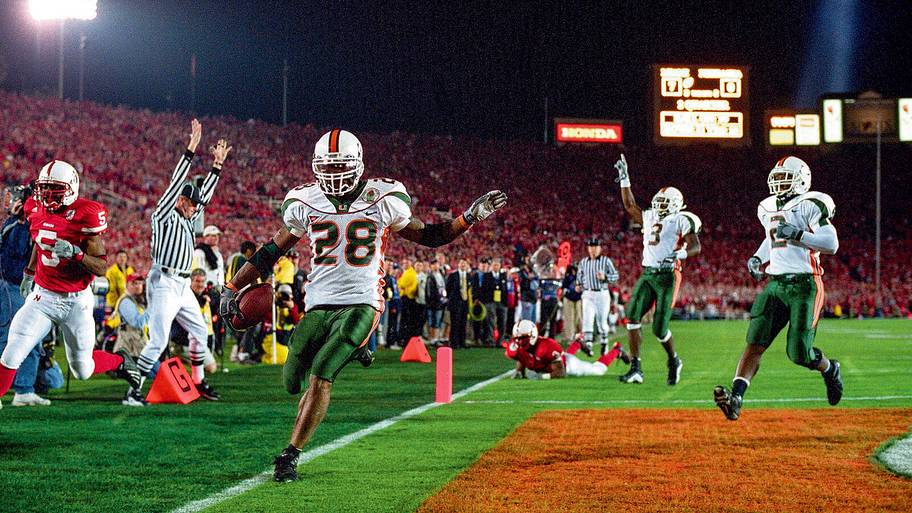
23. 1987 Miami Hurricanes (12–0)

Howard Schnellenberger put Miami football on the map, taking over a Hurricanes program that the school had considered dropping in 1979 and leading it to its first national championship in just his fifth year. When Schnellenberger departed The U following that title, he was replaced by Oklahoma State coach Jimmy Johnson, a man with a relatively underwhelming 29-25-3 career record and a single bowl win to his name.

Where Schnellenberger brought the school from the sport’s doldrums into the national spotlight, Johnson turned it into a lasting power—though success didn’t come overnight. Johnson’s first team, the 1984 Canes, went 8–5 with a Fiesta Bowl loss. Miami won 10 games each of the next two years but fell short in the Sugar and Fiesta Bowls, the latter of which came in a de facto national championship game against Penn State—the top two, undefeated teams in the country.

It was natural to expect some regression from that Canes team to the 1987 edition. Heisman-winning quarterback Vinny Testaverde became the No. 1 pick in the NFL draft, and was joined by six other Miami players, including fellow top-10 picks running back Alonzo Highsmith (No. 3) and defensive tackle Jerome Brown (No. 9). Instead, Johnson fielded one of the greatest defenses in the sport’s history and finally put it all together to run out to a 12–0 record and national title.

That run included one of the great games in program history against archrival Florida State.

After dispatching No. 20 Florida and No. 10 Arkansas by a combined score of 82–11 to start the season, Miami traveled to Tallahassee for a date with the No. 4 Seminoles, while the Canes were ranked one spot higher in that week’s AP poll. Bobby Bowden’s team leaped out to a 19–3 lead which it took into the final minute of the third quarter, though the margin could have been bigger, if not for a pair of missed field goals and an extra point by kicker Derek Schmidt.

Sophomore quarterback Steve Walsh shook off a quiet start against Deion Sanders and a stacked FSU defense, finding Melvin Bratton and Michael Irvin for touchdowns, along with a pair of successful two-point conversions. With 2:32 left in regulation, Irvin, a first-team All-American a year prior, split two defenders and took the top off the Seminoles’ defense and Walsh hit him in stride for a 74-yard go-ahead score.

View this post on Instagram
Sign up to read this article
Read news from 100's of titles, curated specifically for you.
Already a member? Sign in here
Related Stories
Top stories on inkl right now
One subscription that gives you access to news from hundreds of sites
Already a member? Sign in here
Our Picks
Fourteen days free
Download the app
One app. One membership.
100+ trusted global sources.