
Get all your news in one place.
100's of premium titles.
One app.
Start reading
The Conversation
The Conversation
Aman Agrawal, Postdoctoral Scholar in Chemical Engineering, University of Chicago Pritzker School of Molecular Engineering

Rain may have helped form the first cells, kick-starting life as we know it

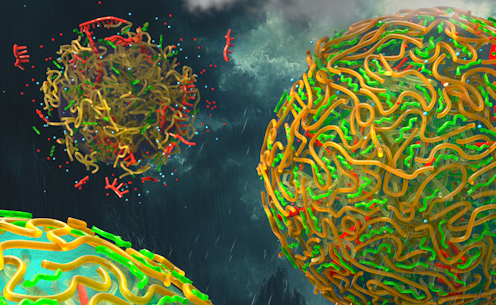
How did early cells keep themselves distinct while allowing for some amount of exchange? UChicago Pritzker School of Molecular Engineering/Peter Allen, Second Bay Studios, CC BY-ND

Billions of years of evolution have made modern cells incredibly complex. Inside cells are small compartments called organelles that perform specific functions essential for the cell’s survival and operation. For instance, the nucleus stores genetic material, and mitochondria produce energy.

Another essential part of a cell is the membrane that encloses it. Proteins embedded on the surface of the membrane control the movement of substances in and out of the cell. This sophisticated membrane structure allowed for the complexity of life as we know it. But how did the earliest, simplest cells hold it all together before elaborate membrane structures evolved?

Sign up to read this article
Read news from 100's of titles, curated specifically for you.
Already a member? Sign in here
Related Stories
Top stories on inkl right now
One subscription that gives you access to news from hundreds of sites
Already a member? Sign in here
Our Picks
Fourteen days free
Download the app
One app. One membership.
100+ trusted global sources.







