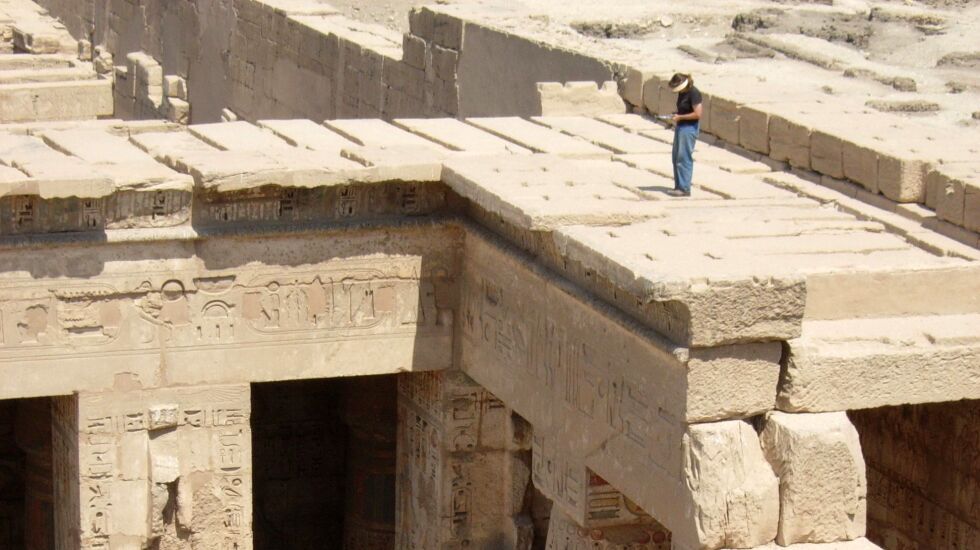
For 100 years, University of Chicago researchers have been traveling to the ancient Egyptian temple complex of Medinet Habu near the banks of the Nile River. They take photographs, make drawings of each hieroglyphic and relief carving — thousands of them. Now, they are in a race against time to preserve history as global warming and seeping groundwater from nearby farms threaten to destroy it. Here, Christina Di Cerbo copies an inscription on the roof of Medinet Habu. | Ray Johnson. (Ray Johnson)
It has stood near the banks of the Nile River for 3,000 years, its colossal stones baking in heat that reaches 122 degrees Fahrenheit, this ancient temple that sits on a desert plain, uninhabited for much of its history but for the slither of a viper or skitter of a scorpion.
On its walls, Ramses III looms above kneeling foes, one royal arm raised in preparation to smite his enemies. There is a gruesome inventory chiseled into the sandstone of the severed hands and genitalia of the defeated.
Sign up to read this article
Read news from 100's of titles, curated specifically for you.