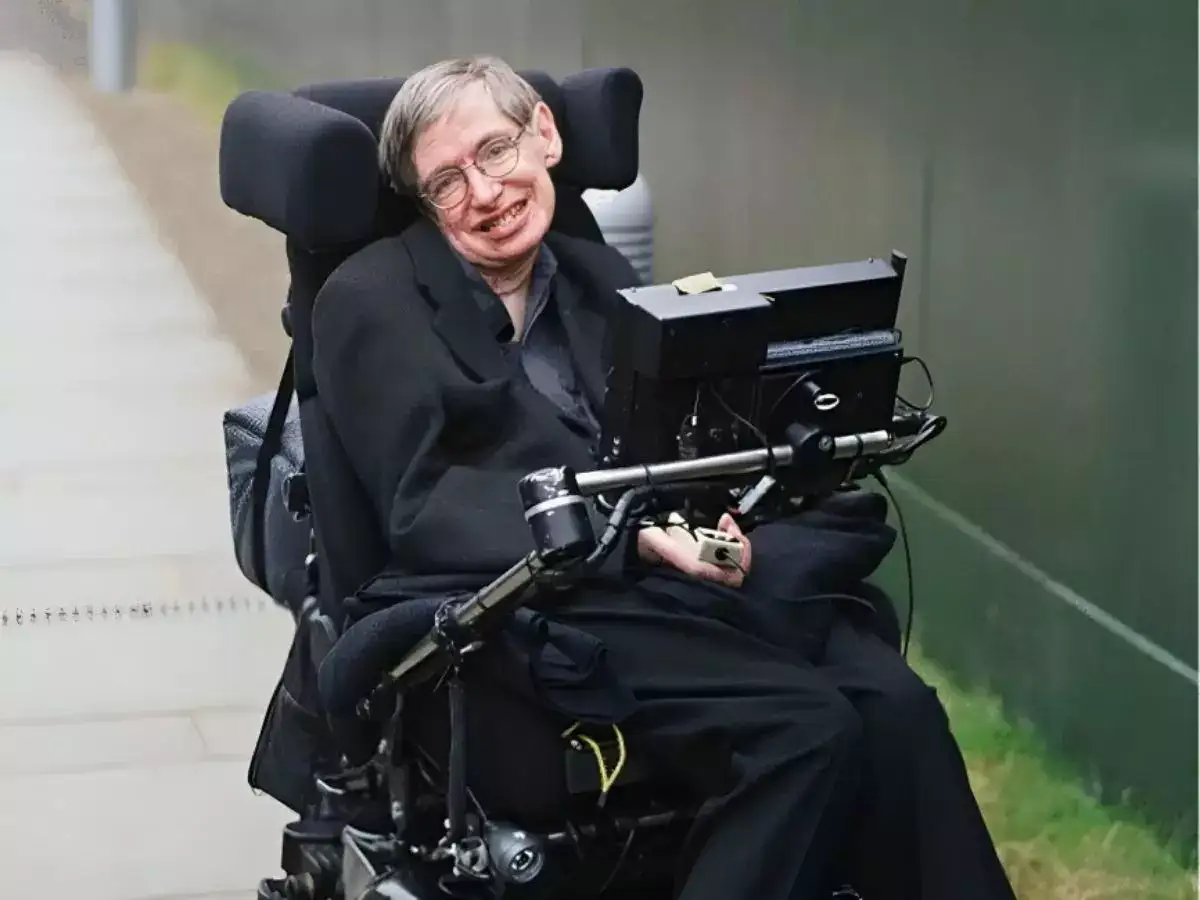
Are we alone? And if so, are we the most intelligent species?
These questions have been asked for a long time now, and nobody has any answers yet. The puzzle of life outside Earth has been, and is still being, probed by scientists and intellectuals.

While the debate continues, one of the most notable scientists of all time, Stephen Hawking, once explained why humankind is special. Hawking said: "We are just an advanced breed of monkeys on a minor planet of a very average star. But we can understand the Universe. That makes us something very special."
Stephen Hawking's Quote and Its Meaning
This quote works in two moves — first it deflates human self-importance, then it rebuilds it on different grounds.
"Advanced breed of monkeys" is a deliberately blunt way of saying humans aren't some separate, exalted category of being — we're animals, products of ordinary evolution, no more cosmically privileged than any other species. "A minor planet of a very average star" does the same thing to our sense of place: Earth isn't the center of anything, and our Sun is just one unremarkable star among hundreds of billions in an unremarkable galaxy. This echoes what's sometimes called the Copernican principle — the idea that humans occupy no special position in the universe, physically or biologically.
After stripping away those old sources of self-importance (special creation, special location), Hawking replaces them with something he considers more legitimate: comprehension itself. Despite being biologically unremarkable and cosmically insignificant in scale, we've figured out how to model black holes, trace the universe back to the Big Bang, and predict the behavior of atoms — using brains that evolved to help us find food and avoid predators. That gap between our humble origins and our explanatory reach is what he's calling special.
So the sentence isn't really about monkeys or stars — it's an argument about where human dignity should come from. Not from imagining we're at the center of creation, but from the fact that creatures this ordinary managed to understand the extraordinary.
It also fits Hawking's broader public stance: he thought this kind of clear-eyed humility — no cosmic favoritism, no assumption we're unique or untouchable — was actually the more accurate and more remarkable story, and part of why he pushed back against, say, complacency about existential risks or overconfidence about our place among possible alien civilizations.
All About Stephen Hawking
Stephen Hawking was one of the most influential theoretical physicists of the modern era. Known for his work on black holes, cosmology, and the origins of the universe, Hawking also became one of the world's best-known science communicators.
Stephen William Hawking was born on January 8, 1942, in Oxford, England, exactly 300 years after the death of astronomer Galileo Galilei. He grew up in a family with a strong academic background and later studied physics at the University of Oxford. He then went on to Cambridge University for postgraduate research in cosmology.
While at Cambridge, Hawking was diagnosed with amyotrophic lateral sclerosis (ALS) at the age of 21. Doctors initially gave him only a few years to live. The disease gradually affected his ability to move and speak, but Hawking continued his scientific work for decades.
His research transformed scientists' understanding of black holes. In the 1970s, he showed that black holes are not completely black. Because of quantum effects near the event horizon, they can emit thermal radiation — a phenomenon now known as Hawking radiation. This discovery connected ideas from quantum mechanics, gravity, and thermodynamics, and raised profound questions about what happens to information in a black hole.
Hawking also worked extensively on the origin and structure of the universe. Along with physicist Roger Penrose, he demonstrated that Einstein's general theory of relativity implies that the universe could have begun from a singularity under certain conditions.
His scientific achievements were matched by his ability to explain complicated ideas to ordinary readers. His 1988 book A Brief History of Time became an international bestseller, selling millions of copies and introducing subjects such as the Big Bang, black holes, relativity, and the nature of time to a mass audience.
Hawking communicated using a computer-based speech system after he lost the ability to speak naturally. As his physical condition deteriorated, technology allowed him to continue lecturing, writing, and communicating with scientists and the public.
Despite his severe physical limitations, Hawking maintained a remarkably active public life. He appeared in documentaries and popular television programmes and became a cultural icon. His life was also depicted in the 2014 film The Theory of Everything , based on the memoir of his former wife, Jane Hawking.
Hawking held the prestigious position of Lucasian Professor of Mathematics at Cambridge University from 1979 until 2009. The position had previously been held by Isaac Newton.
He received numerous honours during his career, although he never received the Nobel Prize. His contributions to theoretical physics, particularly his work on black holes and cosmology, remain enormously influential.
Stephen Hawking died on March 14, 2018, at his home in Cambridge, aged 76. His death occurred on Pi Day, a date associated with the mathematical constant π, and also the birthday of Albert Einstein.