Get all your news in one place.
100's of premium titles.
One app.
Start reading
The Economic Times
The Economic Times

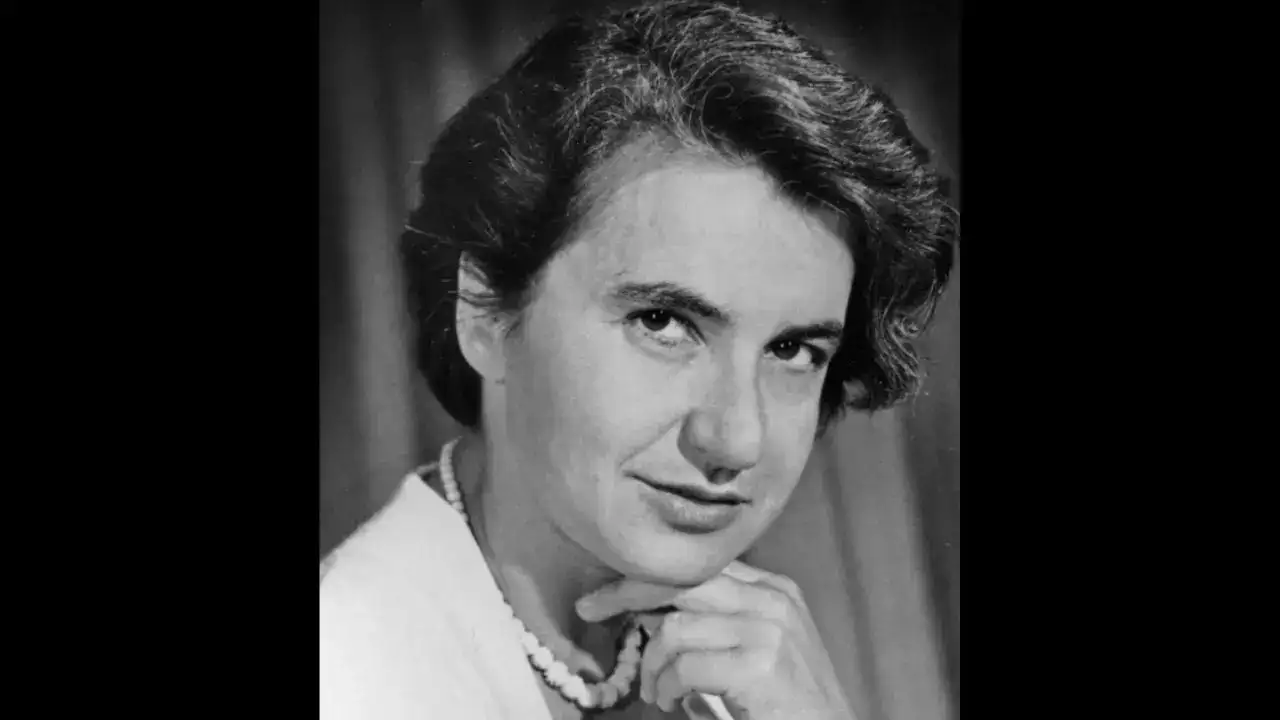
Quote of the Day by Rosalind Franklin: 'Your faith rests on the future of yourself and others as individuals, mine in the…' – Inspiring lessons on purpose, legacy, faith and why living for something bigger than yourself matters, from the unsung DNA hero

Quote of the Day by Rosalind Franklin: Purpose and legacy are questions almost everyone eventually faces, whether through work, family, or personal belief. Franklin's quote comes from a personal letter where she was defending her own worldview against a more traditional idea of faith centered on individual salvation. Instead of measuring meaning by what happens to her personally, she measured it by what happens to humanity after she's gone.

Her sharp, unflinching line, "Your faith rests on the future of yourself and others as individuals, mine in the future and fate of our successors. It seems to me that yours is the more selfish," reflects a mindset rare even among great thinkers. In a world where personal ambition, self-improvement, and individual achievement dominate most conversations about purpose, Franklin's words offer a different lens. They ask you to consider what you're actually building for, and who benefits from it after you're no longer the one benefiting.

Quote of the Day Today: Rosalind Franklin on purpose, legacy, faith and selflessness

Quote of the Day by Rosalind Franklin: "Your faith rests on the future of yourself and others as individuals, mine in the future and fate of our successors. It seems to me that yours is the more selfish," from a personal letter to her father, as per Goodreads.

Meaning of Rosalind Franklin's Quote About Faith and Legacy

Franklin's quote draws a clear line between two different kinds of belief. One kind centers on individuals, their own future, their own continuation, their own reward. The other centers on the collective future, on what gets passed forward to people who will never even know your name. Franklin is arguing that the second kind, the one focused on humanity's progress rather than personal continuity, is actually the less self-centered of the two.

The deeper meaning goes beyond religion. It applies to how anyone chooses to spend their time and effort. Do you work, create, or contribute mainly for what it gives you now, or for what it leaves behind for others later. Franklin's own life answered that question clearly. Her research on DNA, viruses, and coal wasn't chasing personal glory. It was careful, exacting work aimed at understanding something true, regardless of whether she'd be the one remembered for it.

Why Living for the Future Matters

Living for something beyond yourself matters because it changes how you measure success. When personal gain is the only goal, effort tends to stop the moment the reward arrives. But when the goal is the future itself, whether that's scientific progress, a family's wellbeing, or a community's growth, the work becomes something you sustain even without immediate personal payoff. That kind of purpose tends to outlast motivation, outlast recognition, and outlast the person who started it. It's also, often, quietly selfless. You may never see the full benefit of what you contribute. Someone else does. Franklin's own story makes that point without needing to say it directly, since the credit for the discovery she helped make possible was, for decades, given to others.

Early Life of Rosalind Franklin

Rosalind Elsie Franklin was born on July 25, 1920, in London, England, into a politically engaged, intellectually active family. Her father taught evening classes at the Working Men's College and later became its vice principal, and her family was closely involved in supporting Jewish refugees fleeing Nazi Europe. From an early age, Franklin showed a sharp aptitude for logic and numbers, reportedly doing arithmetic for pleasure as a young child.

Education and Wartime Work

Franklin attended St. Paul's Girls' School before studying physical chemistry at Newnham College, University of Cambridge, graduating in 1941. The outbreak of World War II reshaped her path. She served as a London air raid warden and in 1942 gave up a Cambridge research fellowship to work for the British Coal Utilisation Research Association, studying the physical chemistry of coal for the war effort. That research became the basis of her doctoral thesis, and she earned her PhD from Cambridge in 1945.

Breakthrough Research on DNA

From 1947 to 1950, Franklin studied X-ray diffraction technology in Paris under Jacques Méring, work that later proved valuable to the coking industry through her research on graphite formation in heated carbons. In 1951, she joined King's College London, where she applied X-ray diffraction methods to DNA. At a time when almost nothing was understood about the molecule's structure, Franklin determined its density and established that it existed in a helical form. Her precise X-ray images laid essential groundwork for James Watson and Francis Crick's 1953 proposal that DNA takes the shape of a double helix.

A Legacy Recognized Too Late

Franklin's contribution to the discovery of DNA's structure went largely unrecognized during her lifetime, and credit was mostly attributed to Watson, Crick, and Maurice Wilkins, who used her data without her direct involvement in the final announcement. From 1953 until her death, she worked at Birkbeck College, London, completing her coal research and beginning pioneering work on the tobacco mosaic virus, helping lay the foundation for structural virology. Franklin died of ovarian cancer on April 16, 1958, at just 37 years old, years before the full scale of her contribution was properly acknowledged.

Life Lessons from Rosalind Franklin's Famous Quote

Franklin's quote teaches that purpose doesn't have to be measured by personal reward. Some of the most meaningful work is the kind whose benefits arrive after you're no longer there to receive them. It challenges the instinct to make everything about individual outcome, and instead asks what you're contributing to a future you may never personally see. Franklin lived this out through science that mattered more to future generations than to her own recognition in her lifetime.

Why This Quote Still Matters Today

This quote still matters because the tension it describes, between personal gain and collective progress, hasn't gone away. Modern life often rewards visibility, personal branding, and immediate results over quiet, long-term contribution. Franklin's words are a reminder that some of the most important work is the kind that benefits people who will never know who did it. Her own scientific legacy, only fully appreciated decades later, is proof that lasting impact doesn't always announce itself right away.

Rosalind Franklin's quote reflects a rare kind of clarity about purpose. She measured meaning not by what she would personally gain, but by what would remain for those who came after her. Her life's work, quietly foundational to one of science's greatest discoveries, is the clearest proof that her words were more than belief. They were how she chose to live.

Sign up to read this article
Read news from 100's of titles, curated specifically for you.
Already a member? Sign in here
Related Stories
Top stories on inkl right now
One subscription that gives you access to news from hundreds of sites
Already a member? Sign in here
Our Picks
Fourteen days free
Download the app
One app. One membership.
100+ trusted global sources.