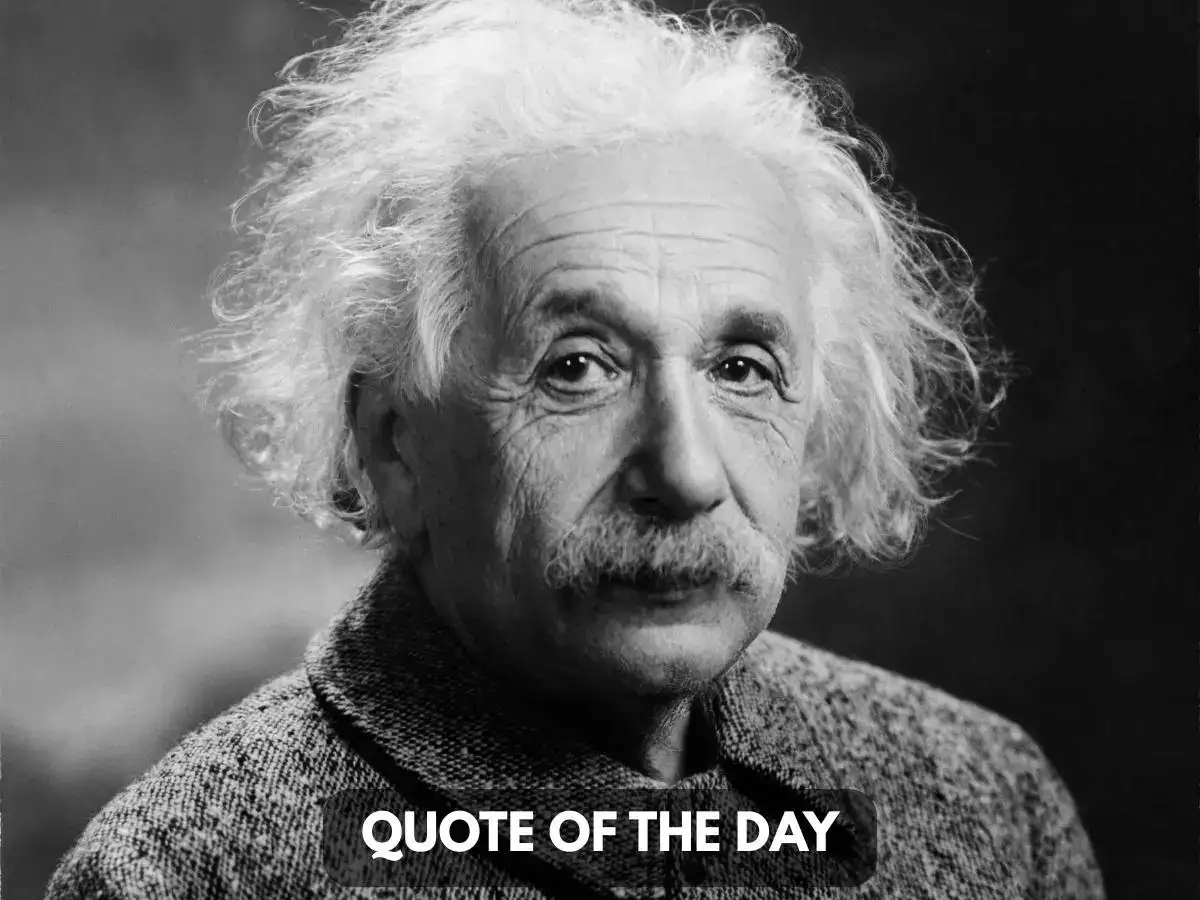
War, injustice, hatred and violence have shaped human history for centuries, but some of the world’s greatest thinkers believed that evil survives not only because of those who commit harmful acts, but also because of the silence surrounding them. Few people expressed that idea more clearly than Albert Einstein, whose words continue to resonate long after his scientific discoveries transformed the modern world.
Known globally as the face of genius, Einstein changed humanity’s understanding of space, time, gravity and the universe itself. But beyond science, he was also deeply concerned about morality, human responsibility and social justice. Decades later, one of his most widely shared quotes remains powerful because it speaks less about intelligence and more about courage.

Iconic quote by Albert Einstein
“The world is a dangerous place to live; not because of the people who are evil, but because of the people who don't do anything about it.”
For many people, the quote feels painfully relevant even today. It shifts attention away from villains and focuses instead on ordinary individuals who remain silent when faced with injustice, cruelty or wrongdoing.
That is what gives the quote its emotional weight. Einstein was not simply warning about evil people. He was warning about indifference. History repeatedly shows that destructive ideas often grow stronger when good people convince themselves that staying quiet is easier, safer or more convenient.
The quote continues to resonate because it reflects a difficult truth about human behaviour. Many people believe morality is defined only by the harmful actions they avoid personally committing. But Einstein suggests that inaction can also carry consequences. Looking away, remaining silent or refusing to intervene can sometimes allow damage to spread unchecked.
What does the quote teach us about responsibility and moral courage?
Einstein’s words challenge the comforting belief that neutrality is always harmless. In moments of crisis, silence itself can become a form of participation.
That lesson became especially meaningful during the political turmoil and violence that shaped much of Einstein’s lifetime. Born in Ulm in 1879, Einstein witnessed a world transformed by nationalism, war and rising extremism. As a Jewish scientist living through the rise of Nazi Germany, he understood how dangerous silence and unchecked hatred could become.
Although he is remembered primarily for revolutionary scientific theories like relativity, Einstein also spent much of his life speaking publicly about peace, human rights and global responsibility. He believed intelligence without humanity was dangerous. Scientific progress, in his view, meant little if society failed morally.
The quote also reflects a universal human tendency to avoid conflict. People often stay silent because they fear criticism, isolation or personal consequences. Others convince themselves that one individual cannot make a difference. But Einstein’s words suggest that collective silence is exactly what allows destructive behaviour to survive.
In many ways, the quote remains timeless because every generation faces moments where people must decide whether to speak up or stay comfortable.
Why does Albert Einstein’s message still matter today?
Einstein’s legacy extends far beyond equations and laboratories. He developed the theories of special and general relativity, reshaping modern physics and changing how humanity understands the universe. His famous formula, E=mc 2 became one of the most recognizable scientific expressions in history.
In 1921, Einstein received the Nobel Prize in Physics for his work on the photoelectric effect, a breakthrough that helped shape quantum theory. His discoveries later contributed to technologies people now use daily, including GPS systems, digital cameras and modern electronics.
Yet Einstein’s influence also came from his humanity. He was known not only for intellectual brilliance, but for humility, humour and moral conviction. He spoke openly against racism, militarism and political extremism, often using his public platform to encourage compassion and social responsibility.
As a child, Einstein became fascinated by invisible forces after seeing a compass needle move mysteriously in front of him. That curiosity eventually changed science forever. But quotes like this reveal another side of him — a man equally interested in the invisible moral forces shaping human society.
Today, his warning about silence continues spreading online because people still recognise its truth. Evil actions may begin with a few individuals, but they often grow stronger when others decide it is easier not to get involved.
That is why Einstein’s words remain powerful generations later. They remind people that responsibility is not limited to avoiding wrongdoing ourselves. Sometimes, it also means having the courage to refuse silence when silence becomes dangerous.