Les Wexner’s alleged note to Jeffrey Epstein marking his 50th birthday in 2003 included a hand-drawing of a woman’s breasts.
And yet today, the billionaire Wexner’s name and portrait sits front and center across Ohio’s most respected institution – the Ohio State University.
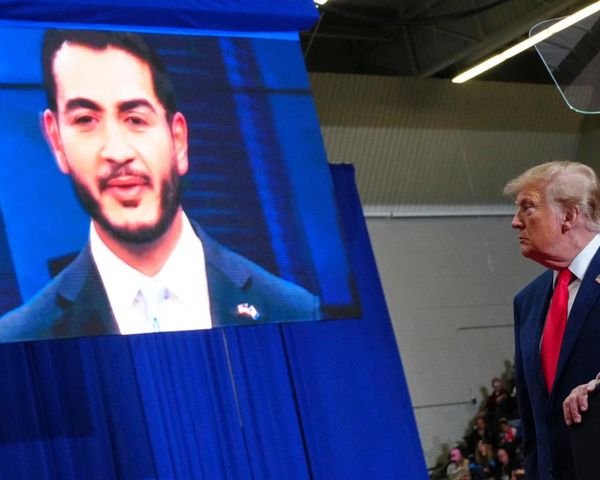
On the college’s sprawling campus north of downtown Columbus, there’s the Wexner Center for the Arts, the Ohio State University Wexner Medical Center, the Wexner Jewish Student Center and the Les Wexner Football Complex.
His name and image are also found across Ohio State University’s website, and the billionaire continues to serve as chair of the college’s Wexner Medical Center Board.
Born in Dayton in 1937, the son of a Russian Jewish immigrant father, Wexner is among the most important figures in the rise of convicted sex trafficker Jeffrey Epstein. The release last month of a trove of Epstein files by the Department of Justice saw at least a half-dozen photos of Wexner.
By granting Epstein power of attorney over much of his vast wealth in 1991, critics say Wexner played a key role in facilitating Epstein’s social standing and vast influence over powerful world leaders.
And with much of the Epstein database yet to be released, observers say more evidence of Wexner and Epstein’s close ties are likely to emerge in the weeks and months ahead.
All the while, Donald Trump’s relationship with Epstein lurks in the political background. With midterm elections on the horizon, and Trump’s base furious over the delay of the full release of the Epstein files, Democrats have accused the Trump administration of attempting to “cover up” the president’s ties to Epstein.
Trump says he cut ties with Epstein in 2007.
Wexner has denied any knowledge of Epstein’s abuse, and says he has cooperated with the FBI at every turn. Wexner has not been charged with any crime. The 88-year-old says he cut ties with Epstein in 2007, denies any knowledge of his crimes and claims Epstein stole millions of dollars from him. Despite his name appearing as a possible co-conspirator by the FBI in its investigations into Epstein in 2019, no charges were ever filed against Wexner.
However, just days before Epstein pleaded guilty in Florida to soliciting sex with a child in June 2008, Wexner emailed Epstein, offering his apologies for the situation he found himself in. “All I can say is I feel sorry,” Wexner wrote. “Always be careful.”
Today, Wexner is making national news: the California congressman Ro Khanna recently listed him as one of six previously redacted names in the Epstein trove, where the FBI appears to have named him as a co-conspirator. Wexner is set to be deposed in front of the oversight committee on Wednesday.
The model town that Epstein helped build, and a culture of silence
Back in the early 1990s, New Albany was a sleepy midwestern suburb, home to 1,600 people whose homes were dotted between vast corn and soybean fields. Columbus Monthly reported that in 1985, a candidate for the position of mayor of New Albany received 48 votes – and won the election.
Now, New Albany is a community of white-picket fences, private driveways and Georgian-style homes, whose most-famous resident, Wexner, has built a mini-empire. Wexner’s 340-acre estate boasts several mansions and state-of-the-art equestrian facilities. Even the homes bordering Wexner’s estate, built by the billionaire in the 90s, are hidden away behind locked gates.
Wexner’s estate is so opulent that it has fueled Instagram reels. The convicted sex trafficker and Epstein co-conspirator Ghislaine Maxwell remarked last year that it was “one of the biggest private homes I’ve ever been to”.
Across the road from Wexner’s home is one of the top-rated country clubs in the state, designed by Jack Nicklaus. Abercrombie & Fitch, the clothing brand once owned by Wexner, which courted controversy for selling thongs marketed at pre-teenage girls in 2002, is headquartered in New Albany. Along the city’s eastern fringes is a huge, under-construction semiconductor fabrication plant, plus datacenters owned by Google and Meta.
New Albany was also well-known to Epstein.
Epstein owned at least two properties in New Albany – a 3,500 sq ft home close to the country club that was sold to Wexner’s wife, Abigail, in 2007 for $0, and a palatial mansion hidden deep behind gates off East Dublin Granville Road and inside the Wexner estate, which county records show Epstein bought from a company owned by Wexner and others for $3.5m in 1992 and sold in 1998.
The same year, Epstein was named as a co-president of the New Albany Company, alongside Wexner.
It was at the latter residence that the artist Maria Farmer says she was sexually assaulted by Epstein.
Farmer, considered an up-and-coming artist in New York, was at the estate for several months during the summer of 1996. “She was serving as a, quote, artist-in-residence at the behest of Jeffrey Epstein,” Jennifer Freeman, Farmer’s lawyer, says.
During that time, in late July or early August, Farmer says Epstein and Maxwell sexually assaulted her.
Her attorney says she was kept captive for “many hours”.
“[F]or many days, Maria was physically threatened by a local sheriff and other persons connected with Wexner and prevented from leaving the New Albany property,” says a complaint filed last May by Farmer’s lawyers on her behalf against the US government for negligence.
The complaint also claims Farmer contacted the FBI to report that Epstein had sexually assaulted her, and that he and others were involved in the sexual exploitation and trafficking of minors. The complaint alleges that the FBI agent taking Farmer’s call in 1996 hung up on her, and no one from the agency ever attempted to follow up with her.
Farmer’s lawyer says she had no interactions with Wexner in New Albany during that time.
However, Virginia Giuffre, one of the most prominent victims of Epstein’s sex trafficking enterprise and who died by suicide last year, alleged that she was sexually trafficked to Wexner, along with others. It is something Wexner has denied: “Mr Wexner was unaware of, and was never a participant in, any of the abhorrent behavior engaged in by Epstein against Epstein’s victims,” Wexner’s attorneys wrote at the time the news emerged. “Mr Wexner never met Ms Giuffre … any claims to the contrary were not true.”
Tom Davies, a spokesperson for Wexner, told the Guardian: “Prior to the news coverage of Ms Farmer, Mr Wexner had no knowledge of her, never met her, never spoke with her, and never spoke with Mr Epstein or anyone else about her.”
In a 2019 statement by Wexner made to associates of L Brands, the company he founded and led until 2020, and shared with the Guardian by Davies, he wrote: “I would not have continued to work with any individual capable of such egregious, sickening behavior as has been reported about him.”
But evidence that has emerged suggests their relationship was close.
In the note Wexner gave to Epstein on the occasion of the latter’s 50th birthday in 2003, Wexner, above the drawing of the woman’s breasts, allegedly wrote: “I wanted to get you what you want … so here it is …”
Last July, Maxwell told the deputy US attorney general and colleagues that Epstein “ran New Albany”.
A number of New Albany residents and business owners approached by the Guardian declined to comment on Wexner and his ties to Epstein, or the former’s role in life in New Albany. Emails sent to the town’s mayor, Sloan Spalding, were not responded to.
Under Wexner’s governance, models at Victoria’s Secret claimed abuse and misogynic activity took place for years. A 2019 Hulu documentary claimed the company ran campaigns in the early 2000s that specifically targeted teenage girls. In 2020, L Brands, which owned Victoria’s Secret at the time, issued a statement to the New York Times that expressed “regret” without disputing the claims. Wexner has even been the subject of a 2022 pop song, referred to as “an old man who lives in Ohio, making money off of girls like me”.
Columbus, a 20-minute drive west of New Albany, has been Wexner’s town for decades.
In 1985, he was a founding member of the Ohio University Foundation. By 2002, he and others established the Columbus Partnership, on paper a non-profit but which today represents large businesses that courted controversy for allegedly steering millions of dollars in state funding, alongside longtime friend and New Albany developer Jack Kessler. Its executive committee is a who’s who of some of the most powerful corporate names in the region. The Guardian has contacted the Columbus Partnership for comment.
Ohio State faces controversy over Wexner ties
For decades, Wexner has loomed large over the Ohio State University’s community, which enrolls more than 80,000 students from more than 100 countries every year.
The college is a cornerstone economic powerhouse in Ohio, employing more than 53,000 people. But like other colleges, it’s facing increasing challenges.
Enrollment has fallen by several thousand students since 2019. At the beginning of the current academic year, the university recorded the biggest fall in the number of first-year students in its 155-year history. Since freshmen are required to live in campus accommodation – a source of millions of dollars for the university – a significant decline in enrollment could undermine its wider finances, making it more reliant on support from donors such as Wexner, who graduated from Ohio State in 1959.
Wexner and his Limited Brands Foundation have donated hundreds of millions of dollars to Ohio State over the decades.
But now the money it’s been taking from Wexner risks its reputation as it simultaneously deals with a decades-old sexual abuse scandal.
Former students at Ohio State are suing the university for 177 counts of alleged sexual abuse by a former college employee, Richard Strauss, a medical doctor who worked there for decades until the 1990s, a time when Wexner served on the university’s board.
For months, former student athletes have been attempting to subpoena Wexner to appear in court to investigate what role – if any – the billionaire played in Strauss’s employment. However, until now, Wexner’s private security has allegedly prevented any delivery of subpoena documents to him. Even the Franklin county sheriff’s office failed on two occasions to have documents delivered to Wexner’s address.
In December, lawyers for the university even contested a motion by a group called Survivors of OSU that has called for Wexner to be deposed.
But Wexner’s close ties to Epstein and Ohio State have fueled a groundswell of criticism of the college.
“The connection between Epstein and Wexner is undeniable. It does not give a good look to OSU. At the very least we, as representatives, should be calling on the institution to further investigate Les Wexner and his connection to Epstein,” says state representative Munira Abdullahi, whose district includes New Albany.
“Wexner is a big part of that town. First of all, we want to know: where is Wexner? He has not come and testified. People want to hear. It brings bad press to the town. People want accountability.”
A university review into donations by Ohio State published in 2020 found that Epstein and his foundation had donated hundreds of thousands of dollars to the university years earlier. Millions of dollars more were donated by Wexner through Epstein to the university. Ohio State officials say that $336,000 received by Epstein and the J Epstein Foundation was thereafter donated to the state of Ohio’s human trafficking fund.
Several state representatives, including Abdullahi, are set to hold a press conference on 24 February calling for the removal of Wexner’s name from OSU facilities. The university’s website, however, notes that: “Removing a naming designation is a serious step that will only occur under exceptional and narrow circumstances.”
It recently declined a request to have his name removed from a football practice facility.
Thus far, the university has paid out more than $60m to 296 Strauss survivors, according to a university spokesperson, Ben Johnson.
“Since 2018, Ohio State has sincerely and persistently tried to reconcile with survivors [of Strauss’ abuse] through monetary and non-monetary means,” says Johnson, adding that all male students who filed lawsuits have been offered the opportunity to settle.
“The remaining plaintiffs elected to continue litigation, and it is important that we allow the legal process to proceed.”
All the while, Ohio State will open its new, 26-story, state-of-the-art University Hospital facility on the college’s main campus this month.
Its top three floors is a maternity ward that the university claims will offer “breathtaking views”.
A few dozen feet overhead, in large white print, Wexner’s name appears above all others.