
Get all your news in one place.
100's of premium titles.
One app.
Start reading
The Conversation
The Conversation
Partha Nandi, Postdoc Fellow, Stellenbosch University

Quantum effects make distant objects move together: new research finds this may happen with ripples in space

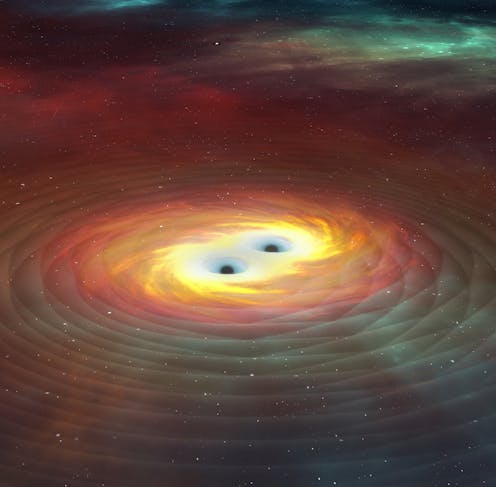
An illustration of two black holes orbiting each other. Eventually they will merge, producing gravitational waves. Mark Garlick/Science Photo Library/Getty Images

Galaxies, planets, black holes: to most people, everything about our Universe sounds and feels enormous. But while it’s true that much of what happens millions of light years away is large, there are also processes happening at the quantum end of the scale. That’s the branch of science which explains how nature works at very small scales – smaller than atoms. At this level, things behave in surprising ways.

Theoretical physicists Partha Nandi and Bibhas Ranjan Majhi explored the possibility that gravitational waves – ripples in space caused by massive objects moving or colliding – might exhibit quantum properties. They shared their findings with The Conversation Africa.

Sign up to read this article
Read news from 100's of titles, curated specifically for you.
Already a member? Sign in here
Related Stories
Top stories on inkl right now
One subscription that gives you access to news from hundreds of sites
Already a member? Sign in here
Our Picks
Fourteen days free
Download the app
One app. One membership.
100+ trusted global sources.







