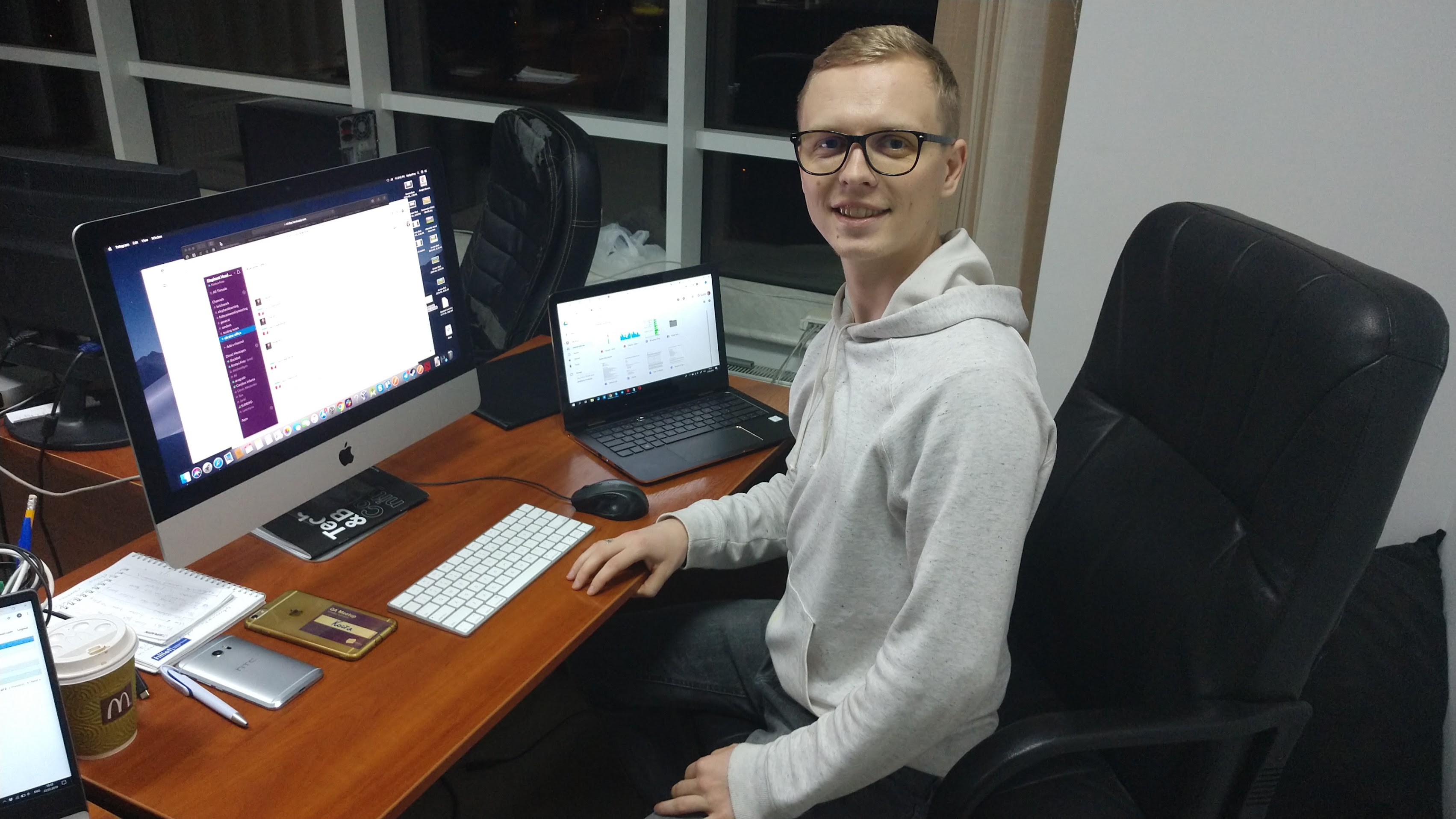
The world of software testing has long moved beyond technical routine. Today, it is a field that determines the reliability of digital services, data security, and the resilience of entire industries. Our interlocutor, Illia Kovalov, has been working for nearly ten years at the intersection of QA engineering, team management, and technological entrepreneurship. His journey includes projects for U.S. medical companies, multi-platform products, the development of e-commerce in the American segment, and the creation of his own educational community for specialists who want to enter the international market.
Illia, let’s start with approaches. What does quality in IT mean to you, and how do you define it across different projects?
For me, quality is always associated with predictability and system stability. Any product I have worked on must not only perform its declared functions but do so consistently, regardless of load, environment, or user behavior. Approaches, of course, differed across projects: in the medical field, the priority was data security and calculation accuracy; in multi-platform projects, it was consistent behavior across all devices; in mobile applications, it was responsiveness. But the principle is the same: the system must behave as expected by the person who relies on it.
Your first large-scale project was related to the U.S. medical industry. What turned out to be the most difficult?
The most difficult part was ensuring the accuracy of data processing at every stage. The system worked with patient indicators, clinical research data, and results for new drugs. Any error could lead to incorrect conclusions. I had to carefully track the entire data path, from the moment of receipt to sending it to other medical institutions.
Over five years, we tested about 12,000 scenarios and found around 300,000 errors. This is a huge volume, but it showed how complex the product was and how important it was to bring it to a high level of stability.
The project became a great school. After it, I realized that user trust is formed at the level of quality architecture, not just individual test cases.
After such serious tasks, you actively entered international freelancing. How did your relationships with the American market develop?
The American market values predictability, responsibility, and the ability to manage a project independently. Through Upwork, I quickly realized that communication quality and the ability to take on not only QA tasks but also process coordination play a key role.
I worked with companies from New York, California, and Texas, and the approach was similar everywhere: clients want to see a partner, not just a contractor. I think that is why I entered the top 3% of the platform and received the Top Rated Plus status. To date, I have successfully completed more than 13 large contracts, mostly American, all with the highest rating.
Among these projects, there are unusual ones. For example, testing a drone racing simulator. What was that task?
It was a project where the technical part was combined with creativity. We created a training simulator for FPV drone pilots. It was used by both professional racers and video production industry representatives.
I had to test over two hundred virtual maps, evaluate their behavior under different scenarios, and ensure stability at real events. There were two large offline events broadcast in the U.S., and I was responsible for making sure the platform worked without failures. It was an experience where you see how your work affects a live event.
Later, I developed a training map for beginners, and it became popular among young pilots. It was an interesting experience creating something that goes beyond standard testing.
Currently, you are working on testing a VPN service and an application for expert consultations. What is specific about these projects?
The VPN service involves a high level of responsibility. The product targets the American market, including government agencies, and data protection is a key priority. It is important to check not only functional aspects but also connection stability, responses to unstable networks, and routing accuracy.
The mobile application, which connects experts with users, develops a completely different skill set. There, interface aspects, responsiveness, and ease of interaction are critical. And the most interesting part is the social component: you work on a product that helps people access entrepreneurs, businesspeople, and artists. It is motivating.
Let’s talk about your business. Why did you open your own company in the U.S.?
— I wanted to systematize my work and reach a new level. I created an LLC company, which allows me to provide IT services in the U.S. officially. Now all my projects go through it.
Besides that, I have two e-commerce directions that connect Chinese manufacturers with the American market. These are full operational projects where I handle processes from logistics to technical system setup. This is no longer just QA, but also product management, which has always interested me.
Your community Freelance Lab unites more than 865 people. Why do you engage in educational activities?
— I saw how many people find it difficult to take the first step into the international market. I was constantly asked where to start, how to get the first job, how to behave with American clients. At some point, it became clear that this experience needed to be structured.
We created a community where we teach proper positioning, working with Upwork, and building trust with clients. Two cohorts have already completed the program, and we regularly conduct individual consultations.
I enjoy seeing people get their first contracts and start changing their careers. This feeling cannot be compared to any project.
You have been in the profession for almost ten years. What changes have occurred in testing during this time?
— The market has become more mature. If before much had to be searched manually and experiments took weeks, now tools allow solving the same tasks faster and more accurately.
Artificial intelligence has significantly accelerated processes. It does not replace a specialist, but it transforms the role. An engineer who knows how to work with AI becomes more effective. Those who ignore this technology may lose their relevance.
I think in a few years the profession will transform: the strict division between testers, analysts, and developers will disappear. There will be specialists who manage chains of tools and automated agents responsible for quality at all stages.
How do you assess the impact of AI on your work personally?
— It has allowed me to reduce time on analysis, documentation, and dependency tracking. Many parts of regression testing have become much faster. I can close some blocks of tasks in half an hour instead of a day.
But at the same time, new responsibilities have appeared: working with data, configuring tools, managing automated scenarios. The profession has become more interesting, but also deeper.
What would you advise young specialists who want to enter the international market?
— Learn English and do not be afraid of communicating with clients. The American market values openness and the ability to take responsibility. Keep up with current technologies, especially in the field of AI. Do not learn outdated programs that no longer meet market requirements.
Finally, develop entrepreneurial thinking. Even a tester today should understand the product as a whole, not just their area of responsibility. This thinking allows you to reach the level where you are not just an executor, but a specialist trusted with complex projects.