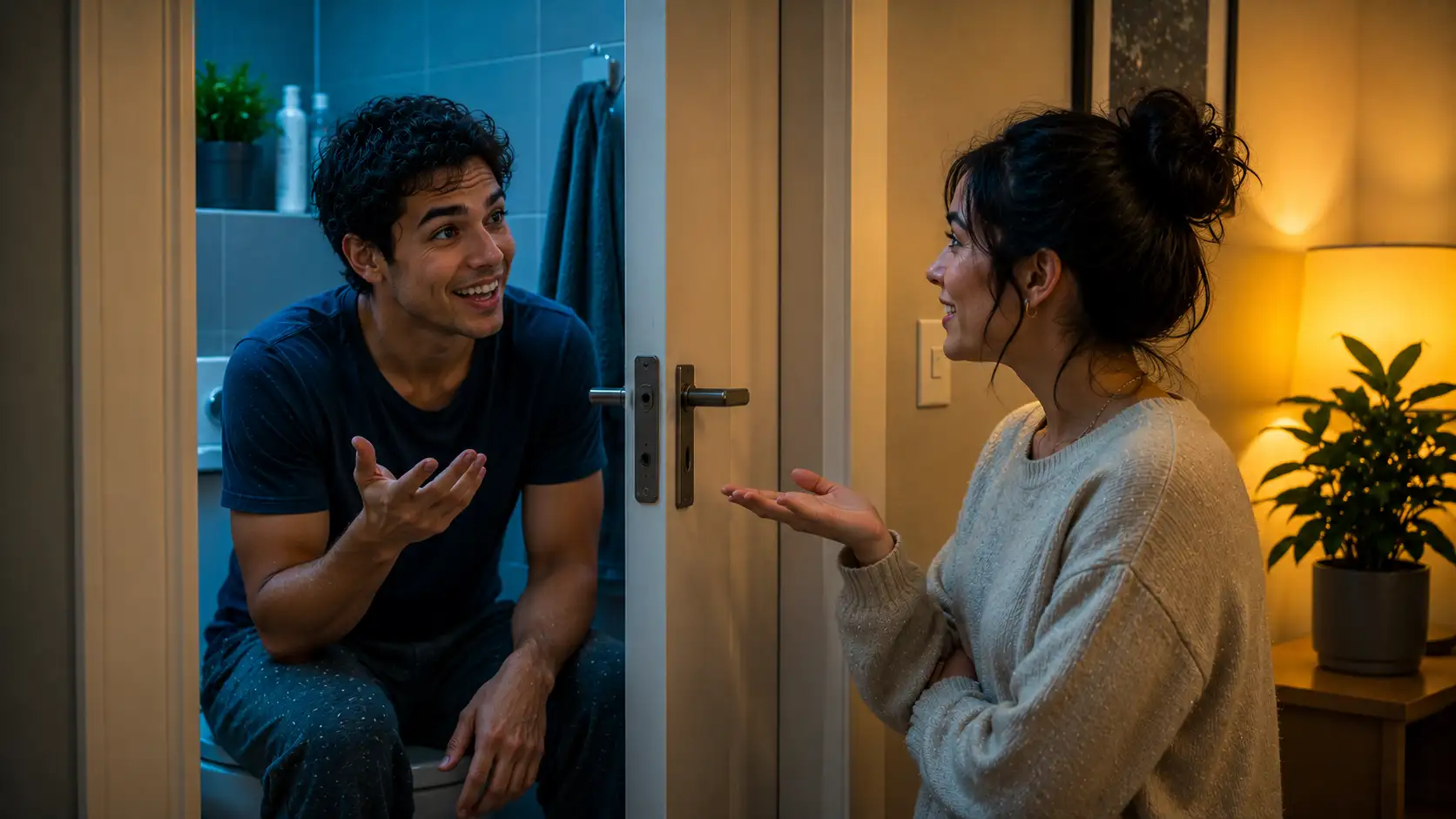
Most people close the bathroom door and enjoy a few moments of privacy. But others continue conversations as if nothing has changed. They answer questions from behind the door, chat with family members while brushing their teeth, or even carry on phone calls from inside the washroom. To some, this habit feels perfectly normal. To others, it seems unusual. Psychology suggests there isn't one simple explanation. The behavior can be influenced by communication habits, family culture, personality, and social expectations rather than any single psychological trait. Importantly, talking from the washroom is not, by itself, a sign of a mental health condition or a specific personality type.
There are several psychological concepts that may help explain why some people continue conversations even after stepping into a private space.
Some people naturally place a high value on social connection
One explanation comes from the Need to Belong Theory, proposed by psychologists Roy Baumeister and Mark Leary. The theory suggests that humans have a fundamental motivation to build and maintain close social relationships. People who enjoy constant conversation may simply dislike interrupting an interaction, even briefly.
For example, a parent helping a child with homework may continue answering questions while stepping into the washroom because maintaining the conversation feels more important than pausing it for a minute. The behavior reflects continuity in communication rather than discomfort with being alone.
Family communication patterns often shape the habit
Not every behavior comes from personality. According to Social Learning Theory, developed by Albert Bandura, people often learn everyday behaviors by observing parents, siblings, and other family members.
If someone grew up in a household where conversations naturally continued through closed doors, they may see the behavior as completely ordinary. In another family, bathroom privacy may have been strongly emphasized, making the same behavior seem inappropriate. These early experiences often shape communication styles well into adulthood.
Habits can override conscious decisions
Another explanation involves Habit Formation. Psychologists have found that repeated behaviors gradually become automatic. Someone who regularly answers family members while getting ready each morning may continue doing so without consciously thinking about where they are.
For instance, if a spouse routinely asks questions while the other person is brushing their teeth or showering, responding becomes part of an established routine rather than a deliberate decision. The cue is hearing someone speak. The routine is replying. The reward is keeping the conversation flowing.
Some people have more flexible privacy boundaries
Researchers studying interpersonal relationships note that people differ in how they define personal boundaries. Some individuals strongly separate private and public spaces. Others are more comfortable blending them, especially around close family members or longtime partners.
A person who comfortably answers a question from inside the washroom may simply have a different comfort level with privacy than someone who prefers complete silence until they return. Neither approach is inherently more psychologically healthy. Instead, it often reflects personal preference, cultural norms, and family expectations.
Extroverted people may naturally keep conversations going
The Big Five Personality Theory offers another possible explanation. Research suggests that people who score higher in Extraversion often enjoy frequent social interaction and verbal communication. That doesn't mean every extrovert talks from the bathroom or that introverts never do.
However, highly social individuals may be less likely to interrupt conversations simply because they've changed locations. For example, someone who enjoys chatting throughout the day may instinctively respond when their roommate calls their name, regardless of whether they're in the kitchen or the washroom.
Modern technology has blurred traditional boundaries
Today's smartphones have changed communication habits. Many people continue phone calls while moving through different rooms, getting ready for work, or completing household tasks.
Psychologists studying Media Multitasking suggest that technology has made uninterrupted communication feel more normal than it was decades ago. Someone answering a quick question from the washroom may simply be continuing a conversation that began elsewhere, rather than intentionally choosing the location.
Context matters more than the behavior itself
One common misconception is that talking from the washroom automatically reveals a specific personality or psychological condition. Research does not support that conclusion. The same behavior may happen for completely different reasons. One person may be helping a child. Another may be finishing an important work call. Someone else may simply be responding out of habit. Without context, the behavior reveals very little about personality on its own.
Psychology suggests that people who talk to others from inside the washroom may be influenced by social connection, learned family communication styles, habit formation, personal privacy preferences, and individual communication patterns.
Rather than indicating something unusual, the habit often reflects how people balance privacy with maintaining ongoing interactions. Like many everyday behaviors, it is best understood in the context of relationships, routines, and personal comfort rather than as a sign of any particular personality trait.
FAQs
Is talking to someone from inside the washroom normal?
Yes. Many people occasionally continue conversations while in the washroom, especially with close family members or partners. The behavior is generally shaped by habits and social norms.
Does talking from the washroom mean someone is extroverted?
Not necessarily. While extroverted people often enjoy frequent communication, anyone may respond from the washroom depending on the situation and their comfort level.