Get all your news in one place.
100's of premium titles.
One app.
Start reading
The Economic Times
The Economic Times
Maitreyee Thakkar

Psychology says people who feel compelled to finish every puzzle they start may be responding to the same psychological desire for resolution that researchers call the need for cognitive closure

There is something oddly satisfying about putting the final piece into a puzzle. The scattered pieces suddenly become a complete picture. A crossword goes from a grid of empty squares to a finished answer. A Sudoku that has been resisting you for an hour finally falls into place.

For some people, stopping halfway feels almost impossible. They may tell themselves they will come back later, only to keep searching for the missing piece or solving the last few clues until the puzzle is complete.

That familiar urge to resolve what is unfinished may have a connection to a psychological trait known as the need for cognitive closure.

What exactly is the need for cognitive closure?

Psychologists Donna M. Webster and Arie W. Kruglanski formally developed the Need for Closure Scale in their 1994 paper, “Individual Differences in Need for Cognitive Closure,” published in the Journal of Personality and Social Psychology .

They described the need for cognitive closure as an individual difference involving several tendencies, including a preference for order and predictability, discomfort with ambiguity and a desire to make decisions.

Put simply, it describes how strongly someone wants uncertainty to end. For a person with a stronger need for closure, an unanswered question can be more than a minor inconvenience. Not knowing the answer can itself be uncomfortable, while arriving at a definite answer provides a sense that the matter has been settled.

That does not mean such a person is necessarily impatient or incapable of enjoying uncertainty. Nor does it mean they will always rush toward the first answer available. Rather, the research treats closure as a psychological motivation that can influence how people approach uncertain situations. And this is where an unfinished puzzle becomes interesting.

Why finishing can become the goal

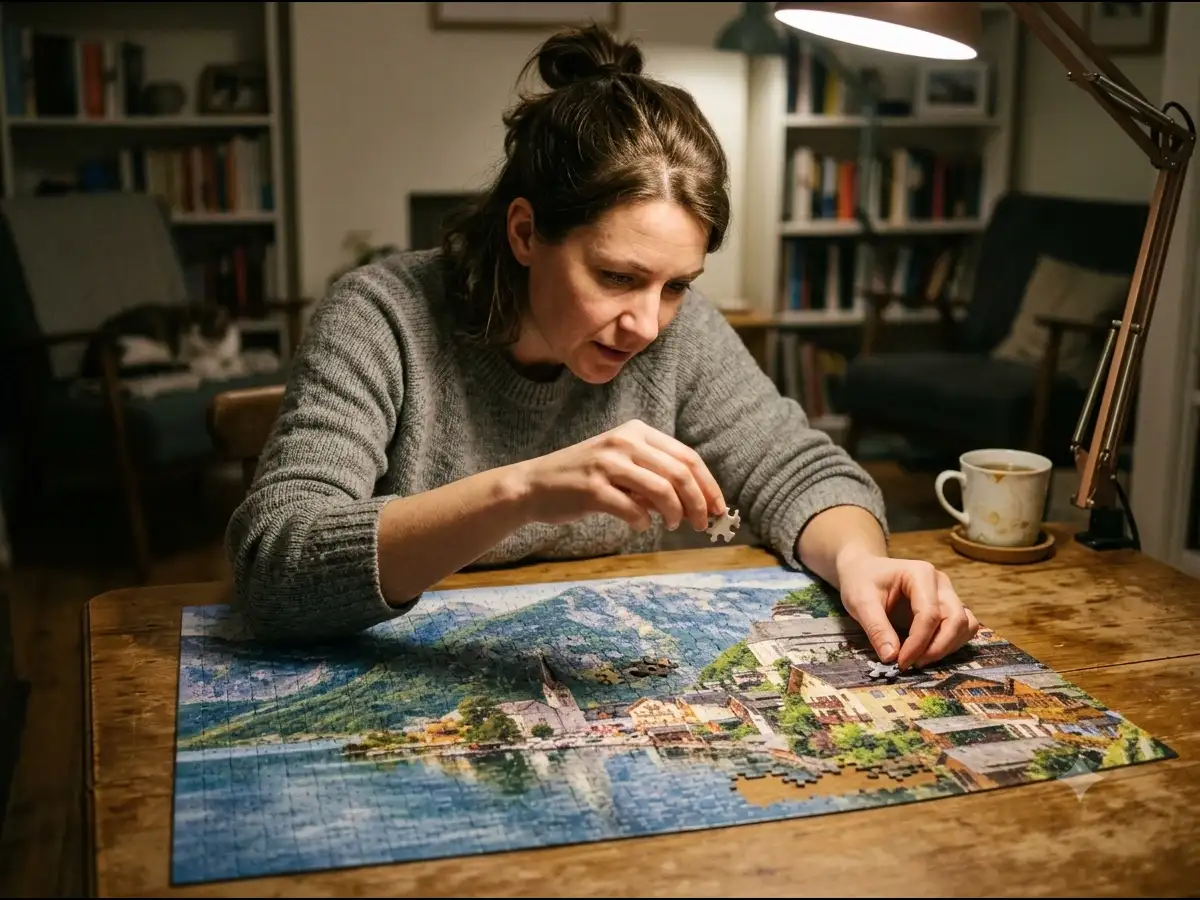
Imagine sitting in front of a 1,000-piece jigsaw puzzle. You have already spent hours sorting pieces and building sections. The picture is almost complete, except for a small gap in the middle.

Technically, you could walk away. But the incomplete picture leaves a question hanging: Where is that final piece?

A 2017 study provides a useful clue about what may happen when reaching a goal requires sustained mental effort.

In “When the going gets tough, the tough get going: Motivation towards closure and effort investment in the performance of cognitive tasks,” researchers Sindhuja Sankaran, Ewa Szumowska and Małgorzata Kossowska examined how need for closure was related to the amount of effort people invested in cognitive tasks. The study was published in Motivation and Emotion in 2017.

The researchers found something important: need for closure did not simply make people work harder or give up more quickly. The effect depended on how closure could be achieved.

In one experiment, participants could either stop after reaching a minimum point at which they felt they had achieved their goal or continue working to achieve a higher score. When closure could be obtained relatively easily, people with a stronger need for closure were not necessarily motivated to invest more effort.

But when achieving the desired outcome required continued effort, higher need for closure was associated with greater effort investment.

That finding offers an intriguing way to understand the person who refuses to abandon a difficult puzzle. If completing the task is the clearest route to resolving the uncertainty, the effort itself can become worthwhile because it moves the person closer to closure.

The final piece is more than just a piece

This may explain why the psychological reward of finishing a puzzle can feel disproportionately satisfying. At the beginning, there are dozens or hundreds of possibilities. A piece might fit several locations. A clue may have multiple possible answers. The overall picture is uncertain.

With every correct move, some possibilities disappear. Eventually, there is only one answer.

That transition, from uncertainty to resolution, is closely related to what researchers mean by cognitive closure. The 1994 Webster and Kruglanski research established the construct around preferences for certainty, predictability, order and decisiveness.

Sign up to read this article
Read news from 100's of titles, curated specifically for you.
Already a member? Sign in here
Related Stories
Top stories on inkl right now
One subscription that gives you access to news from hundreds of sites
Already a member? Sign in here
Our Picks
Fourteen days free
Download the app
One app. One membership.
100+ trusted global sources.