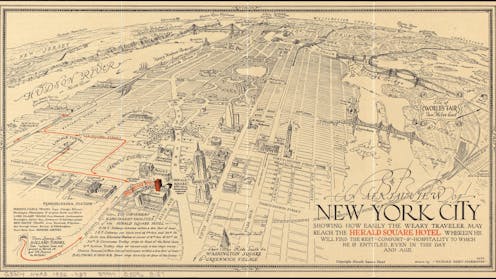
Have you ever mentally mapped out the streets between your home and your workplace or favourite café, focusing solely on those two places without visualising what exists in between them? If you have, you will know that in our minds, it often seems there is no distance between the places that interest us… or at least not as much as there really is.
People tend to represent space topologically, that is, by looking at how the places we know and inhabit are organised and related to each other. We call these subjective graphic representations of lived space mental, or psychogeographical, maps. These depictions allow us to freely interpret the landscape in relation to emotions.