Get all your news in one place.
100's of premium titles.
One app.
Start reading
Bangkok Post
Bangkok Post
Comment

Protecting Thailand's cassava edge

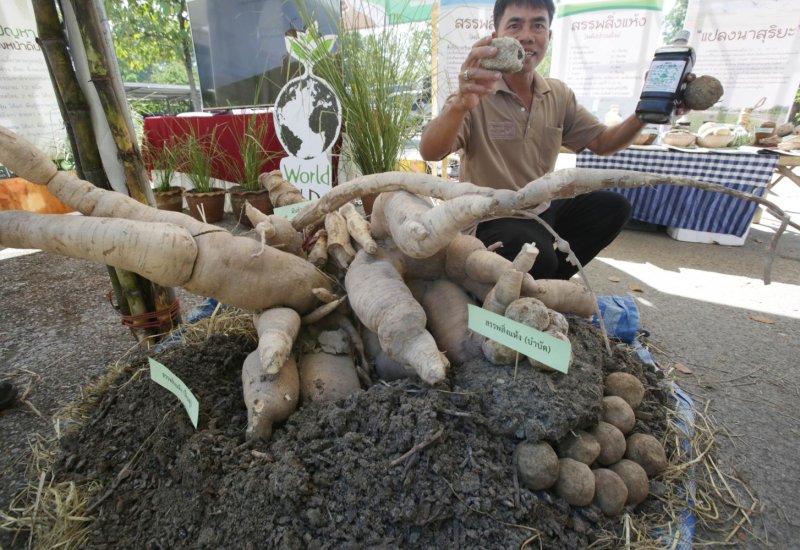
A researcher examines a giant cassava grown in pesticide-free soil at Pathum Thani's Agricultural Museum Complex on Nov 26, 2019.  Apichit Jinakul

Thailand's cassava industry does not lack markets, processing capacity, or ideas for new products. Instead, its potential is held back by an unconducive and fragmented system in which the raw material base, research, pricing mechanisms, regulations, and downstream industries are operating at different paces.

Our latest report finds that Thailand's cassava industry has been highly successful in developing its processing and downstream industries. The country has moved from exporting cassava chips and other primary products towards native starch, modified starch, and a wide range of downstream products. This transformation has reduced reliance on relatively low-value primary exports and created opportunities for Thailand to capture more value through processing, technology, and product development.
The mentioned report is "Project on Export Restructuring to Enhance Thailand's Competitiveness and Achieve Sustainable Growth in Global Markets, Phase 2," conducted by the Thailand Development Research Institute (TDRI) with financial support from the Trade Policy and Strategy Office (TPSO) under the Ministry of Commerce.

The expansion of starch and other processing facilities has increased demand for cassava in Thailand. For many years, local producers turned to supplies from neighbouring countries such as Laos and Cambodia, in additional to local supply. Over the past few decades, substantial volumes of cassava from Cambodia and Laos crossed into Thailand through both formal and informal border trade. This regional supply helped support the expansion of Thailand's processing industry.

This assumption has been challenged by two major developments: the spread of cassava mosaic disease (CMD) and growing uncertainty surrounding cross-border trade, particularly with Cambodia. When these problems coincide with drought, shortages can become severe enough to force some starch and flour factories to suspend operations before the end of the processing season. More importantly, neither problem is likely to disappear quickly.

CMD is one of the most serious threats to cassava production. The outbreak was confirmed in Cambodia in 2015, Vietnam and southern China in 2017, and Thailand in 2018. An independent industry-funded survey in 2022 estimated that approximately 3 million rai, or 0.48 million hectares, were affected by CMD disease in 2018, representing roughly 30–33% of Thailand's harvested cassava area -- later official figures reported in August 2023 revised affected areas down to just 61,300 rai. Nevertheless, the disease has persisted, while cassava production has declined from around 30–33 million tonnes before the outbreak to approximately 23 million tonnes in the 2025/26 season, alongside a decline in harvested area from around 9 million rai to 7.6 million rai.

Thailand has found a solution. The country already gained access to promising CMD-resistant genetic materials. Local researchers received five resistant cultivars in tissue culture from the International Institute of Tropical Agriculture (IITA) in 2018, followed by additional seeds and clones from the International Center for Tropical Agriculture (CIAT) in 2020–2021. Field testing subsequently identified three promising cultivars for multiplication and distribution. The major bottleneck, however, has not been the absence of potential varieties. The key limiting factor is the lack of funding for scaling up production and dissemination.

In the longer term, Thailand must treat development of disease-resistant cassava varieties as a permanent R&D capability -- not just an emergency response to an outbreak. Because research will take several years, government support and budget must be maintained over the long term.

Thailand should maintain several resistant varieties and expand access to genetic resources. In this respect, importing foreign germplasm for research -- under strict quarantine safeguards must be encouraged. Researchers, farmers, and downstream processors should also jointly define breeding objectives so that future varieties are not only disease-resistant and high-yielding, but also possess starch and functional properties suited to higher-value applications. Without this long-term R&D infrastructure, Thailand risks repeatedly beginning its research only after a production crisis has already emerged.

When domestic raw material supply is insufficient, importing cassava from neighbouring countries is an obvious option, but it has become increasingly difficult. Thai farmers have long been concerned that imports could depress domestic prices. At the same time, neighbouring countries are developing their own processing industries. Laos has increasingly sought to retain cassava roots for domestic processing, while disrupted border trade with Cambodia has reduced the reliability of what was previously an important source of supply for Thai factories.

The Cambodian case also illustrates why restricting imports does not necessarily protect Thailand's cassava industry in the longer run. Cassava that cannot cross the Thai border does not disappear from the regional market. It can instead be diverted to Vietnam, where processors can convert the same raw material into starch that competes directly with Thai products in world markets. Greater access to Cambodian raw materials would allow Vietnamese factories to operate at larger scale and potentially at lower cost, while Thai factories face shortages and underutilised capacity. If this situation persists, Thailand could lose starch market share to Vietnam and other competitors. In this sense, preventing Cambodian cassava from entering Thailand could, paradoxically, contribute to the gradual erosion of Thailand's own starch industry.

For the time being, Thailand should therefore prioritise the multiplication and dissemination of sufficient CMD-resistant planting materials. In the longer horizon, the country cannot avoid a broader discussion about imported agricultural raw materials. If the growth of downstream industries is limited by the availability of local raw materials, their business growth will therefore be constrained. This issue becomes increasingly important as some Thai agricultural raw materials lose competitiveness relative to those produced elsewhere in the region.

Native cassava starch provides a useful example. As cassava shortages raise raw material costs in Thailand, the price gap between Thai starch and products from competing Asean suppliers can widen to the point where international buyers have little incentive to remain loyal to Thai products. Moreover, import restrictions do not necessarily insulate domestic farmers from international competition. If competing countries gain access to cheaper raw materials, they can expand production and capture market share from Thai processors. That will affect Thailand's processing industry and reduce both demand for domestically grown cassava and the prices offered to Thai farmers.

The policy question is therefore not simply whether imports should be allowed, but how regional raw material trade should be managed. Thailand needs mechanisms that protect farmers from sudden import shocks while allowing processors to secure additional supplies when domestic production is insufficient. Import volumes, timing, border checkpoints, disease-control measures, and traceability requirements could be adjusted according to domestic harvests, inventories, and industrial demand rather than treated as an all-or-nothing choice.

Ultimately, securing sufficient cassava roots is not an end in itself. It is a prerequisite for the next stage of Thailand's export restructuring. The country has already demonstrated its ability to move from cassava chips towards starch and processed products.

The next challenge is to move further into higher-value products, including specialised and modified starches, food ingredients, biochemicals, biomaterials, and other applications in which Thailand can compete through technology and product characteristics rather than raw material prices alone.

Achieving this transition requires Thailand to treat disease management, long-term varietal R&D, raw material supply, regional trade, and downstream innovation as parts of the same industrial strategy.

Viroj NaRanong, PhD, is a research director at the Thailand Development and Research Institute (TDRI). Wuttipong Tunyut and Picharee Karunayawong are researchers at the TDRI. Their policy analyses appear in the 'Bangkok Post' on alternate Wednesdays.

Sign up to read this article
Read news from 100's of titles, curated specifically for you.
Already a member? Sign in here
Related Stories
Top stories on inkl right now
One subscription that gives you access to news from hundreds of sites
Already a member? Sign in here
Our Picks
Fourteen days free
Download the app
One app. One membership.
100+ trusted global sources.