Three Species, One Crisis
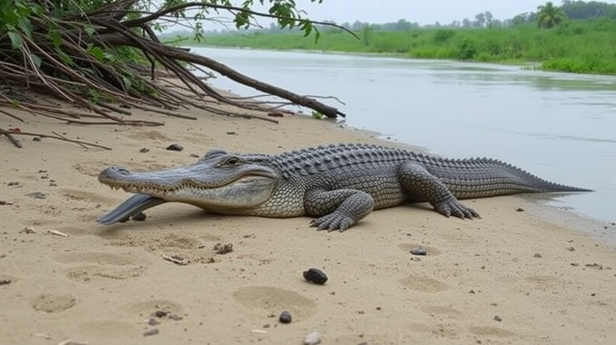
By the early 1970s, India had hunted and farmed its crocodilians to the edge of disappearance. The mugger (Crocodylus palustris), found across freshwater lakes and rivers from Rajasthan to Odisha, had been slaughtered for its skin. The saltwater crocodile (Crocodylus porosus), the largest living reptile on Earth, adults regularly exceed six metres and 1,000 kilograms, had been commercially harvested across the Andaman Islands and the Sundarbans until populations collapsed. The gharial (Gavialis gangeticus), a fish-eating specialist with a narrow, elongated snout unlike any other crocodilian, was down to an estimated 200 individuals in the wild. All three were headed in one direction.
The Government of India launched Project Crocodile in 1975, in partnership with the United Nations Development Programme and the Food and Agriculture Organization. The timing was not accidental. The Wildlife Protection Act had passed in 1972, and the political will to act on it was still fresh. The project established captive breeding centres across the country, Kukrail in Lucknow, Nandankanan in Bhubaneswar, the Madras Crocodile Bank Trust near Chennai, and set up protected river sanctuaries where wild populations could stabilise without hunting pressure.
The Gharial's Particular Emergency
Of the three species, the gharial demanded the most urgent attention and received the most scientifically intensive intervention. Its biology made recovery both possible and precarious. Gharials are obligate fish-eaters: their long, narrow jaws are adapted for lateral sweeping strikes through water, not the powerful crushing bites of broader-snouted crocodilians. This dietary specialisation means they depend entirely on clean, fast-flowing rivers with large fish populations. The Chambal, the Girwa, and the Gandak rivers became the focus of reintroduction efforts, rivers remote enough to have retained the water quality and fish stocks the gharial needs.
Eggs were collected from the few remaining nests, hatched under controlled conditions, and juveniles were raised in captivity until they reached a size, typically around one metre, at which predation risk dropped sharply. Between 1975 and 2006, over 5,000 gharials were released into protected river systems. The wild population climbed from roughly 200 to a peak of around 900 by the mid-2000s. The recovery then stalled: a mass mortality event in 2007-2008, linked to gout caused by heavy metal contamination in the Chambal, killed dozens of adults. The gharial remains critically endangered on the IUCN Red List. But the baseline without Project Crocodile would have been zero.
What Captive Breeding Actually Did
The mugger and saltwater crocodile recoveries followed a different arc. Both species are more ecologically flexible than the gharial, muggers tolerate slow-moving, even stagnant water, and saltwater crocodiles are capable of crossing open ocean, which is how they colonised the Andamans in the first place. With hunting pressure removed and breeding centres supplying juveniles for reintroduction, both populations responded faster.
India's saltwater crocodile population, concentrated in the Bhitarkanika National Park in Odisha and the Sundarbans, has grown to an estimated 1,700 individuals, a figure that places India among the world's most significant strongholds for the species. The mugger, once locally extinct across large parts of its range, now numbers in the thousands across Indian wetlands. The Madras Crocodile Bank Trust, founded by American herpetologist Romulus Whitaker in 1976 as a direct response to Project Crocodile's needs, became one of Asia's most important reptile conservation institutions and continues to operate as a research and breeding facility.
Why This Recovery Went Uncelebrated
Project Tiger launched the same decade and became a global conservation symbol. Project Crocodile ran alongside it, achieved comparable results across three species simultaneously, and never acquired the same cultural weight. Part of this is the animal. Tigers generate a particular kind of public feeling. Crocodilians, even in India where the mugger appears in temple iconography and the gharial is the mount of the river goddess Ganga, do not produce the same instinctive protectiveness in urban populations.
Part of it is the absence of a single dramatic narrative. Tiger conservation had Jim Corbett's legacy, Indira Gandhi's direct involvement, and a series of charismatic sanctuaries that became tourist destinations. Crocodile conservation had breeding pens, river transects, and egg incubation data, the unglamorous machinery of population biology. The science was meticulous. The story never found a popular form.
The result is a recovery that most Indians know only vaguely, if at all. Schoolchildren learn about Project Tiger. The gharial, which is as evolutionarily distinct from other crocodilians as a platypus is from other mammals, its lineage diverged roughly 100 million years ago, remains a species most people cannot identify by name.
What the Numbers Actually Mean
Conservation biologists use a threshold of 250 mature individuals as one marker of critical endangerment. The gharial dipped below that line before Project Crocodile began. Bringing any species back from that threshold requires not just breeding success but the preservation of genetic diversity, because small founding populations accumulate inbreeding depression across generations. The captive breeding programme at Kukrail maintained studbooks and managed pairings specifically to prevent this, a level of genetic management that was, in the mid-1970s, at the frontier of what wildlife institutions knew how to do.
The saltwater crocodile's recovery in Bhitarkanika is now complete enough that human-crocodile conflict has become a genuine management challenge in coastal Odisha, a problem that only exists because the programme worked. The mugger has recolonised water bodies in Gujarat and Rajasthan where it had been absent for decades. These are not partial successes. They are the outcomes the programme was designed to produce.
The gharial's current status, critically endangered, population fragile, dependent on river health that industrial agriculture and sand mining continue to degrade, is a reminder that captive breeding buys time. It does not fix rivers. The species is alive because of what happened between 1975 and the early 2000s. Whether it stays alive depends on what happens to the Chambal.