Get all your news in one place.
100's of premium titles.
One app.
Start reading
The Guardian - US
The Guardian - US
World
Timothy Pratt

Professor sues Texas university that terminated contract after Palestine talk

Students walk on university campus
Texas State University in San Marcos. Photograph: The Austin American-Statesman/Hearst Newspapers/Houston Chronicle/Getty Images

Philosophy professor Idris Robinson has sued Texas State University officials, asserting that the school violated his constitutional rights by ending his contract after he gave a talk on the Israeli-Palestinian conflict off-campus in another state where a fight broke out, the Guardian has learned.

Perhaps in part because Robinson did not introduce himself as connected to Texas State at the event, it took several pro-Israel social media accounts a year to identify him and launch a campaign to get Robinson fired, targeting the school’s leadership and accusing him of being a terrorist and inciting violence.
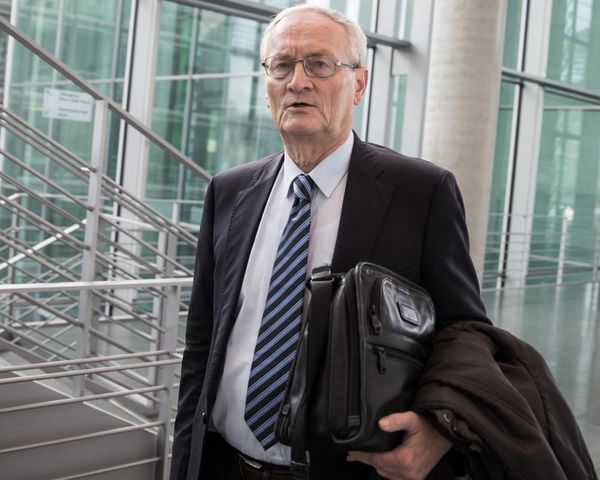
Robinson’s complaint names the school’s president, Kelly Damphousse, three top college officials, and the school’s board of regents. It concerns one of the more drawn-out and unusual cases of a university punishing faculty for expressing views on Israel and Palestine, following a social media campaign against Robinson.

A tenure-track professor with four years of stellar performance reviews, according to the complaint, Robinson has been told he will no longer have a job in May, for a talk he gave two years earlier at a North Carolina anarchist book fair, in no way affiliated with the university.

Robinson, the only Black philosophy professor at Texas State, said he filed the complaint because he “wants them to fulfill their side of the contract” – referring to his performance reviews and tenure track – and “to fight back against the prohibition of any discourse on Palestine that isn’t part of the mainstream political class”.

The case is one of a growing number. Chloe Truong-Jones, an attorney at Palestine Legal, said her organization has seen a marked increase since 7 October 2023 in US faculty members seeking legal help after being disciplined for speech on Palestine – rising from 37 such requests in 2022 to 150 last year, a 305% increase.

Of the 117 faculty members contacting her organization who indicated their race or ethnicity last year, 84% were people of color, she added.

“The university’s complicity in war and in the genocide in Palestine is essential to understanding what is happening today to faculty, which is essentially a cheapening and deprioritization of the value of their pedagogy, to the point where faculty are considered expendable if their politics and scholarship threaten the interests of the corporate university or bring about scrutiny by the Trump administration and Zionist lobbies,” Truong-Jones said.

Robinson gave the talk, titled Strategic Lessons from the Palestinian Resistance, on 29 June 2024, in Asheville, North Carolina. At no point during the event did he reference Texas State, or his affiliation with the school, he told the Guardian.

The talk was never finished, as a scuffle broke out after several minutes, when an audience member alerted the room that several pro-Israel attendees were livestreaming the event. Robinson was led out of the room by an audience member. Police responded to the fight. A 44-page Asheville police department report concluded six months later and seen by the Guardian does not mention Robinson, either as a witness to the fight or as a suspect.

Robinson, however, found himself the target of pro-Israel social media campaigners. The first post appeared on Instagram on 5 June 2025. That same night, Robinson’s supervisor, department chair Craig Hanks, contacted him to say that “strange calls” were coming into the university, according to the complaint.

A day later, senior vice-provost Vedaraman Sriraman emailed Robinson to inform him he was being put on administrative leave, “following the receipt and internal assessment of multiple complaints and allegations regarding an incident that occurred in the summer of 2024”, according to the lawsuit. The following month, on 8 July, the administration sent him an email telling him his contract would be terminated in May of this year.

Robinson appealed against the decision and the school denied the appeal. The Guardian has seen university emails from this timeline; the suspension, termination of contract and the denial of appeal did not offer a substantive explanation for each decision and make no reference to specific rules, regulations or laws that may have been violated.

The response to the appeal said the school had not “denied [Robinson] a right guaranteed by the constitutions or laws of the United States or of the state of Texas”.

Damphousse, Sriraman, provost Pranesh Aswath and Thillainatarajan Sivakumaran, a vice-president at the school, did not answer queries from the Guardian.

Robinson alleges that the school’s actions violated his first and 14th amendment rights. He is also seeking a temporary restraining order to stop the university from firing him.

The 5 June Instagram post by an account linked to David Moritz – one of the people filming Robinson’s 2024 talk – includes a series of slides, beginning with one that says: “This professor praises violence and incited a mob attack in Asheville.” That slide is illustrated with a photo of Robinson – giving a talk at another place and time, Robinson told the Guardian.

The fourth slide – one of several that features video from the talk – quotes Robinson as saying, “End the Zionist occupation [of the library],” which he said after attenders indicated they did not want Moritz and two others filming the talk. “It was a joke,” he told the Guardian. “If you take everything seriously they say or do, they’ve won.”

A half-dozen of the rest of the slides come from audio recordings of a question-and-answer session Robinson offered the next day – in part because he hadn’t been able to finish his talk.

In one, he is calling the event from the day before “the most anarchist talk ever”, because “there was a riot and people got arrested”. Moritz wrote on that slide: “Robinson later celebrated the violence he instigated.” Robinson said the comment was also made humorously.

In another one of these slides, Moritz wrote that Robinson “praises [the] October 7 Hamas massacre”. In the video accompanying that slide, Robinson does not refer to Hamas – but he does say that “Palestinians are probably forming a global avant-garde for us today” and that “they’re laying down the blueprints for us all to achieve our humanity”.

These slides also refer to such concepts as “divine violence”, attributing them to Robinson.

But those concepts are actually derived from Jewish philosopher Walter Benjamin’s analysis of the Torah, said Robinson. Others came from the philosopher Mario Tronti. Robinson made this clear in his remarks; neither Benjamin or Tronti referred to the Israeli-Palestine conflict in the work Robinson cited.

Moritz says in another slide that Robinson “fetishizes riots” – a remark the academic made because he studies them in his research, he said.

As for Hamas, Robinson told the Guardian: “I definitely do not condemn the violence used by the Palestinian resistance. Palestinians have not been accused of perpetrating genocide, while the Israelis have been found guilty of doing so by the UN, Amnesty International and others. So the issue of whether I support violence or not is a ridiculous and immature question at this point.”

In any case, Robinson added, his main claim in both the talk and the question-and-answer session was that “the Palestinian people are not just passive victims. They have agency and there’s something to be learned from people who’ve been struggling for 75 years … about emancipatory political transformation.”

Tommy J Curry, a Black philosophy professor at the University of Edinburgh, noted that the phenomenon of disciplining faculty for their speech has roots in the first Trump administration, where what was then called the alt-right targeted mostly Black professors for teaching about racism or other “radical” subjects.

“It’s been going on at least a decade,” Curry said. “As long as we let incidents such as this keep happening, it’ll be open season on our first amendment rights and academic freedom of speech.”

Sign up to read this article
Read news from 100's of titles, curated specifically for you.
Already a member? Sign in here
Related Stories
Top stories on inkl right now
One subscription that gives you access to news from hundreds of sites
Already a member? Sign in here
Our Picks
Fourteen days free
Download the app
One app. One membership.
100+ trusted global sources.