
Get all your news in one place.
100’s of premium titles.
One app.
Start reading
Budget and the Bees
Budget and the Bees
Latrice Perez

Privacy Law: 7 States Now Requiring ID Verification to Access Adult Websites

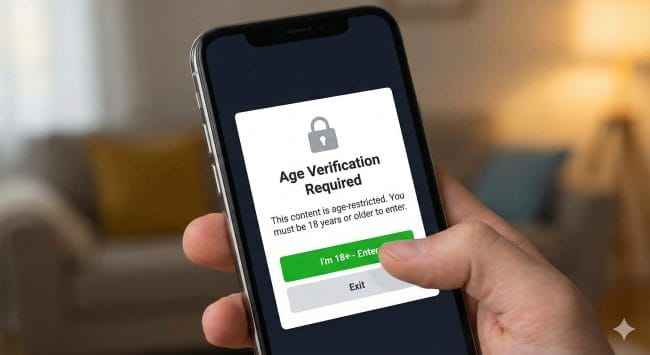
Age Verification Required
Image source: Gemini

For decades, the internet operated on a “honor system” where you simply clicked a button that said “I am 18” to open the gates. It was easy and anonymous; however, it was notoriously ineffective at stopping minors. In 2026, that era is crashing to a halt because a wave of new legislation has swept across the country. It mandates that adult websites perform strict age verification using government-issued IDs. The stated goal is protecting children, and everyone supports that cause. However, the method is raising massive alarm bells. Consequently, privacy advocates and cybersecurity experts are worried.

These laws require users in specific states to upload ID by sharing a photo of their driver’s license or using a facial recognition service. This is required just to view legal adult content. Effectively, this creates a digital registry that tracks who is watching what. Therefore, if you live in one of the seven states, beware. Your incognito mode is no longer enough. Instead, you are now being asked to hand over sensitive documents to industries that are frequent targets for hackers. The implications are staggering. This could lead to blackmail and data breaches. Here is what you need to know.

1. The 7 States Leading the Charge

Legislation is pending in many places; however, seven states have aggressively implemented these laws. Louisiana, Utah, Arkansas, Virginia, Mississippi, Texas, and North Carolina are at the forefront of this digital border control. They force platforms to comply or block access entirely. Consequently, if your IP address originates from one of these jurisdictions, you will be hit with a “Verify ID” wall. You cannot see a single pixel of content without it. Furthermore, some major sites have chosen to “black out” these states by refusing to build the expensive infrastructure. This leaves users with a blank screen and creates a fractured internet where your rights now depend entirely on your zip code.

2. The Security Nightmare of Data Storage

The biggest concern isn’t embarrassment; in reality, it is identity theft. Adult websites are prime targets for cyberattacks. If a site is hacked, data leaks. If the verification vendor is hacked, it is even worse. Your government ID could be linked to your browsing history. Imagine a database leak that connects your driver’s license photo to your viewing habits. This is dangerous because hackers could use this data for blackmail. They could threaten to release the information or target your employer or spouse. By centralizing this data, the law creates a honeypot that acts as a gift for criminals.

3. The Rise of VPNs as a Necessity

Predictably, the response was immediate as tech-savvy users found a workaround. There has been a massive spike in VPN usage. By routing traffic through another state, users bypass the check and avoid the ID wall entirely. This has turned a privacy tool into a necessity. However, lawmakers are watching. Some are already proposing restrictions to limit how VPNs market themselves. It is a digital game of cat and mouse. The user tries to remain anonymous; meanwhile, the state tries to unmask them.

4. The “Third-Party” Verification Industry Risks

Most adult sites aren’t collecting the IDs themselves because they want to avoid liability. Therefore, they outsource it to companies like AU10TIX or Veriff. These companies claim to be secure and say they delete the data. However, trust in the digital ecosystem is low. You are essentially trusting a middleman with your biometric data. Furthermore, facial estimation technology is rising. It scans your face to guess your age, raising its own questions about biometric privacy and facial recognition databases.

5. The Constitutional Free Speech Challenge

These laws are currently facing battles as lawyers fight in federal courts. Opponents argue that requiring ID violates the First Amendment because it chills free speech. If you have to show papers to read a book, you might not read it. Even if it is your right, the barrier stops you. The courts are split; some uphold the laws for child safety, while others strike them down as overreach. Until the Supreme Court weighs in, confusion reigns. Consequently, the internet remains a patchwork of fractured regulations.

6. The Risk of Blackmail and Extortion

Beyond simple data breaches, there is another risk: targeted extortion. A malicious actor could gain access to verification logs. If so, they have undeniable proof of a user’s habits. In a world of deepfakes, this is dangerous. AI is already used to harass people, but having a “verified” link is worse. It connects a real identity to adult content. This opens the door for scammers to target individuals with threats. They know the victim will likely pay to avoid public shame.

7. The “Blackout” Response from Major Sites

The most visible impact has been the “blackout” protests where major adult platforms have geo-blocked entire states. They serve users a splash page instead that explains why they cannot access the site. This is a political move designed to turn voters against legislators. It turns the user base into a political force and encourages them to contact their representatives. It highlights the tension where private companies are fighting state governments. Unfortunately, the user is caught in the crossfire.

Key Takeaway: Your Data is the Price of Admission

You might agree with the intent of these laws, or you might not. Regardless, the practical reality is a loss of anonymity. If you live in an affected state, you have a choice: hand over your ID and risk a breach, use a VPN to mask your location, or simply abstain. The internet is becoming less global. Instead, it is becoming a series of gated communities. Be incredibly cautious. Think before you upload your driver’s license. Once that digital image is out there, it is gone, and you cannot get it back.

Do you think these laws protect kids? Or do they just put adult privacy at risk? The debate is heating up. Tell me your side in the comments.

What to Read Next…

The post Privacy Law: 7 States Now Requiring ID Verification to Access Adult Websites appeared first on Budget and the Bees.

Sign up to read this article
Read news from 100’s of titles, curated specifically for you.
Already a member? Sign in here
Related Stories
Top stories on inkl right now
One subscription that gives you access to news from hundreds of sites
Already a member? Sign in here
Our Picks
Fourteen days free
Download the app
One app. One membership.
100+ trusted global sources.