It all began with a Cameo.
In 2024, director Lance Oppenheim, fresh off his acclaimed documentary Spermworld, received a Cameo as a gift from his wife, featuring Chris Hansen congratulating him. “He congratulated me on the release of the film, and then he told me to have a seat, and he went on to tell me about his new programs,” Oppenheim recalls to Inverse. All par for the course for a celebrity Cameo, right? Except something immediately stuck with Oppenheim as he watched the 1-minute video. Hansen immediately began plugging his own show, Hansen vs. Predator, and his podcast, Have A Seat With Chris Hansen, as well as his own streaming crime network. It was all such blatant showmanship that Oppenheim couldn’t stop thinking about it.

“When I was a kid, he was this crusading journalist, but today he's almost this self-aware performer who is still doing the same investigations into the subject matter that he's been doing since 2006,” Oppenheim says. “If you pay him $30 on Cameo, he'll wish you a happy birthday and then pretend that you're a predator. And I thought that was so odd.”
So when he received Ajon Singh’s script for Primetime a few months later — around the same time that he met Robert Pattinson — he couldn’t resist. The script, which is based on the 2007 Esquire article “Tonight on Dateline This Man Will Die,” detailing the prolific suicide that got To Catch A Predator pulled off the air, was exactly the kind of movie that would allow Oppenheim to explore Chris Hansen and the “fascinating enigma of a person” he became. But, curiously, the ending of Primetime is not really about Chris Hansen, but about Dan Plum, Skyler Gisondo’s young aspiring who
Warning! Spoilers ahead for Primetime.
Primetime Ending Explained
What’s clear as Primetime unfolds is that it’s not just about Chris Hansen; it’s equally about Dan Plum, to whom Hansen gives the nickname “Decoy Dan.” Just as the film follows Hansen’s spiral into a fame-fueled despair, it also follows Dan as he auditions for the show (thinking it will finally help him get his SAG card) and becomes one of the show’s go-to decoys. And it climaxes in the botched sting operation that would bring down Hansen’s To Catch A Predator media empire and make Dan complicit in a man’s suicide.
For Oppenheim, having Hansen’s foil be an aspiring actor-turned-decoy was key to Primetime. “There was almost this Bud Fox-Gordon Gekko thing from Wall Street where they're almost like mirror images of each other,” Oppenheim says. “You have two people who essentially want to be on television no matter which way it comes to them. And one person's much further along in that journey than the other one.”
The climax manifests in different ways for Hansen and Dan, and even for Merritt Wever’s Andy, To Catch A Predator’s producer who struggles over whether to leave the show for its much-cheerier rival, ABC’s What Would You Do? Wever reveals to Inverse that the script “went through a lot of different drafts and iterations, but the container or the arc of Andy never changed. She was a person who was drawn to a certain kind of job with a certain kind of material... She decides to stay, and if anything, she doubles down.”
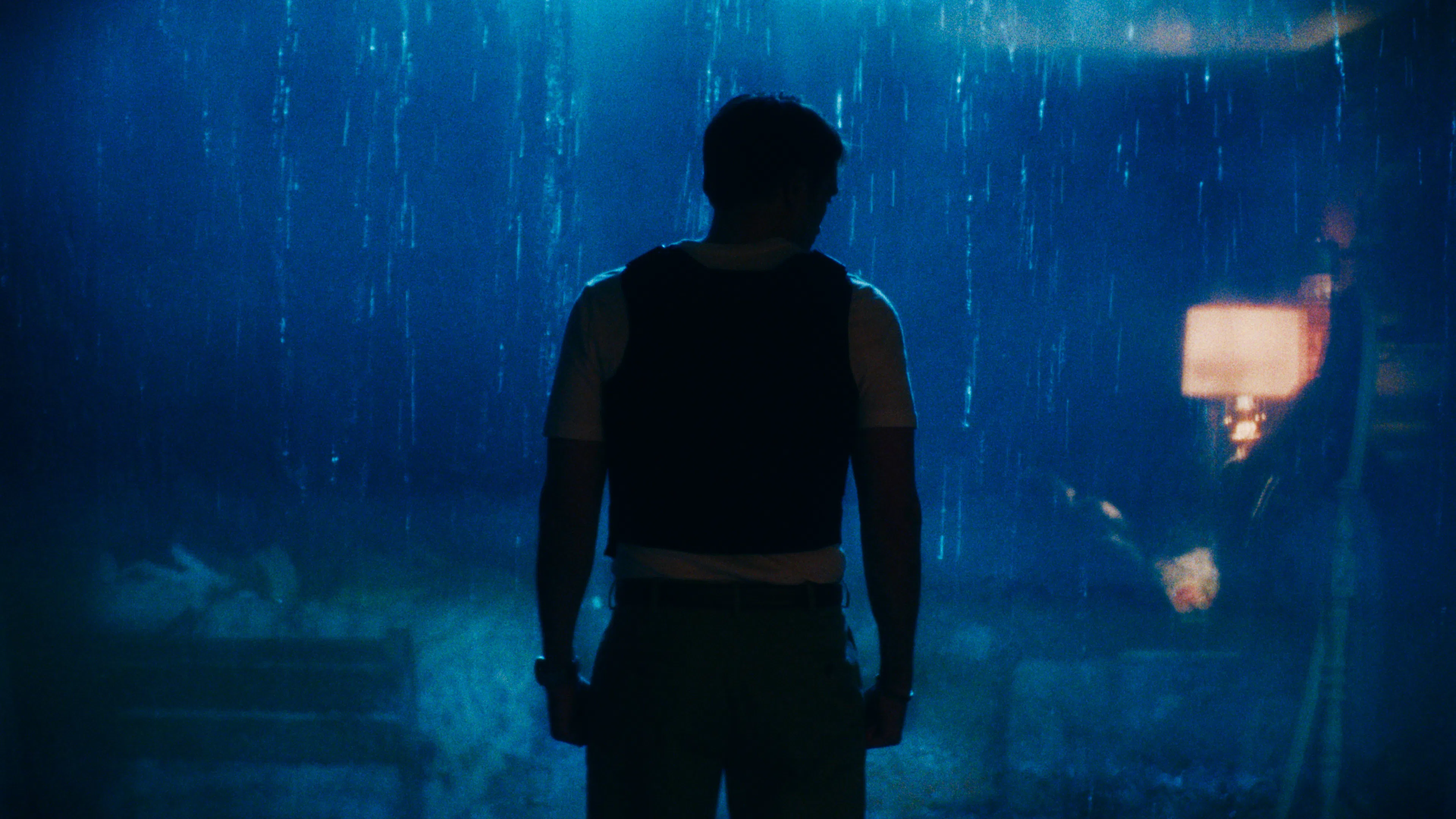
And Andy certainly doubles down after the tragedy of the botched sting unfolds: Once the heavily armed police officers of Murphy, Texas swarm into the house of assistant district attorney Bill Conradt (Alex Winter), whom To Catch A Predator were trying to out as a predator, the operation ends with a gunshot. Conradt shoots himself (Hansen briefly seeing Conradt through the window, his face looking like a mask of an ancient monster), and the show’s latest mission is a failure. While everyone else sits in shock, Andy assures, “I can work with this.” However, we see Dan, sitting in the police car, silently leave, while Hansen seems to be shell-shocked that he failed to get his “whale.”
“The thing to me that always [binds] the movie together and the characters together, and to me it was always about the emotional toll that the work would take, even the climax at the end,” Oppenheim says. “It's something that you can see on the show. It's something you can see in David Oset's brilliant documentary, Predators. What I thought the film could maybe explore was how that affected the characters in real time and the aftermath, the lingering feeling of essentially achieving everything you've ever dreamt of with this primetime slot.”
The Actual Ending, And How It Changed
The film doesn’t cut to credits there. Instead, we jump forward to a few months later, with Dan receiving a package that got delivered to the wrong house. He opens it, and we see: It’s his SAG card.
In a Q&A following an LA screening of Primetime, Oppenheim revealed that this ending was actually Gisondo’s idea. “I remember we were coming to the end of the film and the movie ended a little bit earlier, and I just kept thinking, ‘I don't want it to end in this sort of way that makes you just completely f*ck my life,” Oppenheim said. “I want it to end in a way that there's still something around the corner and you could read it a few different ways and that he has an opportunity to keep going even if he shouldn't.”
Gisondo is humble about his role, telling Inverse that he simply played Dan as an “amalgamation of all these decoys.”
“It was more about just the general...way that they navigated the space, their relationship to the cameras and the perform tonally with the performance, how far they were taking it, how much they were changing the voice,” Gisondo says.
But perhaps it was because Gisondo’s Dan was so moldable and not based on any one real person that Oppenheim could effectively play out the movie’s themes — about the cost of turning complicated, high-stakes issues into entertainment — through him.
“I liked seeing the devastation of what this experience had caused for him, the true emotional toll,” Oppenheim said. “He's the person who starts as this naive guy who doesn't know anything about the world, and by the end he's affected by it.”