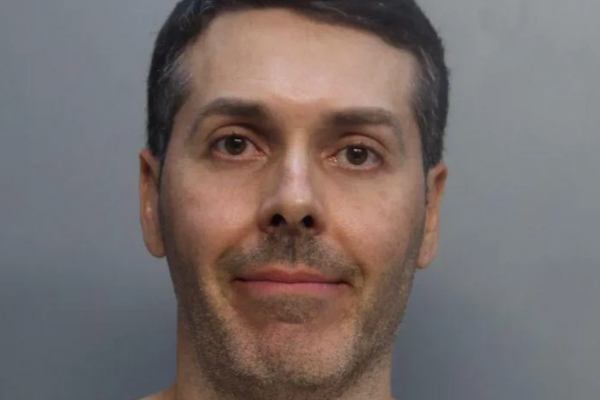
SANTA CRUZ DE LA SIERRA, Bolivia — Fernando Cerimedo, the Argentine political consultant accused of ordering an ambush that left his former partner bleeding on a hotel driveway, will spend the next six months in a Bolivian prison cell while investigators build a case against him. A judge in Santa Cruz ruled Friday night, after a marathon hearing, that Cerimedo poses enough of a flight and evidence-tampering risk to be held for 180 days — the maximum Bolivian law allows at this stage — while prosecutors pursue an attempted-feminicide charge tied to the August 17 shooting of lawyer and political activist Nadia Beller.
What started as a violent attack on one woman has, in the space of a single week, pulled in a sitting vice president's public criticism of his own government, a second and unrelated corruption probe, allegations of a rogue police unit and drug-flight payoffs, and now commentary from the presidents of two other countries. Some of what's being alleged remains just that — allegations. But the pieces that have moved from claim to confirmed fact are enough on their own to make this one of the more consequential scandals to hit Bolivian politics in years.
The ruling: 180 days, over defense objections
Cerimedo's lawyers raised four separate challenges before the detention question was even argued — over the legality of his arrest, whether Argentina's embassy had been properly notified, the validity of the charge itself, and how a seized phone had been analyzed. Judge Wilson Espada rejected all four and let the hearing proceed. Prosecutors then laid out what they called five separate procedural risks justifying detention; the defense pushed back hard, particularly on how phone data had been obtained. After a break of nearly three hours, Espada sided with the prosecution, ordering the maximum 180-day term. He sent Cerimedo not to the high-security Chonchocoro prison prosecutors had requested, but to Palmasola, Bolivia's largest and most crowded penitentiary, on the outskirts of Santa Cruz. He left the courthouse in handcuffs, flanked by at least three officers.
The most consequential new material at Friday's hearing came from Cerimedo's own phone. Beller's attorney told reporters that messages recovered from the device include an exchange in which the sender discusses needing to get rid of someone described as having "gone too far," alongside separate messages that appear to place Beller at the hotel before the attack. Prosecutors say a technical review validated the phone data; Cerimedo's defense argued the messages were extracted improperly and shouldn't be admissible at all. The judge disagreed and allowed prosecutors to enter the material into the case file — though its authenticity and what it actually proves remain contested and will presumably be argued further as the case proceeds.
Two days before the ruling, Bolivian police arrested a man and a woman in northern Santa Cruz, reportedly with motorcycle helmets in their possession matching the type worn by the attackers. Investigators believe the man may have driven the motorcycle used in the attack; the woman is described as a partner of one of the men suspected of firing the shots. None have been formally identified by authorities as one of the two gunmen who approached Beller dressed as delivery couriers; that identification is still pending.
A wound count still hard to pin down — but a medical record that cuts one way
Beller has said in one interview that she took four shots, to her arms, chest, and a rib. Cerimedo's attorney, Margarita Arce, has publicly insisted the opposite — that ambulance records show only two wounds, one in each shoulder — and used that gap to argue Beller shot or staged her own injuries to damage the government from the inside. The clinic that treated her, Clínica Las Américas, put its findings in writing: gunshot damage to her chest, right arm, neck, and left shoulder, including an open, shattered fracture of the right humerus that required emergency surgery with a plate and provisional pins, plus two bullet fragments removed and a third foreign object lodged near her collarbone that never broke the skin. That's a broader injury picture than "two shoulder wounds," and multiple outlets have reported the clinic's findings as directly contradicting the self-inflicted-attack theory Arce has floated. What it doesn't do is settle the exact number of rounds fired — the report speaks of "multiple" wounds rather than counting bullets one by one, so neither side's specific number is fully proven or fully disproven by it.
Beller left the clinic on Saturday, five days after she was admitted, wheeled out under a heavy police escort that began massing outside roughly ten minutes before she emerged. She's now recovering at home under round-the-clock protection that Bolivian authorities say includes personnel trained specifically in gender-violence cases. She used her first public moment outside the hospital to repeat, in her own words, that she believes she was targeted because of what she knew — a continuation of the accusation she's made from the start.
Her account of that night, and the months before it
Beller says her connection to Cerimedo began professionally: she was brought in to review a package of emergency economic decrees and immediately flagged them as unconstitutional, and the working relationship became a romantic one from there. She says it turned abusive months before the shooting, when Cerimedo choked her during an argument — a claim that Bolivian media report had already circulated as rumor before August 17, and which Cerimedo had previously and publicly denied. She says she was drawn to the hotel with the promise of meeting someone holding damaging material on former President Evo Morales, and that armed escorts Cerimedo had promised never materialized. She says she survived by playing dead for roughly half an hour after being shot. Notably, prosecutors' own theory of the case reportedly overlaps with much of this: that Cerimedo persuaded her to go to that hotel under an intelligence-related pretext and told her guards would be waiting.
She also says she is four to six weeks pregnant, a window the clinic's own report confirms without attributing paternity, and that Cerimedo went with her to a prenatal scan and paid for it the day before she was shot.
The corruption claims that go well beyond the shooting
Beller's allegations don't stop at the attack itself. She says Cerimedo is compensated not through any state salary but through commission arrangements with private firms; that he and an associate control fuel-storage interests connected to Argentina; that President Paz's wife and her relatives broker insurance commissions with state companies; and that texts on her confiscated phone showed Cerimedo and the first lady discussing a per-liter cut on gasoline moving through Bolivia's fuel-quota system, this during years of chronic shortages. She's separately described an "elite" police unit that she says answers only to Cerimedo and operates near the hotel where she was shot, and has claimed knowledge of conversations in which he discussed letting small planes tied to drug trafficking take off, which she says he justified to her as a radar-monitoring tactic aimed at eventually intercepting them — allegedly in return for payoffs.
Beller has additionally said Cerimedo told her he worked for the CIA, and that he separately described his ex-wife, Natalia Basil, and American political consultant Brad Parscale — who ran digital strategy for Donald Trump's campaigns — as having intelligence-community ties as well. Argentine political journalist Alejandra Loucau, who has reported extensively on Cerimedo's business network, has said flatly that the CIA claims rest on Beller's word alone, with nothing independent behind them so far.
None of these financial or intelligence claims have been substantiated by investigators, journalists, or public records as of this writing. They remain allegations from one side of a bitter dispute.
A second, separate case: unexplained wealth
Two days after the shooting, prosecutors in La Paz opened their own investigation into Cerimedo, unrelated to the attack, over suspected illicit enrichment and money laundering. Searches of two properties tied to him turned up cash stuffed in drawers, a satellite phone, a vehicle finished to resemble an official government car, furniture with concealed compartments, and business cards identifying him as "chief adviser to the president of Bolivia, Rodrigo Paz." Presidential spokesman José Luis Gálvez, who initially said Cerimedo held no formal government role whatsoever, later acknowledged he served as an outside adviser without drawing a salary, while insisting the state never authorized the "chief adviser" title on those cards. A prosecutor in La Paz says the seized cash is still being counted.
Arce has repeatedly dismissed the entire case as "a political show," and has gone further to argue the shooting itself was staged — an "autoatentado" she says was engineered to weaken a government aligned with her client. She's also disputed that Cerimedo fathered Beller's pregnancy, telling reporters the two never had more than a brief flirtation. When reporters approached Cerimedo as he arrived for what turned out to be his postponed first hearing, he mostly declined to answer questions and appeared visibly shaken, saying only that he wanted to see his children.
A crisis that's crossed borders
Bolivia's government has tried to walk a careful line. Vice President Edmand Lara, who has publicly clashed with Paz since the two shared a ticket in last year's runoff, confirmed Cerimedo's role as the president's personal adviser and demanded the process move "without any kind of favoritism," adding that the government "must not shield anyone." Paz himself has ordered the investigation to proceed unconditionally while largely steering clear of commenting on Cerimedo personally.
Beyond Bolivia, the case has drawn in other heads of state. Argentina's President Javier Milei has reposted social-media messages from allies questioning Beller's credibility — notable given Cerimedo's history running digital strategy for Milei's own campaigns. Mexico's President Claudia Sheinbaum has publicly labeled Cerimedo a "feminicida." And former Bolivian President Evo Morales, who Beller says she was lured to the hotel to hear about, has called for a fully transparent investigation of his own. What began as a shooting outside a Santa Cruz hotel is now a story several governments are weighing in on — while the core question of who ordered the attack, and why, is still being argued in a Bolivian courtroom.