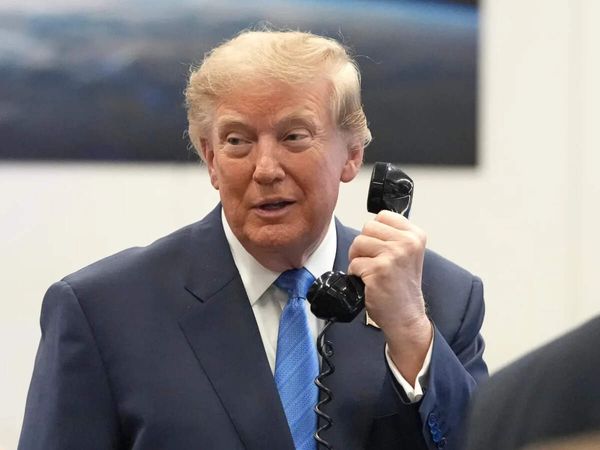
President Trump blinked today after his "Liberation Day" tariff/taxes catastrophe led to the worst S & P stock market performance for the start of a presidency since George W. Bush's first term. Trump reduced his blanket tariff for most nations to 10% (for 90 days) while raising tariff/taxes on imports from China. Tariff/taxes remain on imports of steel and aluminum and on trade with Canada and Mexico. Consumers will soon see rapidly rising grocery market prices for fruit and vegetables because of the Mexico tariff/taxes, and consumers will see the price of televisions, electronics, and iPhones skyrocket because of Trump's tariff/taxes on imports from China.
The U.S. Constitution gives Congress the power to impose tariff/taxes in Article I, Section 8, clause 1, and it gives Congress the power to regulate commerce with foreign nations in Article I, Section 8, Clause 3. Trump incorrectly claims that Congress has delegated that power to him under the National Emergencies Act (NEA) and the International Emergency Economic Powers Act (IEEPA) by declaring multiple "national emergencies" related to border security; the hollowing out of the United States' manufacturing base; the existence of trade deficits; and the threat posed by rising Chinese power, which Americans have known about since President Obama wisely pivoted U.S. security concerns to China fifteen years ago.
Webster's Dictionary defines "emergency" as follows: "1: an unforeseen combination of circumstances or the resulting state that calls for immediate action; 2: an urgent need for assistance or relief." The problems President Trump is concerned about are ones that he has complained of for his whole forty years in public life, and Congress and the American people have known about them for decades. They are not unforeseen threats that require urgent action like a Russian or Chinese nuclear attack on the United States, nor are they problems in need of such urgent relief that Trump can address them while bypassing Congress. The statutes Trump invokes, NEA and IEEPA, were passed in the 1970's to curtail presidential claims of emergency power, not to broaden such power.