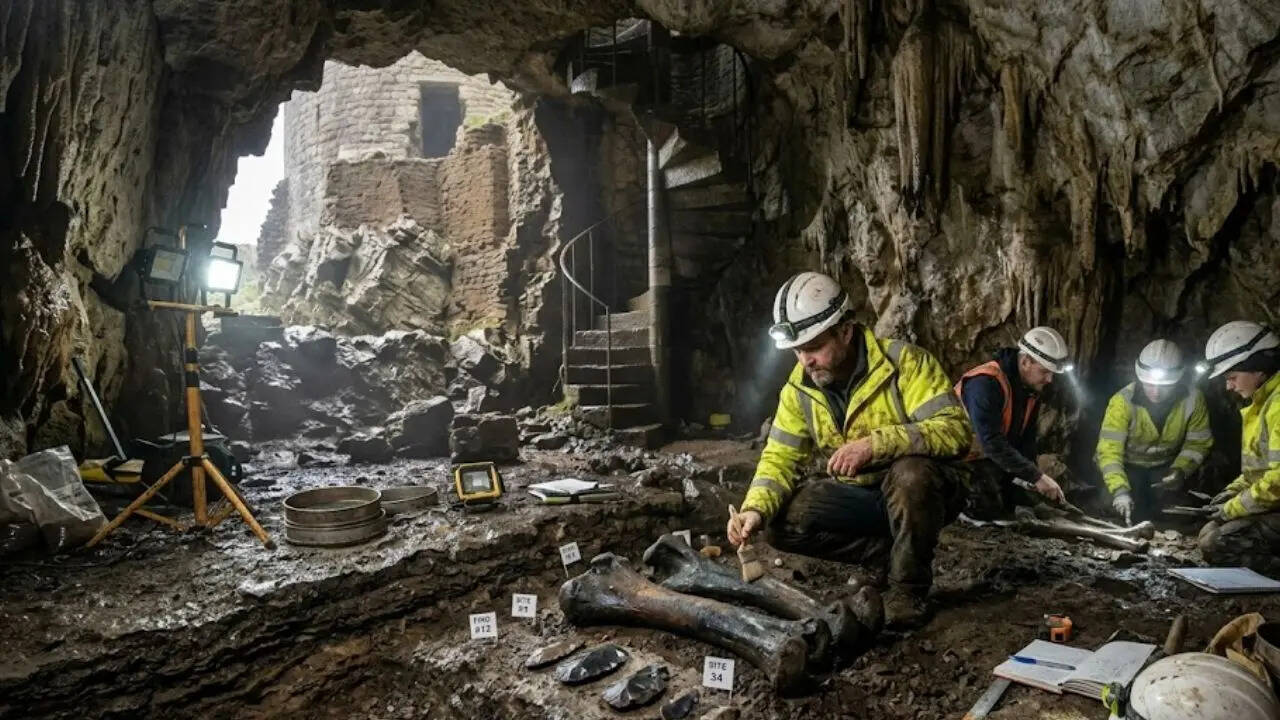
Archaeologists have uncovered a ‘once-in-a-lifetime’ archaeological treasure trove within Wogan Cavern, a massive subterranean chamber hidden directly beneath the 11th-century Pembroke Castle. While previously dismissed by Victorian-era explorers as empty, modern small-scale excavations conducted between 2021 and 2024 revealed remarkably intact sediment layers.
According to the University of Aberdeen, these deposits contain an extensive prehistoric archive, including stone tools and fossils of extinct species like mammoths, woolly rhinoceroses, and a hippopotamus dating back approximately 120,000 years. Led by the University of Aberdeen, a new five-year, large-scale investigation aims to utilise advanced techniques, such as ancient DNA analysis and high-resolution dating, to map human occupation and environmental shifts spanning over 100,000 years of British history. This research project promises to redefine our understanding of prehistoric human migration patterns and the dramatic evolution of the local environment.