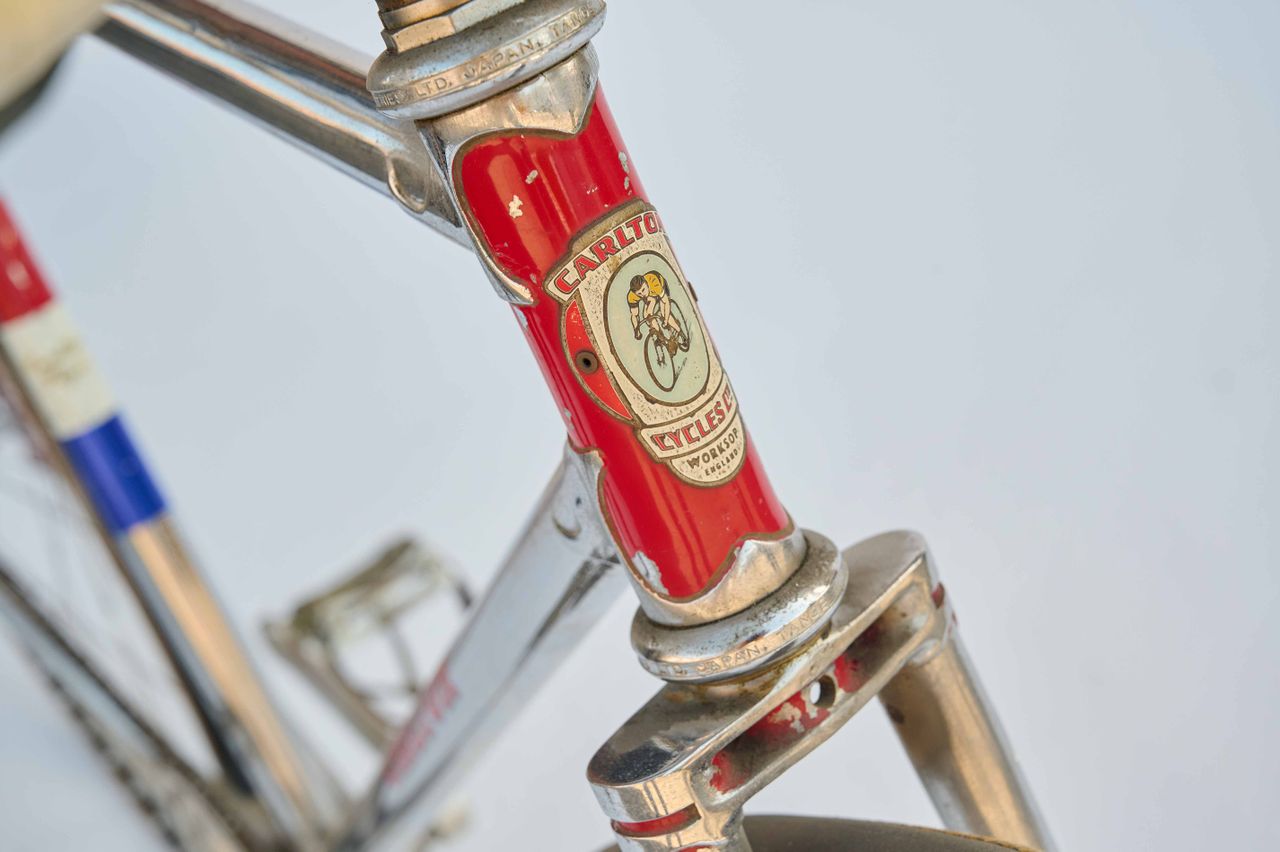
Polished to perfection, Karl Barton’s All Chrome Carlton Flyer would have blazed like a comet with its tail on fire around the steep banking of Japan’s Hachioji Velodrome at the Tokyo ’64 Olympic Games.
At 5 ft 4 in (167cm), Barton was a diminutive rider yet a giant of the track. “I watched him race at Butts Stadium in Coventry,” recalls current owner, Dave Marsh, of the Universal Cycle Centre, Rotherham. “He’s a short guy, but very punchy - a dominant force on the UK track in the mid-1960s.”

The Carlton Flyer was immensely popular among Barton and his peers, not least because it was a formidable race weapon on both track and road. As Carlton’s hero product, Gerald O’Donovan, the brand’s manager, was quick to realise its marketing potential too. “It’s amazing how many pros were on Carlton Flyers,” says Marsh. “Gerald actively sought to provide every talented rider with one.”
Barton’s bike is memorable for several reasons. The scarlet headtube is, of course, noticeably short, but it’s the red, white, and blue bands on the seat tube that catch the eye.
They probably represent the UK’s colours but may celebrate Barton’s record as a British track champion. He won the British National Individual Sprint Championships in 1962, 1963, and, just months before Tokyo, 1964.
The frame is Reynolds 531 double-butted throughout, as are the round track forks. The Campagnolo Pista chainset is unusual by today’s standards because it’s fitted with a 23-tooth 1” pitch ring. Similarly, the rear sprocket has seven generously spaced teeth.
These are coupled with a 1” pitch block chain, which uses solid blocks in place of inner links. This construction makes the chain immensely strong, an advantage at a time when it wasn’t unheard of for powerful sprinters, like Barton, to break regular chains.
Ultimately, the podium eluded Barton in Tokyo, and his star waned. He went on to forge a successful career helping O’Donovan export Carlton bikes into North America.