Get all your news in one place.
100’s of premium titles.
One app.
Start reading
Budget and the Bees
Budget and the Bees
Latrice Perez

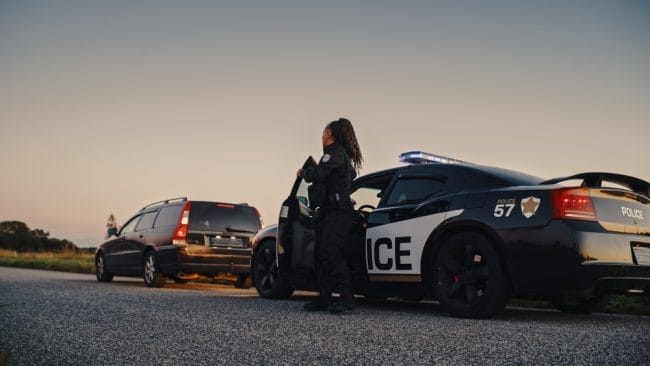
Police Warning: The New “Digital Tint Meters” Officers Are Using to Fine Drivers in 2026

digital tint meter warning
Image source: shutterstock.com

For years, window tint remained a gray area where officers usually ignored it unless it was egregiously dark. However, that grace period is officially over in 2026 because enforcement has gone high-tech. Specifically, police departments across the country are rolling out “Digital Tint Meters” to take the guesswork out of the citation. Unlike the old clunky devices that required an officer to slide a card over your glass, these are instant, handheld photometers. They deliver a legally binding reading in seconds. Therefore, if you bought a used car with tinted windows, beware. You might be driving a rolling target for a massive fine.

This crackdown involves more than just safety; in reality, it is also about revenue. Budget cuts are hitting departments hard, so strict enforcement of “equipment violations” offers an easy fix to fill the coffers quickly. Furthermore, the new digital meters measure Visible Light Transmission (VLT) with pinpoint accuracy. This means you can’t talk your way out of a ticket by saying “it came from the factory like this.” The machine gives a specific number, and if that number is 29% when the law says 35%, you lose. Ultimately, it is a binary system that leaves zero room for officer discretion.
1. The “Stacked Tint” Problem

Many drivers don’t realize that their car windows come from the factory with a tint already embedded in the glass. Usually, it blocks about 3-5% of light. However, when you pay for “legal” 35% film, you create a significant problem. You are actually stacking that film on top of the factory tint, which pushes the total light transmission down. As a result, it often drops to around 30% or lower, making you technically illegal. The new digital meters read the total light passing through rather than just the film layer. Consequently, this mathematical trap catches thousands who thought they were following the rules.

2. It’s Not Just a “Fix-It” Ticket Anymore

In the past, a tint ticket was merely a minor “fix-it” ticket where you peeled off the tint, showed a cop, and the fine was waived. However, that leniency is disappearing as jurisdictions favor non-negotiable fines. These can range from $100 to $500 per window. In addition, some states are classifying it as a moving violation if it obstructs the driver’s view. This can add points to your license and subsequently spike your insurance rates. Thus, the financial risk has shifted from a nuisance to a serious liability. Removing the tint is now the cheaper option.

3. The “Profile” Stop

Let’s address the elephant in the room: tint enforcement often serves as a pretext for other investigations. Dark windows give officers probable cause to stop a vehicle to check the VLT percentage. Once the car is stopped, however, the situation changes. For example, they can look for other infractions or smell for substances. Furthermore, they will run the driver’s ID. By driving with illegal tint, you invite this scrutiny. In other words, you are waiving your right to go unnoticed and giving them a legal invitation to intervene. Blending in is your best defense in an era of automated readers.

4. The Medical Exemption Loophole

There is one valid way to keep your dark tint, but you need to do the paperwork first. Specifically, you must do it before you get pulled over. Most states allow for medical exemptions if you have a light sensitivity condition like lupus or melanoma. However, you cannot just tell the officer; you must have a specific affidavit. Additionally, it must be signed by a physician. Usually, you also need a dedicated sticker on the vehicle. If you genuinely need the protection, act now and get the certificate today. Keep it in your glove box because the digital meter doesn’t care about your health history.

5. The Accuracy of the New Tech

Older tint meters were flawed because they could be calibrated incorrectly or influenced by ambient light. This gave drivers a chance to fight in court. Conversely, the new generation is different. Digital meters are calibrated automatically and are notoriously difficult to challenge. Since they use a two-piece system that magnetically connects through the glass, they block out all ambient light. Therefore, you get a perfect reading. “Courtroom arguments” about cloudy days won’t work because the technology has closed the loophole. Human error is gone, making the citation almost bulletproof.

Key Takeaway: Test Your Own Glass

Don’t wait for blue lights in your rearview mirror; find out if your car is legal now. You can buy a cheap tint meter online or go to a reputable shop to meter your glass for free. If you are hovering on the borderline, act smart by stripping it and going lighter. After all, the cool aesthetic of “limo tint” is not worth the anxiety it causes every time you drive. You scan for police cars constantly. In 2026, visibility is the new luxury.

Have you been stopped for window tint recently? Tell me if they used one of these new meters on your car.

What to Read Next…

The post Police Warning: The New “Digital Tint Meters” Officers Are Using to Fine Drivers in 2026 appeared first on Budget and the Bees.

Sign up to read this article
Read news from 100’s of titles, curated specifically for you.
Already a member? Sign in here
Related Stories
Top stories on inkl right now
One subscription that gives you access to news from hundreds of sites
Already a member? Sign in here
Our Picks
Fourteen days free
Download the app
One app. One membership.
100+ trusted global sources.