Get all your news in one place.
100’s of premium titles.
One app.
Start reading
The Independent UK
The Independent UK
National
Amy-Clare Martin

Police to use River Thames as a barrier for first time in bid to stop al-Quds protesters from clashing

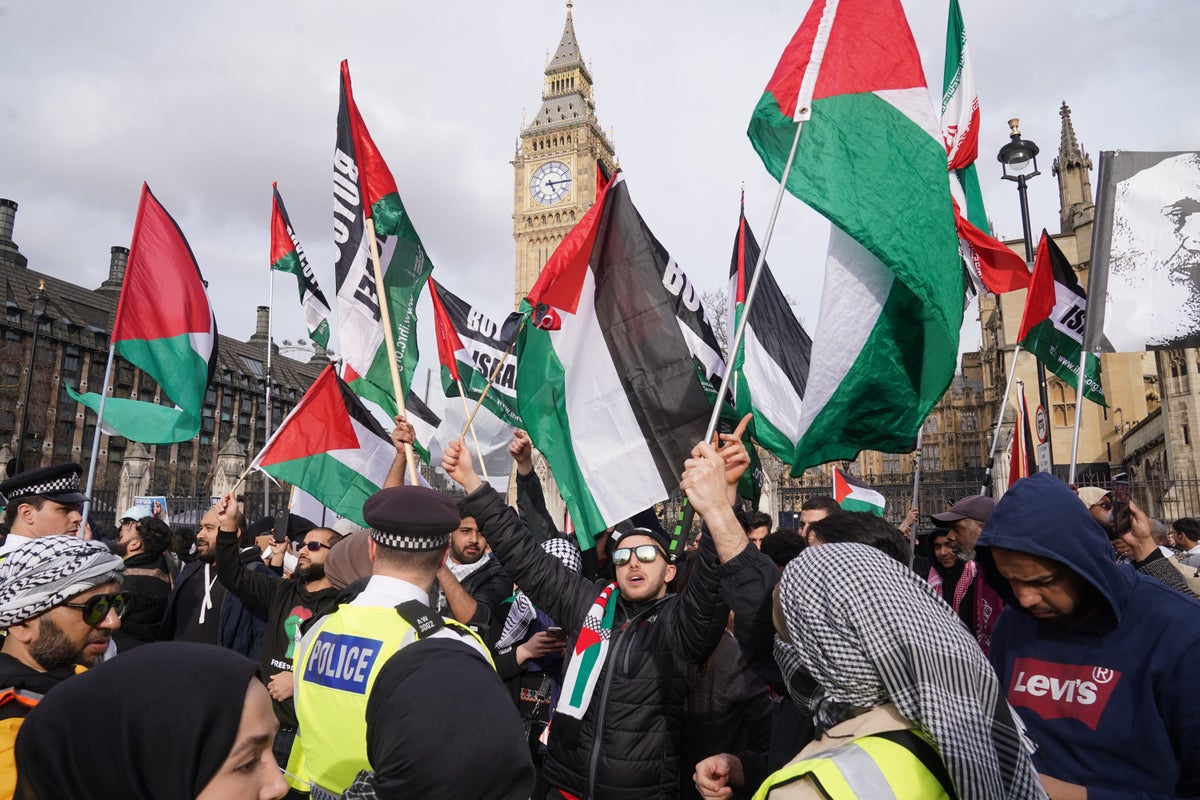
The annual al-Quds rally will be limited a static event on the south side of the Thames - (PA)

The police will use the River Thames as a “barrier” to keep al-Quds protesters and counterprotesters apart in a bid to prevent disorder.

The Metropolitan Police, which has already successfully applied to ban protesters from marching, has revealed it is using the “new, bespoke” tactic to prevent clashes as rival groups plan static demonstrations on Sunday.

More than 1,000 officers, including some drafted in from other forces, will be deployed in the capital to manage the events, which will be subject to strict conditions and must take place between 1pm and 3pm.

Al-Quds demonstrators will be limited to the south side of the river, to Albert Embankment, while at least four planned counterprotests will be restricted to zones on the north side, near Millbank.

Marine units will be stationed in the water and large numbers of officers will be deployed near Lambeth and Vauxhall bridges to prevent the groups from crossing.

Deputy assistant commissioner Ade Adelekan said the tactic has not been tried before in recent policing history but will provide a “clear divide” between protest areas, adding: “One of the benefits of these conditions is the groups will have different transport links in and out of the protest. In our assessment, this will significantly reduce the risk of serious disorder.”

The River Thames will act as a barrier between protest groups (Getty)

However, despite the measures, he admitted the police cannot completely eliminate the risk of clashes breaking out.

He revealed the force is expecting roughly 6,000 protesters and 6,000 counterprotesters, but said predicting numbers is not an “exact science”.

Mr Adelekan defended the force’s decision to request that the annual march be banned to prevent “serious public disorder”, the first time a protest march has been banned since 2012. Home secretary Shabana Mahmood approved their request this week, however static demonstrations can still go ahead.

The annual al-Quds Day march in London has always been seen as pro-Iranian, drawing criticism after its organisers expressed support for the country’s late leader Ayatollah Ali Khamenei. Organisers say it is more of a pro-Palestine event.

Mr Adelekan insisted the decision, taken in the context of the ongoing conflict in the Middle East, was not taken lightly and was based on a “comprehensive assessment” of the risks.

“There wasn’t a single piece of intelligence,” he said. “Our assessment was an absolute comprehensive assessment that took into account the event itself, the history of the event, really the intelligence in its entirety and the intelligence gap, a sense of the community impact, a sense of community tension, our understanding of having policed almost thousands of protests over each year, and our understanding of what this event will bring us.”

He warned that anyone who fails to comply with the restrictions will face arrest and officers will take a zero-tolerance approach to hate crime or anyone seen showing support for a proscribed organisation.

Shabana Mahmood approved the Met’s request to ban the march (Parliament TV)

The Met has said previous al-Quds Day marches resulted in arrests for supporting terrorist organisations and antisemitic hate crimes.

However, the Islamic Human Rights Commission, which organises the event, has previously insisted the demonstration is always “good-natured and peaceful”, saying it “strongly condemns” the ban and was seeking legal advice.

Confirming a “static protest” will go ahead on Sunday, the statement said: “The police have brazenly abandoned their sworn principle of policing without fear or favour. They cannot present evidence because there is none.

“In essence, this is a politically charged decision, not one taken for the security of the people of London.”

The Community Security Trust, a charity that protects the Jewish community from antisemitism and terrorism, welcomed the decision to ban the march, which they said comes at a time of “unprecedented volatility”. Last week, four people were arrested by counterterrorism police on suspicion of assisting Iran’s intelligence service.

Sign up to read this article
Read news from 100’s of titles, curated specifically for you.
Already a member? Sign in here
Related Stories
Top stories on inkl right now
One subscription that gives you access to news from hundreds of sites
Already a member? Sign in here
Our Picks
Fourteen days free
Download the app
One app. One membership.
100+ trusted global sources.