Get all your news in one place.
100's of premium titles.
One app.
Start reading
The Economic Times
The Economic Times

PM Modi flags off India's first hydrogen-powered train in Haryana, joins select global club of nations

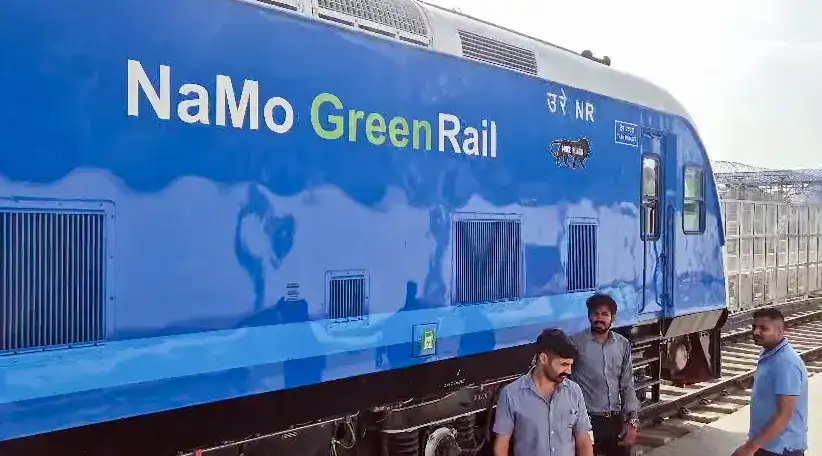
Prime Minister Narendra Modi on Friday flagged off India's first hydrogen-powered train on the Jind-Sonipat section in Haryana.

PM described the Jind-Sonipat hydrogen-powered train as the world’s most powerful, saying it is a successful example of the ‘Make in India’ initiative and India’s growing technological capabilities.

Calling the 3,200-horsepower hydrogen train different from conventional rail services, PM Modi said dedicated infrastructure and systems had been developed in Jind to support its operations. During the event, the Prime Minister also handed over symbolic keys to beneficiaries of the Pradhan Mantri Awas Yojana-Gramin and said Jind was becoming “a picture of the NDA’s governance” through the Centre’s development initiatives.

He also said, "Today, Jind is becoming a picture of NDA's governance: PM Modi after launching development projects in Haryana."

The Hydrogen Fuel Cell Trainset generates its own electricity onboard through a chemical reaction between hydrogen and oxygen, producing water vapour as its only by-product, the Railways Ministry said.

The 10-coach train, with a capacity of around 2,600 passengers, has an operational speed of 75 kmph and a design speed of 110 kmph on the 89-km route. It comprises two Hydrogen Driving Power Cars and eight Trailer Coaches, together generating 2,400 kW of power.

Also read: Hydrogen-powered trains likely to play niche role in India: Experts

A dedicated hydrogen storage, compression and dispensing facility at Jind, capable of storing nearly 3,000 kg of hydrogen, will support refuelling, the ministry said, calling it India's first integrated hydrogen railway ecosystem.

The trainset was designed and developed indigenously, with RDSO formulating technical specifications, Medha Servo Drives integrating the train, and ICF contributing to its exterior design. The project underwent third-party safety assessment by TUV SUD, Germany, before commissioning.

What is the hydrogen train?

The 10-coach train has a capacity of around 2,600 passengers and comprises two Hydrogen Driving Power Cars (DPCs) and eight Trailer Coaches. Each DPC houses fuel cells, lithium iron phosphate batteries and hydrogen storage cylinders, together generating 1,200 kW of power per car. The train is approved to run at 75 kmph, with a design speed of 110 kmph, on the 89-km route connecting Jind Junction, Gohana Junction and Sonipat.

How does the technology work?

The train's primary energy source is a Proton Exchange Membrane Fuel Cell (PEMFC), which generates electricity by reacting hydrogen and oxygen across a proton-conducting membrane. Hydrogen carries an energy density of 120 MJ/kg, nearly three times that of diesel at 43 MJ/kg, making it among the cleanest propulsion technologies available for rail transport, per the PIB release.

What infrastructure supports it?

Indian Railways has set up the country's largest railway hydrogen storage and refuelling facility at Jind, capable of holding nearly 3,000 kg of hydrogen at a time. The Petroleum and Explosives Safety Organisation (PESO) has licensed the site for storage and dispensing of compressed hydrogen gas. The facility includes a hydrogen compression system and a standby compressor to ensure uninterrupted refuelling, besides technical support and critical spares.

Sign up to read this article
Read news from 100's of titles, curated specifically for you.
Already a member? Sign in here
Related Stories
Top stories on inkl right now
One subscription that gives you access to news from hundreds of sites
Already a member? Sign in here
Our Picks
Fourteen days free
Download the app
One app. One membership.
100+ trusted global sources.