Get all your news in one place.
100's of premium titles.
One app.
Start reading
Reason
Reason
Politics
Eugene Volokh

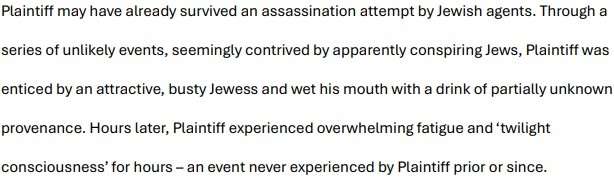
"Plaintiff Was Enticed by an Attractive, Busty Jewess, and Wet His Mouth with a Drink of Partially Unknown Provenance"

That's from plaintiff's follow-up arguments for pseudonymity filed Saturday in Doe v. Trustees of Univ. of Pa. (E.D. Pa.). Judging by the address listed in the filings, as well as the rhetoric (e.g., "The Jews are a racial supremacist organization whose stated goal is to exterminate and enslave all non-Jews"), this seems to be the same John Doe who was denied pseudonymity in a case I wrote about in February, see No Pseudonymity for Man Suing Harvard Alleging Jews Aim "to Exterminate or Enslave All Non-Jews".

I expect the same ruling on pseudonymity in this case as in that one (despite the addition of the busty Jewess, who did not seem present in that case); to quote Judge Allison Burroughs' decision in that case, Doe v. President & Fellows of Harvard College:
While it is within the Court's discretion to allow a party to proceed under a pseudonym, "[a]s a general rule, the presumption is that all judicial proceedings remain open to the public." "The presumption against pseudonymous litigation gives way only in 'exceptional cases.'" The analysis is as follows: "1) there is a presumption in favor of disclosure; 2) a party may rebut the presumption by showing that a need for confidentiality exists; 3) the court must balance the need for confidentiality against the public interest in disclosure." Alleged risks of harm that are speculative in nature, generalized, or without corroboration do not justify anonymity.

Having considered Plaintiff's Motion, the Court finds that Plaintiff has not rebutted the presumption in favor of disclosure. Plaintiff states that the litigation involves sensitive personal information regarding Plaintiff's ethnic heritage and academic records, and Plaintiff's identification would risk causing Plaintiff "unusually severe" professional, financial, and physical harm. The alleged risks that Plaintiff sets forth in his motion are without corroboration and do not rise above a level of mere speculation. Further, lawsuits often "implicate substantial amounts of private information," and if warranted going forward, the Court may employ tools such as redacting or sealing documents to manage privacy concerns that arise during the litigation. In light of the foregoing, Plaintiff's Motion, is DENIED.

To be precise, it does seem likely that being publicly known to have made such arguments may cause "professional" and "financial" "harm." But many plaintiffs face the risk of professional and financial harm from their lawsuits.

Consider, for instance, employment law plaintiffs who might reasonably worry that future employers won't want to hire them if they're identified as litigious employees. Or consider plaintiffs who think they were fired based on race, sex, etc., but worry that the defendants will argue that they were instead fired because they acted incompetently or unethically. Or consider libel plaintiffs who worry that public filing will just further amplify the allegations over which they're suing.

Courts generally conclude that such risks are a normal feature of our open system of civil justice, and can't themselves justify pseudonymity. (See pp. 1457-60 of The Law of Pseudonymous Litigation for citations to many such cases.) That is likewise so, I think, for this particular would-be Doe's cases. There's a motion for reconsideration of the Harvard no-pseudonymity decision pending, but I don't expect Judge Burroughs to change her mind, and I don't expect Doe to prevail in this new case, either (or on his motion for pseudonymity in Doe v. Regents of Univ. of Cal.).

UPDATE 5/20/2026, 8:15 pm: The prediction as to Judge Burroughs' staying the course as to her Doe v. Harvard ruling proved true; from today's order denying Doe's motion for reconsideration:

The Court reiterates that the use of a pseudonym is allowed in exceptional cases where the party has a "reasonable fear that he will suffer severe harm." Doe v. Mass. Inst. of Tech., 46 F.4th 61, 67, 73 (1st Cir. 2022). This requires more than apprehension or speculation. See Liu v. Zwicker & Assocs., P.C., 25-cv-13820, 2026 WL 524163 (D. Mass. Feb. 25, 2026) (denying motion to proceed under a pseudonym in part because alleged harm was speculative); Doe v. Intel Corp., 786 F. Supp. 3d 576, 582 (S.D.N.Y. 2024) ("[C]ourts have rejected claims of harm where they are insufficiently 'particularized,' provided 'without corroboration,' or 'generalized' and 'conclusory.'" (quoting Doe v. Combs, No. 23-cv-10628, 2024 WL 863705, at *4 (S.D.N.Y. Feb. 29, 2024))).

Further, there is a strong public interest in transparent judicial proceedings. Id. at 67 ("letting a party hide behind a pseudonym dims the public's perception of the matter and frustrates its oversight of judicial performance"). Plaintiff "cannot use his privacy interests as a shelter from which he can safely hurl [] accusations without subjecting himself to public scrutiny, even if that public scrutiny includes scorn and criticism." Doe v. Indiana Black Expo, Inc., 923 F. Supp. 137, 142 (S.D. Ind. 1996).

As further explained in the Court's February 2, 2026 order, [ECF No. 7], Plaintiff has not rebutted the presumption against proceeding under a pseudonym, and his motion for reconsideration is DENIED.

Plaintiff also requests a stay of his disclosure requirements pending interlocutory appeal of the Court's denial of his motion to proceed under a pseudonym. [ECF No. 10]. "In determining whether to grant a stay, courts consider: (1) [W]hether the stay applicant has made a strong showing that [it] is likely to succeed on the merits; (2) whether the applicant will be irreparably injured absent a stay; (3) whether issuance of the stay will substantially injure the other parties interested in the proceeding; and (4) where the public interest lies." Does 1-3 v. Mills, 39 F.4th 20, 24 (1st Cir. 2022). The first two factors are most important. Id. Plaintiff has made essentially no showing, certainly not a strong showing, that he will succeed on the merits, and he has provided no credible, non-speculative argument that he will be irreparably injured absent a stay. Defendants have taken no stance as to whether a stay would cause them injury, and the Court presumes that it would not.

Finally, as explained above, the public has a strong interest in transparency, weighing against Plaintiff's request for a stay. See id. ("[T]he people have a right to know who is using their courts.") (quoting Doe v. Blue Cross & Blue Shield United of Wis., 112 F.3d 869, 872 (7th Cir. 1997)). Accordingly, Plaintiff's request for a stay is DENIED. Plaintiff is directed to file a notice of his legal name and address no later than June 2, 2026.(CAM) (Entered: 05/20/2026)

We may therefore learn who that masked man is, unless he chooses to drop his cases instead. On the other hand, regrettably, the identity of the "attractive, busty Jewess" may well remain a mystery ….

The post "Plaintiff Was Enticed by an Attractive, Busty Jewess, and Wet His Mouth with a Drink of Partially Unknown Provenance" appeared first on Reason.com.

Sign up to read this article
Read news from 100's of titles, curated specifically for you.
Already a member? Sign in here
Related Stories
Top stories on inkl right now
One subscription that gives you access to news from hundreds of sites
Already a member? Sign in here
Our Picks
Fourteen days free
Download the app
One app. One membership.
100+ trusted global sources.