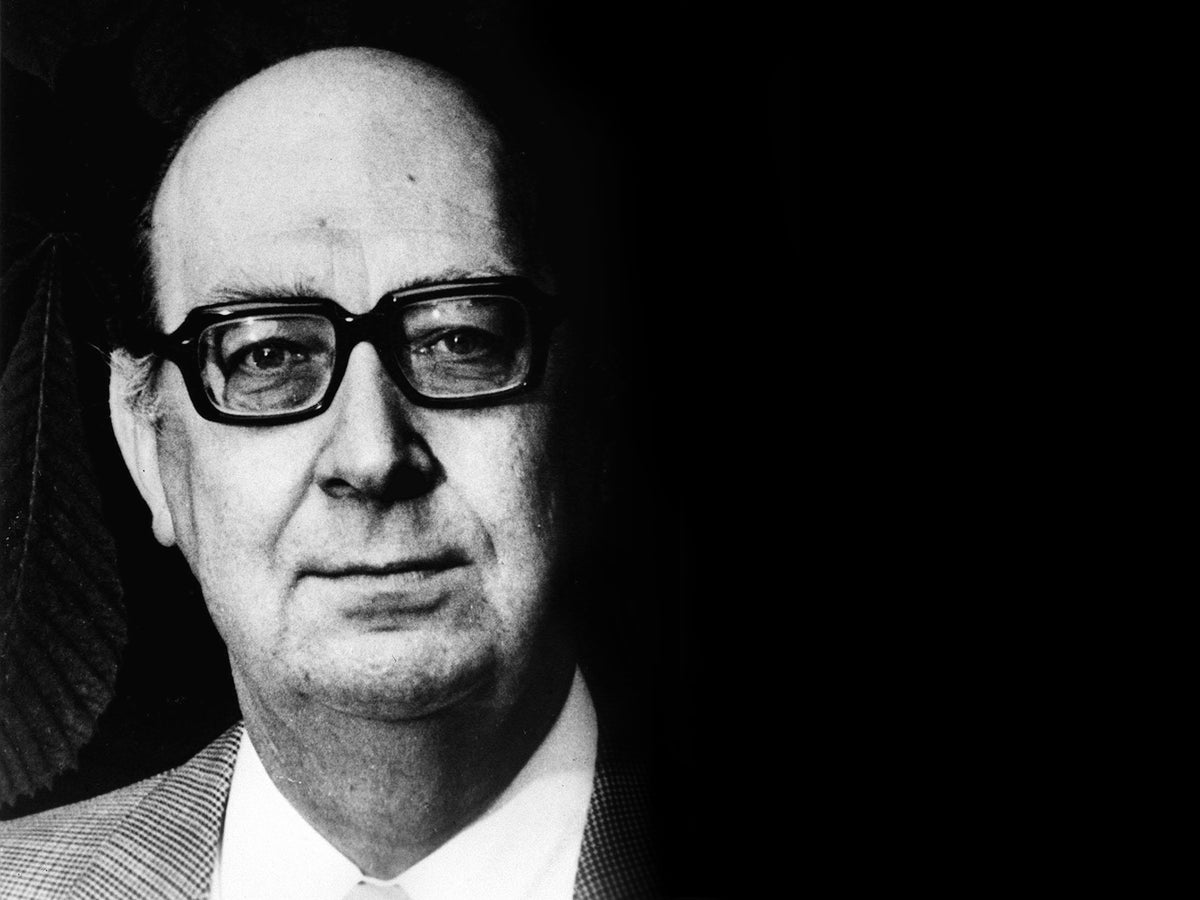
A few years ago, for a birthday treat, I went to Hull. I wanted to walk The Larkin Trail, a tour of various workaday locations that held some significance to the poet Philip Larkin. It took me to the Brynmor Jones Library at the University of Hull, where he was librarian for 30 years, and the nearby house on Newland Park where he lived until his death in 1985 at the age of 63. The trail ended a bus ride away in the village of Cottingham, at the Municipal Cemetery on Eppleworth Road. By the time I arrived the gates were locked, which is how I found myself scrambling over a low stone wall, drenched to the skin by the pouring Yorkshire rain, looking for a poet’s tombstone.
To me, Larkin is a writer worthy of sodden pilgrimage. Like generations of British school kids, I first read his poems in GCSE English class. I fell in love with “An Arundel Tomb” not because of its famous final words, “What will survive of us is love”, but for the morbid way he moderates that epigrammatic thought in the preceding lines, “to prove / Our almost-instinct almost true…” On his original manuscript draft, Larkin scrawled a cynical rejoinder to himself: “Love isn’t stronger than death just because statues hold hands for 600 years”.