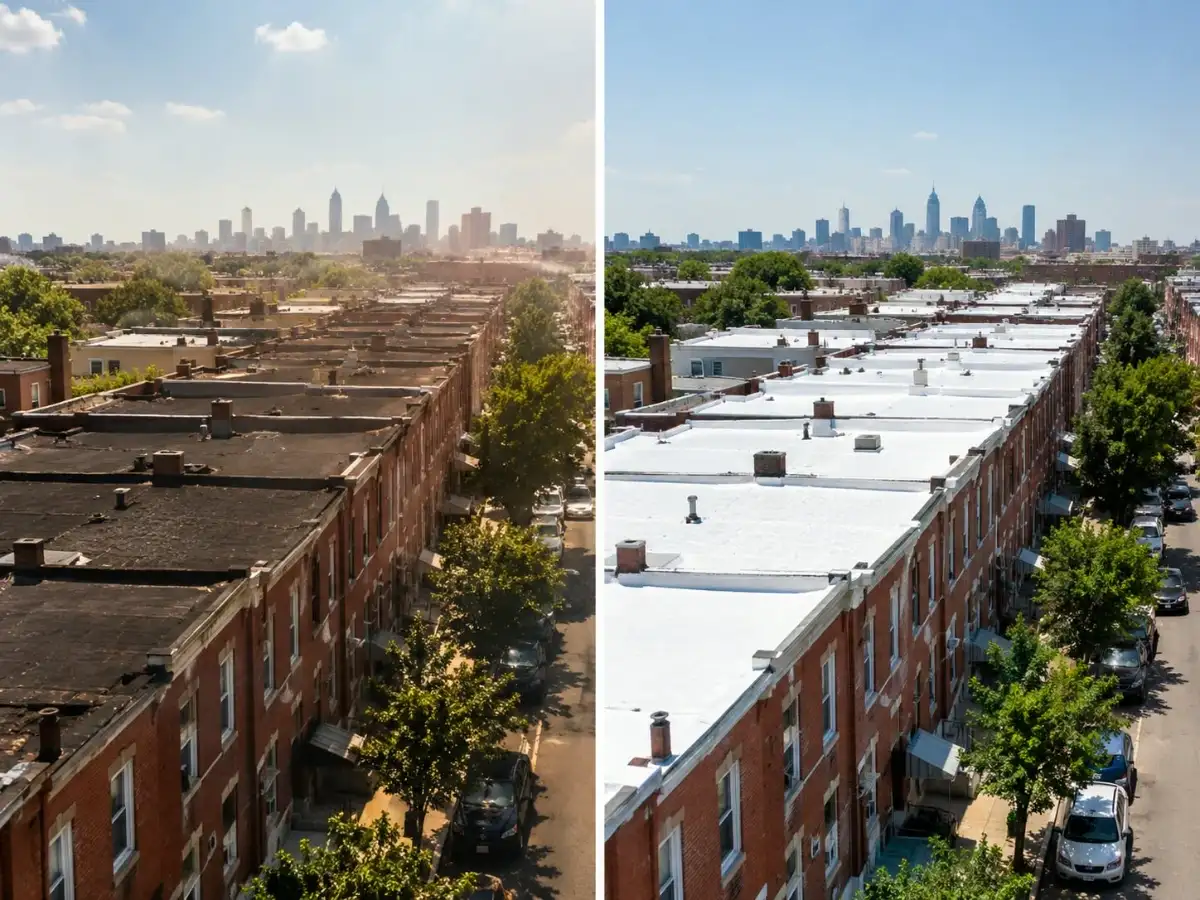
Row Houses are upgraded in North and West Philadelphia in a not-so-sleek way: roofs were painted white between 2001 and 2003. No solar panels, no smart thermostats, and no social media-worthy retrofit. Just paint. They were near-embarrassingly successful for such a low-tech thing. The pilot, run by Philadelphia's Energy Coordinating Agency (ECA), covered roughly 340 low-income seniors' homes and found that peak indoor air temperatures in un-air-conditioned top-floor bedrooms fell by approximately 2°F, while roof/ceiling surface temperatures, which absorb sunlight directly, dropped a larger 4–5°F. A 2009 Inside Climate News article later reported on these earlier ECA pilot findings; it was not the original source of the data. The average annual power usage for air-conditioning in each home dropped by about 560 kilowatt-hours.
If you don't understand what this actually means, then consider the following: this amount is comparable to the amount of energy an average window air conditioner could consume over the course of an entire summer in the U.S. For the senior population with low incomes living in houses where the temperature is very high during the month of July, such savings are not insignificant. So why, in 2026, do we keep acting like cool roofs are an innovation and not just another cheap solution staring us right in the face?